



By pool length and dimensions
Best robotic pool cleaner for large pools: what 40 to 50 feet demands.
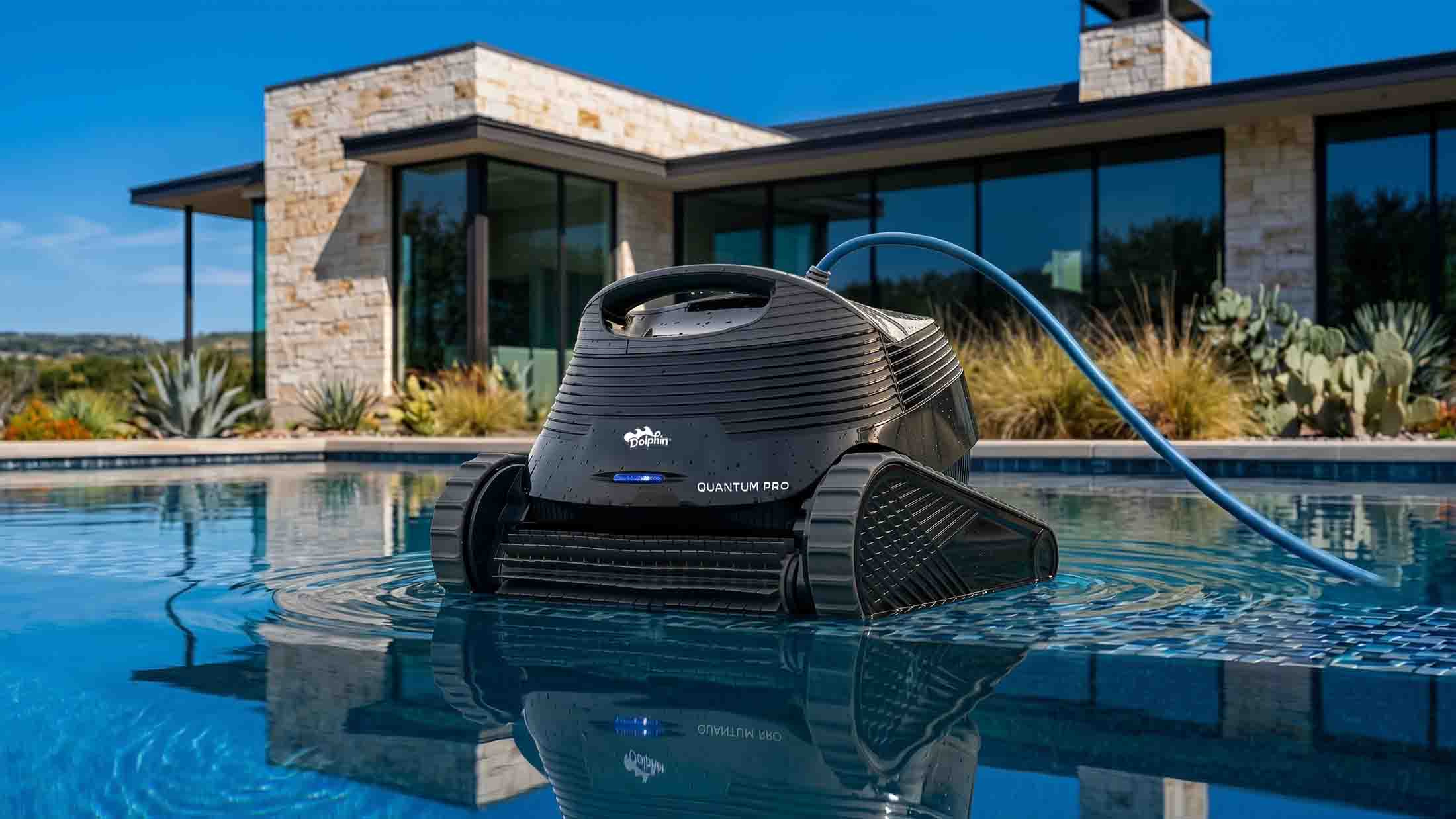
Top pick: Dolphin Quantum
Live prices · Ships free · 30 Day Trial
A big pool punishes a robot that is short on rating, cable or basket. Here is how the three 50 ft robots in this guide compare where it counts.
The quick answer
The Dolphin Quantum is our pick for most large pools: it is rated to 50 ft, carries a 55 ft cable with an anti-tangle swivel and an XXL MaxBin basket, and it is the lowest-priced 50 ft robot in this guide. Choose the Dolphin Premier instead when the pool collects heavy leaves or you want a 3-hour cycle and a 3-year warranty, and the Dolphin Sigma for gyroscope navigation.
A large pool is where a robot's spec sheet stops being fine print. For a 40 to 50 ft pool, the best robotic pool cleaner for large pools is the one that can reach the far wall, come back without knotting its cable, and still have room in the filter when the cycle ends. Miss one of those and you own a robot that cleans two thirds of the pool well.
These guides cover three robots rated to 50 ft: the Quantum, the Premier and the Sigma, all in-ground ProLine models with 55 ft swivel cables. The Cayman and Escape stop at 33 ft and are not for this job. Past 50 ft, nothing here is rated, and we would rather tell you that now.
The picks, ranked
The three 50 ft robots, ranked for large pools.

$1999$1599Save $400 off the list price
Temporarily out of stock
Pick 1: Best value in a 50 ft robot
Dolphin Quantum
Large pools are where the Quantum's mix lines up. It meets the size requirements with a 50 ft rating, 55 ft of cable on an anti-tangle swivel and continuous HyperGrip tracks. Its XXL MaxBin basket has over 400 sq in of filter area and opens from the top with one click. Large pools also tend to be the ones with sun shelves, Baja ledges and wide stairs, and the Quantum is the only robot here that lists those in its coverage.
The trade is cycle length. Two hours is the shortest of the three, so set the timer or the app for every day or every 2 days in swim season.
- Best for
- 40 to 50 ft in-ground pools where full coverage, app control and the lowest 50 ft price all matter.
- The trade-off
- Shortest cycle of the three, and a 2-year warranty. In a pool that fills with leaves, the Premier's leaf bag is the better tool.

$2499$1949Save $550 off the list price
Temporarily out of stock
Pick 2: Longest cycle, and a leaf bag for big debris loads
Dolphin Premier
The Premier gives a large pool the most time and the most filter choice. Its 3-hour cycle is the longest of the three, which counts when one length of the floor is a 45 ft trip. Dual ProLine motors move 4,500 GPH, and the Multi-Media system matches the filter to the season: the oversized leaf bag when trees are dropping, NanoFilters for fine dust, standard fine filters in between. A big pool under trees can pack a panel basket in one cycle; the leaf bag is how you avoid that.
The weekly timer sits on the power supply and the warranty runs 3 years.
- Best for
- Large pools under trees, and owners who want the longest cycle and a 3-year warranty.
- The trade-off
- No app, and no shelf or stair cleaning in its published coverage. It costs more than the Quantum.

$2999$2349Save $650 off the list price
Temporarily out of stock
Pick 3: Most methodical coverage of a long floor
Dolphin Sigma
The Sigma is the most heavily equipped robot on this page, and a long floor is where that shows. Three ProLine motors move 4,500 GPH, quad scrubbing brushes work the surface, and SmartNav 3.0 uses an onboard gyroscope to hold its lines, which matters most where a robot that drifts has the farthest to wander. Its 2.5-hour cycle sits between the other two.
The myDolphin Plus app schedules cleaning by day and time and sends a filter alert when the cartridges need rinsing. It is third because it costs the most and, at 24.6 lb, is the heaviest to lift.
- Best for
- Owners who want gyroscope navigation, day-and-time scheduling and a 3-year warranty, and accept the top price.
- The trade-off
- The heaviest and most expensive robot here. Its filters are cartridges, and stairs and ledges are not in its coverage.


Side by side
The 50 ft robots, spec by spec.
| Specification | Dolphin Quantum | Dolphin Premier | Dolphin Sigma |
|---|---|---|---|
| Price today | $1599 | $1949 | $2349 |
| Pool length | Up to 50 ft | Up to 50 ft | Up to 50 ft |
| Cable | 55 ft with anti-tangle swivel | 55 ft with 360° anti-tangle swivel | 55 ft with 360° anti-tangle swivel |
| Cycle time | 2 hours | 3 hours | 2.5 hours |
| Cleans | Floor, walls, waterline, sun shelves and stairs | Floor, walls and waterline | Floor, walls and waterline |
| Navigation | SmartNav 2.0 | SmartNav 2.0 | SmartNav 3.0 with gyroscope |
| Scheduling | Weekly timer: every day, every 2 days or every 3 days | Weekly timer: every day, every 2 days or every 3 days | Weekly scheduler by day and time |
| Robot weight | 18.3 lb | 20.3 lb | 24.6 lb |
| Warranty | 2 years | 3 years | 3 years |
What to look for
Four things a 40 to 50 ft pool demands.
-
A 50 ft rating
The rating refers to the pool's longest straight run, not the diagonal. A 33 ft robot does not become a 40 ft robot by running longer; past its rating it misses the far end. Start with the three 50 ft models.
-
Cable for the run to the outlet too
The cable covers the distance from power supply to water, the run to the farthest corner, and the drop to the floor. All three picks carry 55 ft, which near 50 ft only works with the supply toward the middle of the long side.
-
A swivel
A robot turns constantly as it works, and each turn can twist the cable. A swivel lets the twists unwind instead of coiling the cable and shortening its reach. All three picks have one; over 40 ft you want it.
-
Cycle length and filter capacity
More floor puts more debris in the same basket. The Premier runs 3 hours, the Sigma 2.5 and the Quantum 2. A shorter cycle is fine if it runs more often; a filter that packs solid halfway through is not.
Measure the longest run first.
For a robot, pool length means the longest straight line of water, wall to wall. On a rectangle that is the length. On a freeform, stretch a tape along the longest axis and ignore the curves. Diagonals do not count toward the rating. Between 40 and 50 ft you need a 50 ft robot. Over 50 ft, none of the robots on this page is rated for the pool, so talk to us before buying anything.
Check cable reach separately. From where the power supply will sit, set back from the water as the manual directs, pace to the farthest corner and add the depth of the deep end. That total has to fit inside 55 ft with slack to spare.
What you will empty, and how often.
A large pool has more surface open to the wind, so more lands in it. Plan to rinse the basket or filters at least weekly, and after every cycle or two during leaf drop. The Quantum's XXL MaxBin and the Premier's leaf bag hold the most, and both load from the top. The Premier has no app but shows a full-filter indicator on its power supply. The Sigma's app sends a filter alert to your phone; the Quantum's app sends alerts too, though it does not list a filter alert by name.
Use NanoFilters when the problem is dust or pollen and coarser media when it is leaves. Fine filters in a leafy pool clog early, and a clogged filter is a common reason a robot seems to lose suction.
How often to run it.
One cycle a week is rarely enough for 40 to 50 ft of pool in season. The Quantum and Premier timers offer every day, every 2 days or every 3 days, set on the power supply with no phone needed; the Quantum and Sigma can also be scheduled in the app. Every 2 days is a sensible start, and daily under trees. Between scheduled cycles the robot can stay on the pool floor. It should come out for three things: the weekly filter rinse, any shock or chemical dose, and long idle spells, when it belongs somewhere dry and shaded.
Setting up for a long pool.
- Put the power supply near the midpoint of the pool's long side, not at one end. That takes many feet off the run to the farthest corner.
- Before the first run, lay the cable out straight on the deck to relax the coils from the box, then feed it into the water.
- Start with the standard filters. Switch to NanoFilters once the first few cycles have cleared the heavier debris, so the fine media does not clog early.
- Check the far end after the first cycle. If the last few feet look untouched, the cable is running out: move the power supply toward the middle before blaming the robot.
Questions, answered
Large-pool questions.
What counts as a large pool when choosing a robot?
A longest straight run of about 40 to 50 ft: 18 x 40 and 20 x 40 rectangles, and big freeforms. Gallons are a rough guide at best. Length decides the robot, because that is what the rating and the cable have to cover.
Can a 33 ft robot handle a large pool if I run it twice?
No. A second cycle does not add reach. The Cayman and Escape are rated to 33 ft, with 50 ft and 40 ft cables and no swivel, so in a 40 ft pool they come up short of the far end. A robotic pool cleaner for large pools has to start with a 50 ft rating.
Does a longer cycle mean a cleaner large pool?
Not by itself. A longer cycle gives more passes per run, which helps a pool that is cleaned once or twice a week. A shorter cycle run more often gets to the same place. With the Quantum's 2 hours, plan on a more frequent schedule than you would with the Premier's 3.
How heavy are the 50 ft robots to lift out each week?
The Quantum weighs 18.3 lb, the Premier 20.3 lb and the Sigma 24.6 lb, and each sheds its water as you raise it at the surface. None includes a caddy. If the robot is stored away from the pool, a caddy saves carrying it and 55 ft of cable across the deck.
The bottom line
The decision rule for a large pool.
Confirm the longest run is 50 ft or less, then choose by what lands in the water and how you want to control the robot. Mixed debris, ledges or stairs, and an app at the lowest 50 ft price: the Quantum. Heavy leaves, or a preference for a 3-hour cycle and a 3-year warranty: the Premier. Gyroscope navigation and day-and-time scheduling: the Sigma. Whichever you choose, place the power supply mid-pool and run it more than once a week.
More buying guides
