



Buying Guides
Start with the pool
you have.
161 buying guides
By size · surface · debris · budget
One question per guide
Pick your pool. Get a straight answer.
Each guide takes one situation: a pool of a certain size or shape, a surface, a kind of debris, a feature you want, a budget. It ranks the Dolphin robots we sell for that job, says who each one suits, and says plainly where it stops. The prices on every page are today’s.
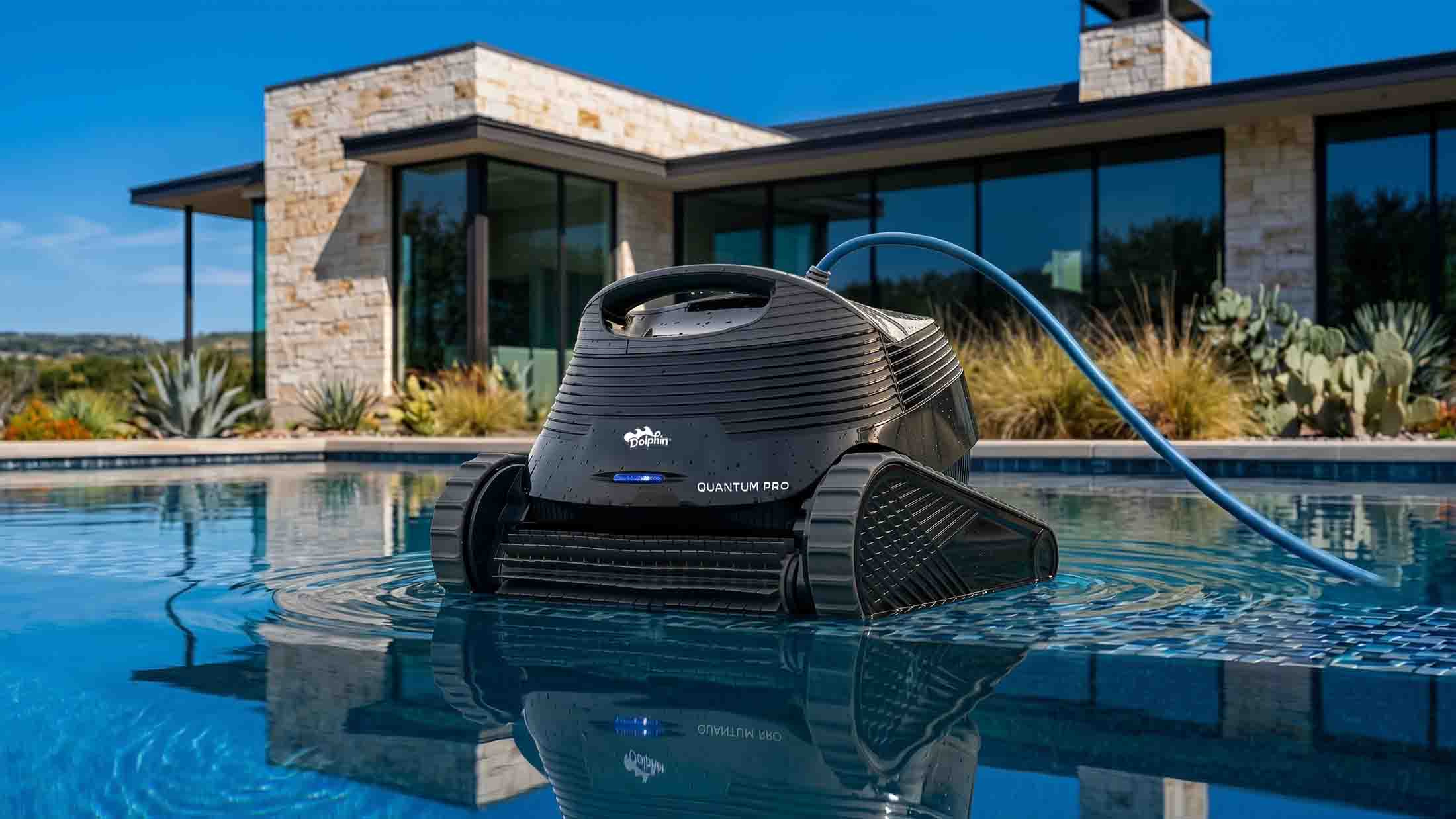
This store is built around the Dolphin Quantum, and for a lot of in-ground pools it is the answer: a 50 ft robot that scrubs the waterline, with a top-load basket you empty in seconds and a timer that runs the week for you. Where a Premier, Sigma, Cayman or Escape does the job better, the guide says so.
By pool size in gallons
- 5,000-gallon poolsAt 5,000 gallons every robot in this guide has capacity to spare, so the choice comes down to whether your pool sits above the ground or in it, and what you want scrubbed.Top pick: Escape
- 10,000-gallon poolsA 12 x 24 ft in-ground pool or a 21 ft round above-ground pool sits well inside the range of the two lowest-priced picks here, so the bigger machines are upgrades you choose, not requirements.Top pick: Cayman
- 12,000-gallon poolsAt this size the two 33 ft robots still fit, so the real decision is coverage: a floor-and-wall cleaner at a lower price, or a robot that also scrubs the waterline, steps and shelves.Top pick: Cayman
- 15,000-gallon poolsA 14 x 28 or 15 x 30 ft pool sits near the top of the 33 ft robots' range, so this is the size where a 50 ft robot starts to make sense.Top pick: Quantum
- 18,000-gallon poolsAt 32 ft long, the typical 18,000 gallon pool sits at the very edge of what a 33 ft robot is rated for, which is why we lead with a 50 ft model.Top pick: Quantum
- 20,000-gallon poolsAt 36 ft, the usual 20,000 gallon pool is longer than the two lower-priced robots here are rated for, so this guide is mostly about choosing among the three 50 ft models.Top pick: Quantum
- 25,000-gallon poolsAn 18 x 36 ft pool with a deep end or a shallow 20 x 40 has more floor and taller walls to cover, so cycle length, filter capacity and cable reach now decide the ranking.Top pick: Quantum
- 30,000-gallon poolsA 20 x 40 ft pool has about 800 square feet of floor and 120 ft of waterline, so we rank the 50 ft robots by how thoroughly one cycle covers it.Top pick: Premier
- 40,000-gallon poolsPools this large are either 20 x 40 ft with a diving end or stretch to 45 or 50 ft, and both put a robot's cycle time and cable to the test.Top pick: Premier
- 50,000-gallon poolsA pool this large sits at or beyond the 50 ft limit of every robot in this guide, so the first job is a tape measure and the second is choosing among three.Top pick: Sigma
By pool length and dimensions
- Small poolsFor pools of about 30 feet and under, the right robot matches your pool type, lifts out easily, and finishes before anyone wants to swim.Top pick: Cayman
- Large poolsA big pool punishes a robot that is short on rating, cable or basket. Here is how the three 50 ft robots in this guide compare where it counts.Top pick: Quantum
- 10-foot poolsA 10-foot pool has little floor, tight turns and sometimes shallow water. Here is which robot suits it, and when a brush and hand vacuum are enough.Top pick: Escape
- 15-foot poolsFifteen feet is the classic backyard round. A robot covers its floor quickly, so the choice turns on pool type, cable and how hands-off you want to be.Top pick: Escape
- 20-foot poolsAt 20 feet every robot fits, so this page ranks them by what the extra money gets you in a pool this size, and when it is wasted.Top pick: Cayman
- 25-foot poolsTwo very different pools measure about 25 feet. This guide picks a robot for each, and explains why gallons matter less than you think.Top pick: Cayman
- 30-foot poolsThirty feet is inside every robot's rating, but only just for some. Here is how to choose between comfortable margin and a lower price.Top pick: Quantum
- 35-foot poolsAt 35 feet the lower-priced robots run out of rating. This guide explains why stretching one is a false economy and which 50 ft robot to buy instead.Top pick: Quantum
- 40-foot poolsFor 20 x 40 and 18 x 40 pools: which 50 ft robot to buy, where the power supply has to sit, and how often to run it.Top pick: Quantum
- 50-foot poolsFifty feet is the most these robots are rated for. Here is which one handles it best, and the set-up and schedule that make it work.Top pick: Premier
- 60-foot poolsNo robot in this guide is rated past 50 ft, so a 60-foot pool means a workaround. Here is how owners do it, what it costs in coverage, and when to stop.Top pick: Quantum
- 65-foot poolsA 65-foot pool is 15 feet beyond the rating of every robot in this guide. This page covers the one honest stopgap, what it demands of you, and the better answer.Top pick: Quantum
- Olympic-size poolsA true Olympic pool is far beyond any residential robot, and we will not pretend otherwise. If your pool is really a long backyard lap pool, the answer changes.Top pick: Premier
- Sizing guide by pool dimensionsFind your pool's dimensions in the chart, read across to the robots rated for it, then check that the cable reaches from where the power supply will sit.Top pick: Quantum
By pool surface
- Vinyl liner poolsA liner is the softest surface a robot ever works on. All four picks are published for vinyl; the ranking turns on weight, grip, pool size and what you want scrubbed.Top pick: Quantum
- Fiberglass poolsGelcoat is easy to keep clean and hard to climb. The right robot holds a slick wall, scrubs the scum line and reaches the steps and ledges molded into the shell.Top pick: Quantum
- Gunite poolsGunite is the shell; plaster, pebble or tile is what the robot touches. Rough, porous finishes call for fast brushes, fine filters, a waterline pass and a 50 ft rating.Top pick: Quantum
- Concrete poolsPoured, shotcrete, painted or bare, concrete is the roughest surface a robot meets. Three of the four picks name it on their surface lists, and that decides the order here.Top pick: Sigma
- Plaster poolsPlaster starts smooth, sheds dust for weeks, then slowly roughens and scales. The robot to buy is the one whose filtration can change as the plaster does.Top pick: Premier
- Pebble Tec and pebble finishesA pebble finish is a field of small bumps and valleys. Fine dirt settles in the valleys, and it takes fast brushes, firm traction and fine filters to get it out.Top pick: Quantum
- Tile poolsGrout lines hold dirt and the tile band shows every film line, so the right robot is the one that scrubs both, on a schedule, without slipping.Top pick: Quantum
- Glass tile poolsA clean robot brush will not scratch glass tile, but glass is the slickest wall a robot can be asked to climb, so buy with a test cycle in mind.Top pick: Quantum
- Aggregate finishesAggregate runs from stones you can feel underfoot to a polished surface as smooth as plaster, and the brushes, filter and upkeep you need change along that range.Top pick: Quantum
- Painted poolsOld pool paint chalks into a white powder fine enough to slip through a standard filter, so on a painted pool the filter decides which robot to buy.Top pick: Quantum
- Stainless steel poolsSteel shells are smooth, hard and often built with overflow edges, so the questions are wall traction, grit and gutters, not whether the brushes are gentle enough.Top pick: Quantum
- Above-ground vinyl poolsA thin liner over sand, flexible walls and a small footprint call for a robot built for above-ground use, light enough for the floor and quick enough for the pool.Top pick: Escape
By debris and dirt problem
- LeavesA robot that fills up early spends the rest of its cycle pushing leaves around, so basket size and easy emptying matter more than suction figures.Top pick: Quantum
- Heavy leaf loadsWhen trees hang over the water, any robot fills before its cycle ends, so the right machine is the one that is quickest to empty and send back in.Top pick: Quantum
- Large debrisBig debris asks two questions of a robot: will it fit through the intake, and is there somewhere roomy for it to go once it is inside.Top pick: Quantum
- Fine debrisFine debris is whatever a standard filter lets back into the water, so the robot to buy is the one with ultra-fine media included and a filter that is easy to rinse.Top pick: Quantum
- DirtOrdinary dirt is a job every robot here can do, so the choice comes down to brushing, basket size and how quickly the filter rinses clean.Top pick: Quantum
- SandSand is heavy and gritty, so it takes real suction at the floor, a filter fine enough to hold it and a basket that can carry the weight.Top pick: Quantum
- Fine sandPlay sand, blown desert sand and filter sand pass straight through ordinary panels, so the right media and a patient routine matter more than raw power.Top pick: Quantum
- SiltSilt is finer than sand and passes through ordinary robot filters, so clearing it takes ultra-fine panels, still water and more than one cycle.Top pick: Quantum
- DustDust is light, fine and constantly replaced, so ultra-fine filters and short daily runs do more than one long clean on the weekend.Top pick: Quantum
- PollenPollen is the skimmer's problem while it floats and the robot's once it sinks, and only ultra-fine filters hold it when it does.Top pick: Quantum
- AlgaeSanitizer kills algae; a robot scrubs the surfaces where it tries to settle and filters out what brushing and chlorine have loosened.Top pick: Sigma
- Dead algaeWhat a shock leaves on the floor is among the finest debris a pool holds, so it takes NanoFilter-class media, settled water and repeated rinsing.Top pick: Quantum
- Mustard algaeMustard algae is cured with chemistry, not machinery, but daily wall scrubbing and fine filtration help keep it from re-anchoring, provided the robot itself is washed.Top pick: Sigma
- AcornsAcorns are hard, heavy and round, so the job comes down to basket capacity, the right filter panels and a robot that runs before they stain.Top pick: Quantum
- Pine needlesNeedles are thin enough to slip past a coarse basket and springy enough to wedge in a brush, so the right robot is the one that traps them and clears quickly.Top pick: Quantum
- TwigsA robot will collect short twigs all day; it is the long ones that bridge the intake and stop pickup, so basket room and a quick hand pass matter more than power.Top pick: Quantum
- BugsInsects arrive nightly, some float and some sink, so the answer is a robot on a daily timer with fine filters, plus a skimmer doing its share.Top pick: Quantum
- Pet hairWhen a dog swims, hair mats the filter and winds round the brushes, so pick the robot with the biggest basket you can lift out and hose in a minute.Top pick: Quantum
- Grass clippingsClippings arrive all at once, float for hours and then sink in clumps, so you need capacity, a fine enough mesh and a cycle the same evening.Top pick: Quantum
- Oak leavesAn oak gives a pool three kinds of debris a year, so the right robot is the one whose filters change with the season and whose timer beats the tannin stain.Top pick: Quantum
- Palm tree debrisPalms drop seeds a robot collects easily, fibers that wrap its brushes, and fronds no robot can swallow, so buy for basket room and plan a little hand work.Top pick: Quantum
By pool shape and design
- Rectangular poolsA rectangle is the easiest shape a robot will ever meet, so the choice comes down to the length of the long wall, the waterline and where the outlet is.Top pick: Quantum
- Round poolsA round pool has no corners to miss but one long curved wall that coils a cable, so choose by above-ground rating, diameter and cable length.Top pick: Escape
- Oval poolsAn oval's curved ends are easy for any robot; what decides the purchase is the true length of the long axis and how far the cable has to travel.Top pick: Cayman
- Kidney-shaped poolsA kidney pool curves in on one side and swells into two lobes, so the right robot is the one that covers both ends evenly without tying its cable in knots.Top pick: Quantum
- Freeform poolsCurves, a cove, a sun shelf and a pebble finish each ask something different of a robot, so this guide ranks four Dolphins on the features a freeform pool really has.Top pick: Quantum
- Irregular-shaped poolsWhen a pool has a peninsula, an island, a T-junction or a split-level floor, the question is not how the robot turns but how it gets around what is in the way.Top pick: Quantum
- L-shaped poolsAn L-shaped pool is two legs joined at an inside corner, and whether a robot cleans both comes down to the longer leg, the cable route and where the power supply sits.Top pick: Quantum
- Grecian poolsA Grecian pool is a rectangle with its corners clipped at 45 degrees, so choosing a robot comes down to length, liner and whether there is a stair bay to clean.Top pick: Quantum
- Lagoon poolsLagoon pools ask more of a robot than any other backyard shape, so this guide ranks three Dolphins and says plainly which parts of the pool none of them will reach.Top pick: Quantum
- Infinity and vanishing-edge poolsWith the edge pump off, a robot turns back short of a vanishing edge, but it will not clean the catch basin, so here is what each Dolphin does and what is left to you.Top pick: Sigma
- Lazy riversNo robot in this guide is designed for a lazy river, but a small backyard one can be cleaned in sections if the current is off and the channel gives the robot room to turn.Top pick: Quantum
- Narrow poolsIn a pool only 6 to 10 ft wide, a robot spends its cycle turning and climbing, so the cable and the wall cleaning matter more than raw power.Top pick: Quantum
- Lap poolsA lap pool is all length, so this guide ranks three 50 ft Dolphins for 40 and 50 ft lanes and says plainly that a 75 ft pool is beyond every one of them.Top pick: Premier
- Plunge poolsPlunge pools are short, narrow and deep, so the right robot is a light one that climbs well, not the one with the longest reach.Top pick: Cayman
- SpoolsA spool is part spa and part pool, with more bench than floor, so this guide starts with what a robot can actually reach before naming one.Top pick: Cayman
By steps, ledges and tricky features
- Stairs and stepsPool steps are where product claims and real pools part company, so we rank four Dolphins by what their spec sheets actually say about stairs.Top pick: Quantum
- Tanning ledges, Baja shelves and sun shelvesA ledge holds a few inches of water, which stops most robots at its edge. One model here lists the shelf in its coverage, and we explain how far that goes.Top pick: Quantum
- Shallow waterA pool that is 4 ft deep all over and a ledge under 12 inches of water are both shallow, and they call for different robots.Top pick: Quantum
- Deep poolsDepth changes three things for a robot: how much cable it uses, how much wall it climbs and how far you lift it. Here is how four Dolphins handle each.Top pick: Quantum
- Sloped floorsGrip gets a robot up a slope, and holding a heading keeps it from drifting back down. We rank four Dolphins on both, from a gentle transition to a hopper bottom.Top pick: Quantum
- Deep endsThe deep end is the pool's dustpan. The right robot is the one that reaches it on every cycle and has the capacity to carry away what it finds there.Top pick: Quantum
- Uneven floorsA robot rides over an uneven floor. It does not fix one. Here is which Dolphin copes best with dips, wrinkles and patches, and where each will stall.Top pick: Quantum
- Main drainsA drain cover is a speed bump in the dirtiest part of the pool. These four Dolphins list drain covers among the obstacles they handle, and one is described as sensing them.Top pick: Quantum
- Robots that don't get stuckMost stalls trace back to a twisted cable or a full filter, so the robots least likely to stop are the ones built around those two problems.Top pick: Quantum
- Tight cornersA robot does not fit into a corner; it scrubs it with brush width and repeated approaches, which makes brush design the spec to read first.Top pick: Quantum
- Curved wallsA curve keeps turning the robot the same way and changes the angle of every wall climb, so the cable and the navigation matter more than the brushes.Top pick: Quantum
- BenchesA bench is a narrow shelf halfway up a wall, and most robots read it as wall, so the honest answer includes a brush as well as a robot.Top pick: Quantum
- Swim-outsA swim-out is a seat, a step and three walls in a space barely wider than the robot, so coverage, cable and navigation all get tested at once.Top pick: Quantum
- Beach-entry poolsA zero-entry slope runs out of water before it runs out of floor, so every robot stops somewhere short of the top; what differs is where.Top pick: Quantum
By pool type and installation
- In-ground poolsFour robots cover almost every residential inground pool, and two facts about yours, its longest run and what falls into it, decide which one fits.Top pick: Quantum
- Above-ground poolsAbove-ground pools have flat floors, flexible walls and short runs, so the right robot is a light one rated for them, not a scaled-down in-ground machine.Top pick: Escape
- Semi-inground poolsA semi-inground pool looks in-ground from the deck, but its walls and floor are above-ground construction, and that is what a robot has to be rated for.Top pick: Cayman
- Saltwater poolsSalt does not change which robot cleans best; it changes how you rinse it, where scale appears and how much a waterline scrub is worth.Top pick: Quantum
- Chlorine poolsNormal chlorine rules no robot out, so this guide picks by pool size and debris, then covers the shock, tablet and pH habits that decide how long a robot lasts.Top pick: Quantum
- Natural poolsA robot can keep the lined swimming zone of a natural pool free of sediment, biofilm and leaf litter, provided it never enters the planted zone and goes in clean.Top pick: Quantum
- Indoor poolsNo leaves fall indoors, so the dirt is dust, hair, lint and an oily film at the tile line, and the right robot is chosen for fine filtration and scrubbing.Top pick: Sigma
- Outdoor poolsAn outdoor pool collects something different every week, so the right robot is the one with the range to handle leaves, pollen, dust and storm debris in turn.Top pick: Quantum
- Heated poolsWarm water speeds up algae, biofilm and the waterline ring and stretches the swimming season, so a heated pool needs frequent scheduled cleaning that fits around its cover.Top pick: Quantum
- Cold waterCold water is where the hardest cleaning of the year happens, at opening and closing, so capacity, a short cycle and a few cold-weather habits decide the choice.Top pick: Quantum
- Soft-sided poolsInflatable-ring and frame pools have thin liners, flexible walls and shallow water, so only a light robot rated for above-ground pools belongs in one, and only when the pool justifies it.Top pick: Escape
- Steel-wall poolsA steel-wall pool can be an above-ground pool or an in-ground liner pool built on steel panels, and the right robot depends on which one is in your yard.Top pick: Cayman
- Intex poolsFrom Easy Set rings to the 32 ft Ultra XTR, Intex pools vary a great deal, and so does the answer to whether a robot belongs in yours.Top pick: Escape
- Bestway poolsBestway pools range from small Fast Set rings to Power Steel rectangles around 31 ft, so the right robot depends on the shape, the size and where the outlet is.Top pick: Escape
- Coleman poolsA Coleman frame pool comes home in a carton with a small pump. Here is the robot that fits its size, its liner and your routine.Top pick: Escape
- Endless PoolsA swim-in-place pool is small, warm and built around a current unit. A robot can clean its floor and walls, if you choose a small one and ask first.Top pick: Cayman
By feature
- Waterline cleaningThe band at the top of the wall is the part of the pool everyone sees. Three of the robots here climb up and scrub it; two turn back first.Top pick: Quantum
- Wall climbingEvery robot on this page climbs. What separates them is where they stop, how hard they scrub on the way up, and what keeps them there.Top pick: Quantum
- Weekly timerA timer turns pool cleaning from a chore you remember into something that has already happened. The four timers here are not the same.Top pick: Quantum
- Automatic schedulingHow often a robot runs is one decision. When it runs is another, and only some robots let you make it.Top pick: Quantum
- Wi-Fi and app controlAn app lets you start, stop and schedule a robot from the house. It does not empty the filter, and it only works where your Wi-Fi reaches.Top pick: Quantum
- BluetoothBluetooth is the link that works when your home network does not reach the pool. One robot here has it, and we will not pretend otherwise.Top pick: Sigma
- Ultra-fine filtersThe debris that makes a pool look tired is too small to see one grain at a time. Ultra-fine filters hold it, at a cost you should know about.Top pick: Quantum
- NanoFiltersNanoFilters come in the box with three of the five Dolphins compared here and as an add-on for the other two. Here is what they are and how to look after them.Top pick: Quantum
- Large filter basketFour Dolphins ranked by how much they hold before the filter fills, with a plain account of how often you will lift each one out to empty it.Top pick: Quantum
- Dual brushesThree in-ground Dolphins with more than one brush, ranked for scrubbing, plus an honest word on the two single-brush models that are not on this list.Top pick: Quantum
- Active brushesAn active brush turns faster than the robot moves; here are four Dolphins ranked by the real scrubbing they deliver, with each brush described exactly as published.Top pick: Quantum
- TracksAll five Dolphins compared here drive on HyperGrip tracks, so this guide ranks four of them by what the tracks carry: coverage, size, weight and price.Top pick: Quantum
- Swivel cableThree Dolphins with a swivel on a 55 ft cable, ranked for the pools where tangling causes the most trouble, plus the cable habits that help whatever you own.Top pick: Quantum
- Strong suctionPublished flow figures for four Dolphins, an honest look at why the highest number is not always the cleanest pool, and the robot that keeps its flow up longest.Top pick: Quantum
- Smart navigationHow these robots find their way without cameras or maps, which one holds its heading best, and when the lower-priced scanner is all the navigation your pool needs.Top pick: Sigma
- GyroscopeOnly one robot here has a gyroscope, so this page explains what the sensor does, the pools where it shows, and the pools where you can save the money.Top pick: Sigma
- Remote controlTwo Dolphins you can start, stop and schedule from your phone, with a plain statement of what app control includes and what it does not.Top pick: Quantum
- Top-load filter accessThe filter is the part of a pool robot you handle every week, so here are four Dolphins ranked by how little effort it takes to lift, open, empty and rinse them.Top pick: Quantum
- CaddyNone of these robots ships with a caddy in the box, so the useful question is which robot is worth pairing with one and what the caddy changes in your week.Top pick: Quantum
- Long warrantyWarranty length is the headline number, but the terms behind it decide what you are covered for. Here is how four Dolphin robots compare on both.Top pick: Premier
- Automatic waterline parkingNone of these robots parks itself at the waterline, so this guide ranks the next best thing: the robots that are easiest to bring up and lift out.Top pick: Quantum
Corded, cordless and convenience
- Corded robotsA cord means full power from the first minute to the last, and a cable to plan around. This guide ranks four corded robots and shows how to check the reach.Top pick: Quantum
- Cordless and battery robotsThe Dolphin Liberty lineup: battery powered, with no cable in the pool.
- No chargingA robot that never needs charging is a corded robot. Here is what that buys you each week, and which of four plug-in Dolphins fits your pool.Top pick: Quantum
- Daily cleaningDaily cleaning means small loads, short jobs and a pool that never falls behind. It takes a timer with an every-day setting and a basket that is quick to empty.Top pick: Quantum
- Automatic cleaningAutomatic should mean the pool gets cleaned whether or not you remember it. These four robots are ranked by how little they ask of you each week.Top pick: Quantum
- Hands-free cleaningHands-free comes down to three tests: does it start itself, does it cover the pool without being moved, and can it hold a week of debris?Top pick: Quantum
- Vacation homesA pool nobody watches for weeks needs a robot you can start from somewhere else, and an honest plan for who puts it in the water.Top pick: Quantum
- Rental propertiesA rental pool has to look clean at every check-in, whoever is doing the turnover. These four robots are ranked for speed, simplicity and replacement cost.Top pick: Quantum
- Easy to use (older owners)Five Dolphins judged on the three jobs an owner actually does by hand: lifting the robot out, emptying the filter and telling it when to run.Top pick: Quantum
- Lightweight robotsPublished weights for five Dolphins, what each lighter robot gives up to get there, and how to bring any of them out of the water without a struggle.Top pick: Cayman
- Whole-pool coverageWhole-pool cleaning means floor, walls and waterline. Here is which robots do all three, which one goes further, and the spots every robot leaves to you.Top pick: Quantum
- Unattended cleaningA robot that works while you are at the office or asleep has to start itself, stay untangled and tell you when it is full. Four that do.Top pick: Quantum
By budget
- Under $300A straight answer for a tight budget: what a cleaner under $300 can and cannot do, and the least expensive robot here that climbs walls.Top pick: Escape
- Under $500No robot in this guide lists under $500, so this page does the next most useful thing: it shows what the stretch to a wall-climbing robot actually gets you.Top pick: Escape
- Under $600At $600 you are close to a wall-climbing Dolphin but not quite there. Here are the three sensible moves and how to choose between them.Top pick: Escape
- Under $700One robot fits this budget, in its standard form. This page covers what the Escape does, what it leaves out, and when to wait for the next robot up.Top pick: Escape
- Under $800This budget still buys the Escape, and now it covers the version that starts itself. Here is why that upgrade matters and who should hold out for more.Top pick: Escape
- Under $1,000A four-figure ceiling sounds generous, yet one robot in this guide fits it. Here is how to spend the headroom, and when the pool calls for a bigger step.Top pick: Escape
- Under $1,200A ceiling of $1,200 buys a very capable robot for pools up to 33 ft. Here is which one, why, and the two things this money does not reach.Top pick: Cayman
- Under $1,500With $1,500 to spend you can buy the right robot for a pool up to 33 ft and equip it properly, or go a little further for a 50 ft robot.Top pick: Cayman
- Budget robotsThree robots, three price floors: the entry point for above-ground pools, the in-ground pick with a timer included, and the least you can spend on a 50 ft pool.Top pick: Escape
- Best valueValue is not the lowest price. It is what you get for the money, for the pool you actually have, over the years you will own the robot.Top pick: Quantum
- Premium robotsPremium money buys more motors, more brushes, smarter navigation and a longer warranty. This page shows which of those your pool will notice, and when to keep the money.Top pick: Sigma
- Professional-grade robotsProfessional-grade on a home robot means commercial-derived motors and a build meant for long service. It does not mean a commercial-rated machine, and this page keeps the two apart.Top pick: Premier
- Commercial robotsThe Dolphin Wave lineup, for hotel, club and municipal pools.
- 3-year warrantyTwo of the five Dolphins in these guides are covered for three full years. Here is how they differ, what the warranty wording means, and when two years is enough.Top pick: Premier
Commercial and specialty pools
- Hotel poolsA hotel pool is usually the size of a home pool with many times the swimmers. These robots can keep one presentable overnight, within clear limits.Top pick: Quantum
- Resort poolsA resort has several kinds of pool, and only some suit a residential robot. This page sorts them, then matches a robot to each one that fits.Top pick: Quantum
- Apartment poolsMost apartment pools get a weekly service and a hard weekend. A scheduled robot fills the days in between, within the limits of a residential machine.Top pick: Quantum
- HOA poolsA plain case a board can vote on: which robot suits a shared pool of 50 ft or less, who runs it, and what the warranty may not cover.Top pick: Premier
- Community poolsMeasure the pool, then match the robot to what swimmers leave behind: fine debris on the floor and a film at the waterline.Top pick: Quantum
- Public poolsMost public pools are beyond every robot on this page. We explain what a commercial unit has to offer, and the one small-pool case where a Premier or Sigma can help.Top pick: Premier
- School poolsA six-lane, 25-yard pool is 75 ft long, past the rating of every robot here. This page says what that pool needs, and which robot suits a smaller teaching pool.Top pick: Premier
- Swim clubsA 25-yard or 25-meter main pool is too long for any robot here. For the smaller member club, this is how three 50 ft Dolphins compare across a summer season.Top pick: Quantum
- Competition poolsNo robot on this page belongs in a 25-yard, 25-meter or 50-meter pool. Here are the criteria for the machine that does, and two picks for a home training pool.Top pick: Premier
- Therapy poolsWarm water, fine debris, ramps and rails: what to verify before a robot goes into a therapy or rehab pool, and which of four Dolphins suits it.Top pick: Quantum
- Swim spasA swim spa is short, narrow, warm and full of molded seats. Here is what a robot will clean in one, what it will miss, and which light Dolphin suits the job.Top pick: Cayman
- Pool service companiesA route robot has to be light, quick to empty and right for most pools on the list. Here is how four Dolphins compare as working tools.Top pick: Quantum
NEXT STEPS
Try Quantum in Your Pool for 30 Days
Every pool deserves an intelligent robot.
Take Quantum home and try in your own pool for 30 days.
