



By pool shape and design
Best robotic pool cleaner for lazy rivers: the closest fits, and the limits.
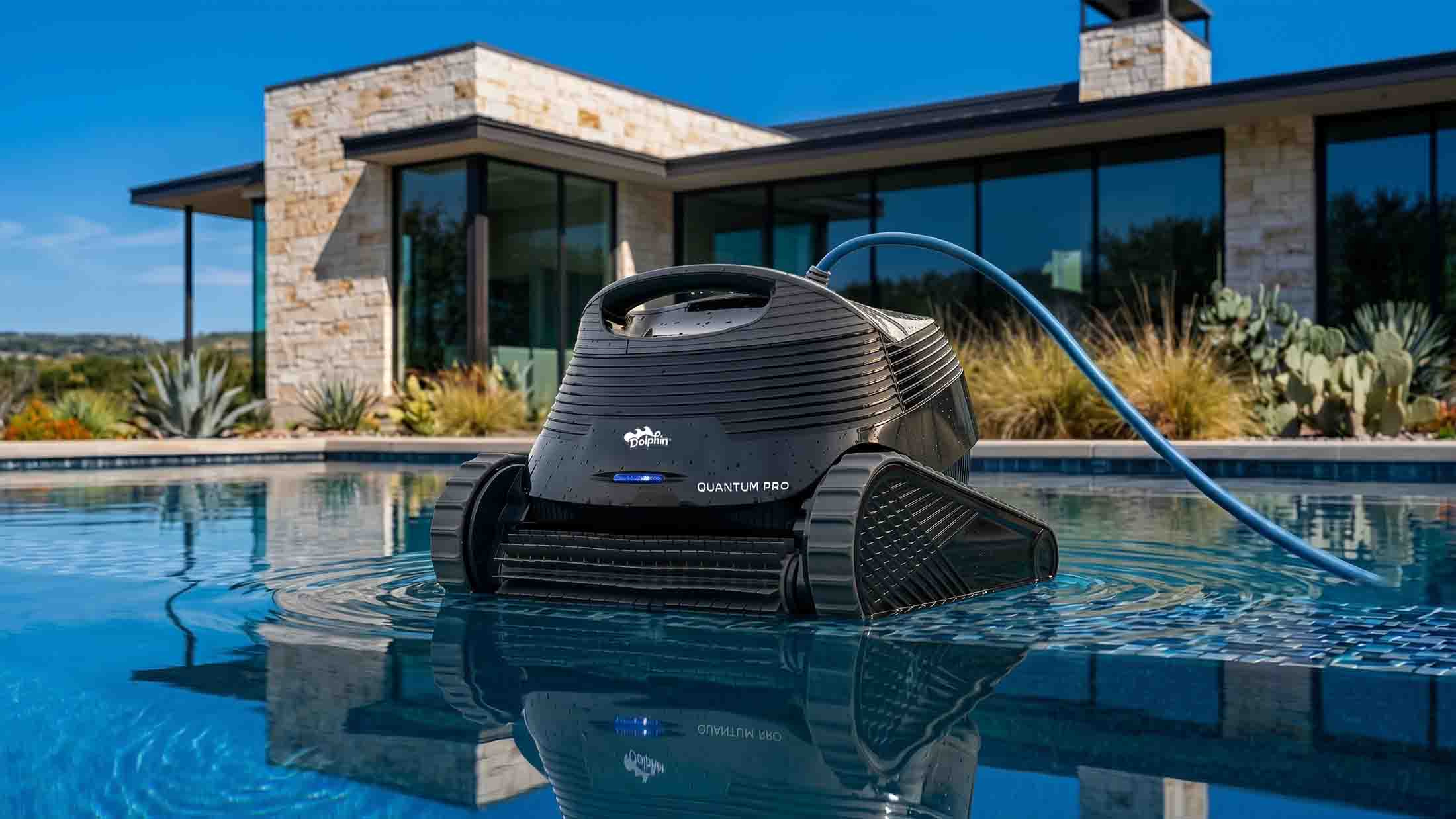
Top pick: Dolphin Quantum
Live prices · Ships free · 30 Day Trial
No robot in this guide is designed for a lazy river, but a small backyard one can be cleaned in sections if the current is off and the channel gives the robot room to turn.
The quick answer
For a small backyard lazy river, the nearest fit is the Dolphin Quantum: a swivel cable, a 2-hour cycle per section, and the lowest weight of the three, 18.3 lb, when you carry it to the next section. The Dolphin Premier is the alternative where leaves pile up at the bends. Either way the current must be off, and the river is cleaned a section at a time.
Know this first
None of the robots in this guide is designed for a lazy river. They are residential pool cleaners rated for pools up to 50 ft, and a river is a long loop with a current and an island in the middle. A small backyard river can be cleaned in sections with the current off. Resort-scale rivers need commercial equipment: talk to us before you buy.
A lazy river is a channel, not a pool: a long, narrow loop around an island, with pumps pushing a current and often a hundred feet or more of water. The honest answer to the search for the best robotic pool cleaner for lazy rivers is that none of the robots here was built for one. They are designed to work back and forth across a pool with walls on all sides.
A short backyard river can still be cleaned by a pool robot if you accept a routine: current off, one stretch at a time, and the power supply moved between stretches. For that routine the Quantum, the Premier and the Sigma are the closest fits, in that order. If your river belongs to a resort, a community pool or a water park, chat with a Dolphin Expert instead.
The picks, ranked
The closest fits for a small lazy river.

$1999$1599Save $400 off the list price
Temporarily out of stock
Pick 1: Closest fit for a short backyard river
Dolphin Quantum
Cleaning a river in sections is mostly carrying and waiting, and the Quantum makes both shorter. At 18.3 lb it is the easiest of the three to carry, and a 2-hour cycle means three sections can be done in a day. Its 55 ft cable carries an anti-tangle swivel. It scrubs the walls and waterline, which in a narrow river are a large share of what you see. It is also the lowest-priced of the three, which matters for a job no robot is designed to do.
- Best for
- A short residential river with still water, a channel wide enough to turn in, and an owner willing to move the power supply.
- The trade-off
- Not designed for rivers; in a loop it may wander past the section you intended until the cable stops it.

$2499$1949Save $550 off the list price
Temporarily out of stock
Pick 2: Closest fit where leaves collect at the bends
Dolphin Premier
Rivers gather debris the way streams do: on the inside of bends and wherever the current used to slow. If yours runs under trees, the Premier handles that load best. An oversized leaf bag comes with its Multi-Media filtration, alongside NanoFilters and standard fine filters, and the full-filter indicator is on the power supply. The 3-hour cycle is thorough but means fewer sections per day. It moves 4,500 GPH through dual ProLine motors, its 55 ft cable swivels through 360 degrees, and the warranty is 3 years.
- Best for
- Tree-lined backyard rivers where each section holds a lot of leaves and time is not pressing.
- The trade-off
- A 3-hour cycle per section and 20.3 lb to carry; like the others, it is not built for a channel with a current.

$2999$2349Save $650 off the list price
Temporarily out of stock
Pick 3: Closest fit for orderly passes in a channel
Dolphin Sigma
The Sigma's onboard gyroscope gives it a sense of heading that scanning alone does not, and in a curved channel that helps it keep to orderly passes after each turn at the wall. Four scrubbing brushes and three ProLine motors moving 4,500 GPH make it the strongest scrubber of the three, and its 55 ft cable has a 360-degree swivel. It is third for practical reasons: it weighs 24.6 lb, the most to haul from section to section, its cycle is 2.5 hours, and it is the highest-priced of the three.
- Best for
- Owners who also have a conventional pool up to 50 ft and want one top-end robot for both.
- The trade-off
- Heaviest and highest-priced of the three, and still limited to still water and one section at a time.


Side by side
The three closest fits, side by side.
| Specification | Dolphin Quantum | Dolphin Premier | Dolphin Sigma |
|---|---|---|---|
| Price today | $1599 | $1949 | $2349 |
| Navigation | SmartNav 2.0 | SmartNav 2.0 | SmartNav 3.0 with gyroscope |
| Cable | 55 ft with anti-tangle swivel | 55 ft with 360° anti-tangle swivel | 55 ft with 360° anti-tangle swivel |
| Pool length | Up to 50 ft | Up to 50 ft | Up to 50 ft |
| Cleans | Floor, walls, waterline, sun shelves and stairs | Floor, walls and waterline | Floor, walls and waterline |
| Cycle time | 2 hours | 3 hours | 2.5 hours |
| Scheduling | Weekly timer: every day, every 2 days or every 3 days | Weekly timer: every day, every 2 days or every 3 days | Weekly scheduler by day and time |
| Warranty | 2 years | 3 years | 3 years |
What to look for
What decides whether a robot can work in your river.
-
The current is off.
A robot is not built to hold its line against moving water, and a current drags the cable downstream. Shut the river pumps off before the robot goes in and leave them off until it is out. If the river cannot be stilled, a robot is not an option.
-
Channel width and depth.
The robot has to turn around, not just fit. A channel comfortably wider than the robot is long lets it turn at the walls and work across as well as along. Depth has to meet the minimum in the manual, and many rivers are shallower than a pool. Measure both at the narrowest, shallowest point.
-
Cable reach, section by section.
Each of these robots has a 55 ft cable, and some of that is used getting from the power supply to the water. What is left reaches only so far up and down the channel. A longer loop is cleaned in sections, with the power supply moved for each one.
-
A swivel, because of the island.
In a loop, the robot can travel around the bend and keep going, laying cable along the island wall. A swivel lets the cable rotate freely so it does not kink as the robot doubles back. All three picks have one. A robot without a swivel is the wrong tool here.
Is your river small enough to try?
Three questions decide it. Can the current be switched off for as long as a cycle takes? Is the narrowest part of the channel wide enough for the robot to turn, and the shallowest part deeper than the minimum in the manual? And is the loop short enough that you are willing to clean it in sections? A no to either of the first two ends the idea.
For the third, picture the cable. Of 55 ft, allow for the setback from the water's edge (roughly 12 ft is a typical example; use the figure in your own manual) and the depth. What remains is how far the robot can travel from the power supply, and the robots are rated for pools up to 50 ft long, so plan sections shorter than that. A 120 ft loop means at least three positions.
How to clean a river in sections.
Turn the current off and let the water settle. Set the power supply level with the midpoint of the first section, on the outer bank if you can, so the cable does not have to cross the island. Nothing keeps the robot inside the stretch you chose, so stay within sight for the first few runs and see where it goes.
When the cycle ends, lift the robot out, empty the basket, check that the cable has not been laid around the island, and move everything to the middle of the next section. Bends collect the most debris, so brush the inside of each bend toward the straight before you start.
Resort and community rivers.
A river at a hotel, resort, HOA or water park is a different scale: hundreds of feet, and current systems that cannot be idled for hours. The robots in this guide are residential machines and are not the answer. That job needs commercial cleaning equipment. If that is what you manage, talk to us with the length, width and depth, and we will tell you plainly what we can and cannot supply. The Cayman and Escape, rated to 33 ft and without a swivel, are not suitable for any river.
If you go ahead, do it this way.
- Switch the river pumps off first and confirm the water is still before the robot goes in.
- Measure the narrowest and shallowest points of the channel and compare them with the manual before ordering.
- Start each section with the power supply at its midpoint, on the outer bank.
- Do not run a river on the timer or leave it unattended; start each cycle by hand and check the cable afterward.
Questions, answered
Lazy river questions.
Is there a robotic pool cleaner made for lazy rivers?
Not among the robots in this guide. A lazy river is long, narrow and has a current, while these robots are rated for still pools up to 50 ft. For a small backyard river the Quantum is the closest fit, used a section at a time with the current off.
How wide does the channel need to be?
Wide enough for the robot to turn around with space to spare. No minimum is published, so measure the narrowest point and send it to us before buying. As a rule of thumb from narrow pools, under about 5 ft wide is marginal for any of these robots.
Will the cable wrap around the island?
It can. If the robot keeps traveling in one direction around the loop, the cable follows the island wall and eventually pulls tight. The swivel on the Quantum, Premier and Sigma prevents twisting but cannot undo a wrap. Keeping sections short, placing the power supply on the outer bank and checking after each cycle are the safeguards.
Can one robot clean both my pool and the river that joins it?
Yes, as separate jobs. Leave the robot on its schedule in the pool, where it is doing the job it was designed for, and move it to the river for a supervised cycle when the river needs it. Size the robot for the pool first; the river is the secondary use.
The bottom line
The plain decision for lazy rivers.
If the river is commercial, long, or cannot be stilled, do not buy a pool robot for it; talk to us and we will say plainly whether we can help. If it is a short backyard loop with still water, a channel wide enough to turn in and enough depth, a robot can clean it in supervised sections. For that, choose the Quantum for its weight and 2-hour cycle, the Premier if leaves are the main load, or the Sigma if it will also serve a full-size pool.
More buying guides
