



Commercial and specialty pools
The best robotic pool cleaner for school pools depends on which pool you mean.
Top pick: Dolphin Premier
Live prices · Ships free · 30 Day Trial
A six-lane, 25-yard pool is 75 ft long, past the rating of every robot here. This page says what that pool needs, and which robot suits a smaller teaching pool.
The quick answer
For a 25-yard school pool, none of these robots is suitable: ask about a commercial-rated unit. For a smaller teaching pool of 50 ft or less, the Dolphin Premier is the pick we would make: controls on the power supply that a custodian can run, and a 3-year warranty. The Dolphin Sigma is the alternative for a facilities office that wants app scheduling, and the Dolphin Quantum costs less.
Know this first
A standard school pool is 25 yards long: 75 ft, with a deep end. Every robot on this page is rated for 50 ft at most, so none is the answer for it. That pool needs a commercial-rated robot. The picks below are for teaching pools of 50 ft or less only, on residential warranty terms.
Ask a facilities manager how long the school pool is and the answer is usually 25 yards. That is 75 ft of water, typically six lanes and about 45 ft wide, sloping to a deep end. Every robot compared on this page is rated for pools up to 50 ft. So the best robotic pool cleaner for school pools of that size is not on this page, and it would be wrong to pretend otherwise.
What we can do is describe the equipment that pool needs, so a purchase request is written around the right questions. Then, because some schools also have a second, smaller pool for swim lessons or adapted physical education, we rank the robots that suit a teaching pool of 50 ft or less.
The picks, ranked
For a teaching pool of 50 ft or less, in order.

$2499$1949Save $550 off the list price
Temporarily out of stock
Pick 1: Simplest to hand to a custodian
Dolphin Premier
In a teaching pool of 50 ft or under, the Premier is the one we would hand to a custodian. Everything is on the power supply: start, the weekly timer with every day, every 2 days and every 3 days presets, and a light that says the filter is full. Multi-Media filtration includes NanoFilters for the lint and hair a lesson pool collects, and the filters load from the top with no tools. The 3-year warranty, described as not prorated and not limited by cycle count, suits a school budget cycle, once you have confirmed how it applies to institutional use.
- Best for
- Schools with a lesson or adapted-PE pool of 50 ft or less, run by a custodian on building rounds.
- The trade-off
- A 3-hour cycle and 20.3 lb to lift. It is not a solution for the 25-yard pool next door.

$2999$2349Save $650 off the list price
Temporarily out of stock
Pick 2: For a facilities office that schedules by app
Dolphin Sigma
The Sigma suits a school where the facilities office, not the custodian, sets the schedule. Its weekly scheduler works by day and time in the myDolphin Plus app, so cleaning can be set for the nights the pool is free and left off on nights it is booked. Underneath, it is the most heavily equipped of the three: three ProLine motors rated at 4,500 GPH, four scrubbing brushes, a gyroscope steering its SmartNav 3.0 passes, and NanoFilters whose published figure is 2 microns, fine enough for lesson-pool lint. A cycle takes 2.5 hours, and the warranty runs 3 years. School networks often restrict new devices, so ask IT before relying on the app.
- Best for
- Districts where one facilities manager oversees the pool remotely and wants day-by-day scheduling and alerts.
- The trade-off
- The highest-priced pick here and the heaviest at 24.6 lb. Scheduling depends on the app, and the filters are cartridges.

$1999$1599Save $400 off the list price
Temporarily out of stock
Pick 3: Shortest cycle and lowest price of the three
Dolphin Quantum
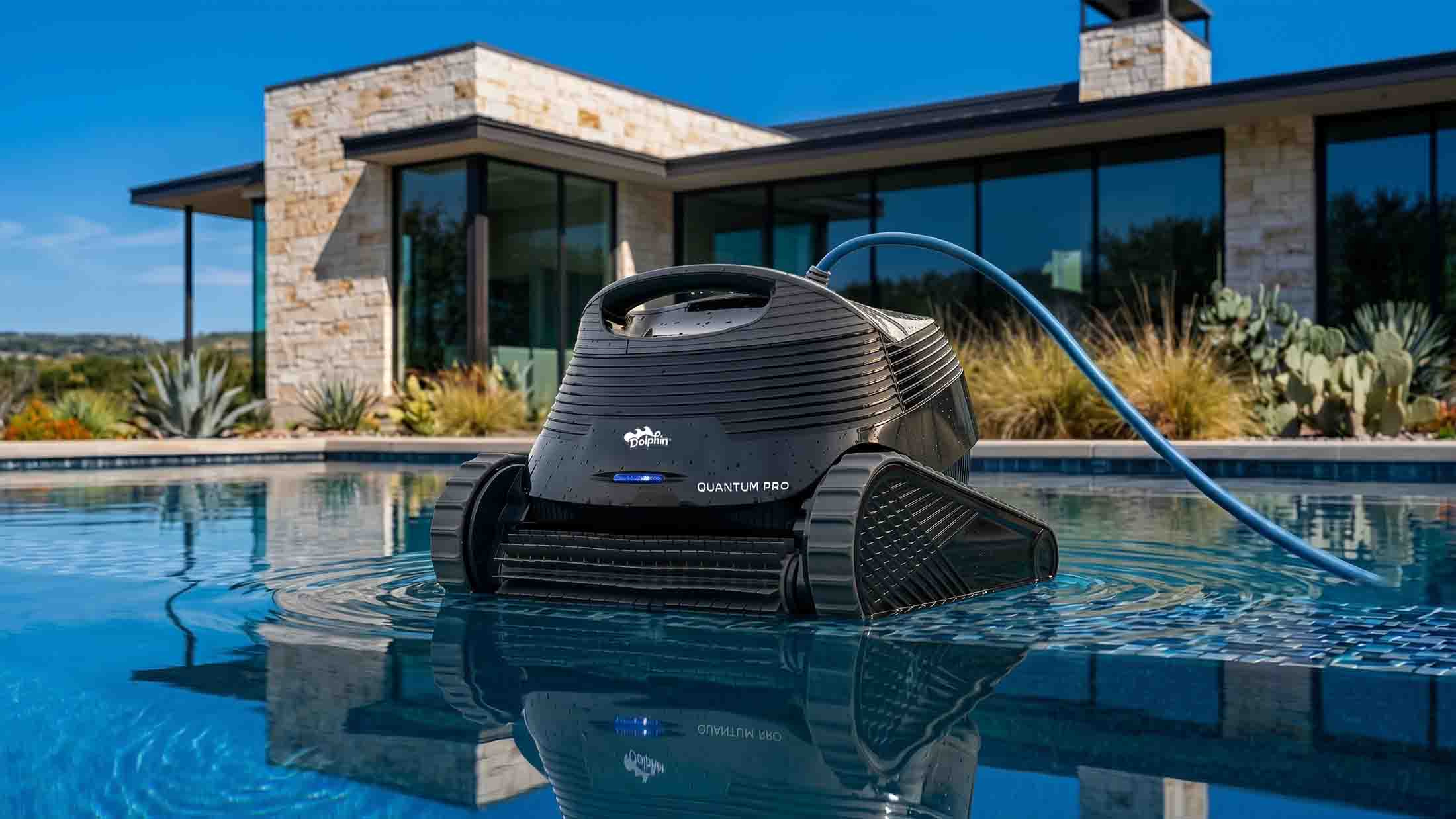
The Quantum is the budget-conscious choice for a teaching pool, and the right one when the pool has wide entry stairs: its published coverage includes stairs, sun shelves and Baja ledges along with the floor, walls and waterline. The cycle is 2 hours, which helps when the gap between evening lessons and morning classes is tight. Its XXL MaxBin is emptied from the top in one click, and NanoFilter panels come in the box. It runs from the power-supply timer alone or from its Wi-Fi app. It ranks third for a school because the warranty is 2 years and the flow 4,000 GPH.
- Best for
- Smaller schools and swim-lesson programs with a pool of 50 ft or less, entry stairs and a limited equipment budget.
- The trade-off
- Two-year warranty, a year less than the other picks. Like them, it is out of range for a 25-yard pool.


Side by side
Teaching-pool picks compared.
| Specification | Dolphin Premier | Dolphin Sigma | Dolphin Quantum |
|---|---|---|---|
| Price today | $1949 | $2349 | $1599 |
| Pool length | Up to 50 ft | Up to 50 ft | Up to 50 ft |
| Cable | 55 ft with 360° anti-tangle swivel | 55 ft with 360° anti-tangle swivel | 55 ft with anti-tangle swivel |
| Cycle time | 3 hours | 2.5 hours | 2 hours |
| Filtration | Multi-Media: NanoFilters, oversized leaf bag and standard fine filters | NanoFilters and standard filter cartridges | XXL MaxBin basket with standard and NanoFilter panels |
| Scheduling | Weekly timer: every day, every 2 days or every 3 days | Weekly scheduler by day and time | Weekly timer: every day, every 2 days or every 3 days |
| Robot weight | 20.3 lb | 24.6 lb | 18.3 lb |
| Warranty | 3 years | 3 years | 2 years |
What to look for
What matters when the pool belongs to a school.
-
Seventy-five feet of travel.
In a 25-yard pool the robot must reach a wall 75 ft away, and its cable also has to cover the deep end and the run back to the power supply on deck. A 55 ft cable cannot cover that pool from any spot. Commercial units are built with cables to match.
-
The overnight window.
The last practice may end in the evening and the first class may start early next morning. The cycle has to fit that gap with time to spare, because someone still has to lift the robot out and put the lane lines back.
-
Lane lines out, every time.
A robot cable and a lane line in the same water will find each other. Lines must be unhooked and reeled in or pulled aside before a robot goes in. If that takes two people, it belongs in the staffing plan, or the robot will sit unused.
-
A custodian, not a pool technician.
The person running the robot usually has a building to look after as well. Favor obvious controls, a filter that opens with no tools, and a caddy so the machine rolls from the storage room to the pool edge and is not carried.
What a 25-yard pool needs instead.
A six-lane, 25-yard pool calls for a commercial-rated robot. Commercial robots cost more and weigh more than anything on this page, and they are sized for the job. Chat with a Dolphin Expert with the pool's dimensions and schedule and we will help you frame the request, whether or not the answer is a robot from this store. These are the points to write into it.
- A cable long enough for a 75 ft pool, including the deep end and the route to the power supply.
- A cycle that completes the floor and walls between the last evening session and the morning.
- Filter capacity for a full day of classes, teams and community swim.
- A caddy, so one custodian can move and store the machine.
- A commercial warranty and a named service contact.
The lane-line routine.
Nothing stalls a school robot program faster than a cable wrapped around a lane line. Before any cycle, unhook the lines and reel them in or float them against one wall, clear of the robot's path. Pull kickboards, pull buoys and dive rings from the water, and check that portable stairs are out. After the cycle, lift the robot, rinse the filter, and only then restring the lines.
Decide who does each part. A workable split is for the last team of the day to strip the lines after practice, the custodian to start the robot on the evening round, and whoever opens in the morning to pull it out.
Teaching pools: check these before ordering.
A lesson pool is usually warmer and shallower than the main pool, and both matter. Each robot's manual gives a maximum water temperature and a minimum working depth. We do not quote either here, so check the manual against your pool before buying. A very shallow instructional area or a wheelchair ramp may be outside what the robot can cover. Confirm the longest run is 50 ft or less, then find the nearest outlet. The manual says how far from the water the power supply must sit, and the 55 ft of cable is measured from that spot to the farthest corner.
Making it work on a school schedule.
- Post the routine on the storage-room door: lines out, robot in, start, robot out, rinse filter, lines back.
- Rinse the filter after each cycle during the swim season. A full day of PE classes leaves more lint and hair than you would guess.
- Shock nights are robot-free nights: pull it before the chemicals go in and leave it out until the readings settle.
- Over summer or winter break, store the robot dry, off the pool deck and out of the sun.
Questions, answered
What schools ask before buying.
Does a robotic pool cleaner for school pools need special wiring?
No. Each robot here plugs into a standard outlet through its power supply, which sits back from the water's edge by the distance in the manual. Ask your facilities electrician to confirm the outlet near the pool is suitable and protected as your code requires, and check the manual before using any extension cord.
Can the robot run in the teaching pool between classes?
No. Run it when the pool is empty for the night, not between classes. A cycle takes 2 to 3 hours, a cable in the water has no place in a lesson, and every start and stop means lifting a wet robot. Overnight, on the nights the pool is free, is the routine that works.
What if we cannot take the lane lines out every night?
Then schedule the robot for the nights they are already out, such as before a meet setup or after a deep clean. Do not run any robot, residential or commercial, under strung lines: the cable catches and twists and the cycle stalls. A robot that runs three nights a week is still worth having.
Can students or the swim team run the robot?
Keep it with staff. Starting a cycle is simple, but the routine includes handling a power supply near water, lifting a wet machine of 18 to 25 lb, and making sure nobody is in the pool. A custodian, coach or aquatics director should own it, with the steps written down for whoever covers.
The bottom line
How to decide, pool by pool.
Treat the two pools separately. The 25-yard pool goes on a commercial quote: cable for 75 ft, an overnight cycle, a caddy, a commercial warranty. The teaching pool, if it is 50 ft or less and its temperature and depth sit inside the manual's range, can take a Premier for simplicity. A Sigma adds app scheduling, and a Quantum costs least. Confirm warranty terms for school use before any of them is ordered.
More buying guides
