



By feature
Best robotic pool cleaner with strong suction, and what GPH really tells you.
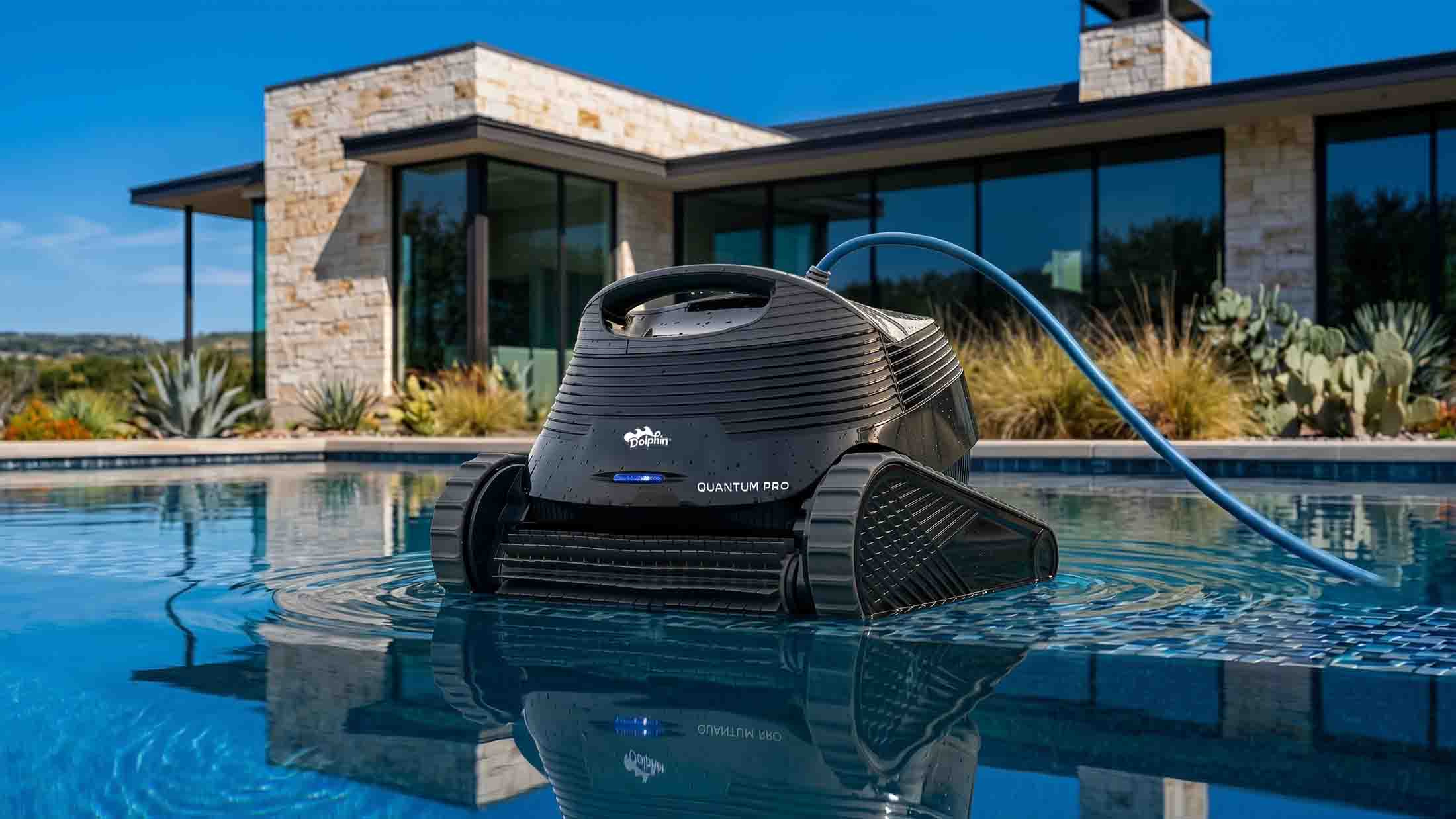
Top pick: Dolphin Quantum
Live prices · Ships free · 30 Day Trial
Published flow figures for four Dolphins, an honest look at why the highest number is not always the cleanest pool, and the robot that keeps its flow up longest.
The quick answer
Our pick is the Dolphin Quantum: 4,000 GPH from dual commercial-grade motors, pulled through the largest basket of the five Dolphins compared here, so the flow holds up as debris collects. The Premier and the Sigma publish the highest figure on the page, 4,500 GPH each; choose one of them if raw flow is your first priority. The Cayman moves over 4,000 GPH in pools up to 33 ft.
A pool robot has no hose to the pool pump. Its suction is made on board: a motor draws water in through the underside, pushes it through a filter and sends it back out clean. So when you shop for the best robotic pool cleaner with strong suction, the figure to look for is flow, quoted in gallons per hour (GPH).
The published numbers for the robots here sit in a narrow band, from 4,000 to 4,500 GPH. That is worth knowing before you pay extra for a few hundred gallons. What separates a robot that picks up everything from one that leaves a trail is usually what happens around the flow: whether brushes loosen the debris first, whether the debris fits the intake, and whether the filter is clean enough to let water through.
The picks, ranked
Four picks, ranked for suction you can use.

$1999$1599Save $400 off the list price
Temporarily out of stock
Pick 1: Flow that holds up: 4,000 GPH and the XXL MaxBin
Dolphin Quantum
The Quantum's dual commercial-grade motors move 4,000 GPH. That is not the highest figure here, and it ranks first anyway for what surrounds the number. The XXL MaxBin has over 400 square inches of filter area, so the flow has more places to go as the basket loads. Dual HyperBrushes, spinning at twice the speed of standard brushes, loosen debris just ahead of the intake.
Standard panels and a full set of NanoFilter panels are both included, so you can match the media to the mess instead of choking the flow with the wrong one.
- Best for
- In-ground pools up to 50 ft with mixed debris, where suction has to last the whole cycle.
- The trade-off
- The published figure is 500 GPH below the Premier and Sigma. If the number itself is your priority, choose one of those.

$2499$1949Save $550 off the list price
Temporarily out of stock
Pick 2: Highest published flow, with a leaf bag behind it
Dolphin Premier
The Premier's dual commercial-grade ProLine motors are published at 4,500 GPH, tied for the top figure here. It puts that flow to work on bulk: the Multi-Media set includes an oversized leaf bag, so strong suction is not wasted on a filter that fills in the first half hour. A full-filter indicator on the power supply tells you when flow is being held back.
It is second on price: it sits in the upper tier, and for most mixed-debris pools the Quantum's flow is ample.
- Best for
- Leafy in-ground pools that need high flow and room to store what it collects.
- The trade-off
- Upper price tier and a 20.3 lb lift. It has two scrubbing brushes at standard speed, not HyperBrushes.

$2999$2349Save $650 off the list price
Temporarily out of stock
Pick 3: 4,500 GPH from three motors, for fine debris
Dolphin Sigma
The Sigma also publishes 4,500 GPH, from three commercial-grade ProLine motors. Its flow is aimed at the other end of the debris range. The included NanoFilters are described as filtering down to 2 microns, and fine media resists flow, so a high published figure counts most on exactly this kind of filter. Quad scrubbing brushes stir up settled silt so the flow can take it.
The app's filter alert is the practical bonus: it tells you when a loaded filter is costing you suction. It is third because it is the highest-priced robot here.
- Best for
- Pools troubled by silt, pollen and dust, whose owner wants an alert when flow drops.
- The trade-off
- Highest price here, heaviest at 24.6 lb, and cartridges hold less bulk than a basket. Not the pick for heavy leaves.
$1299$1049Save $250 off the list price
Temporarily out of stock
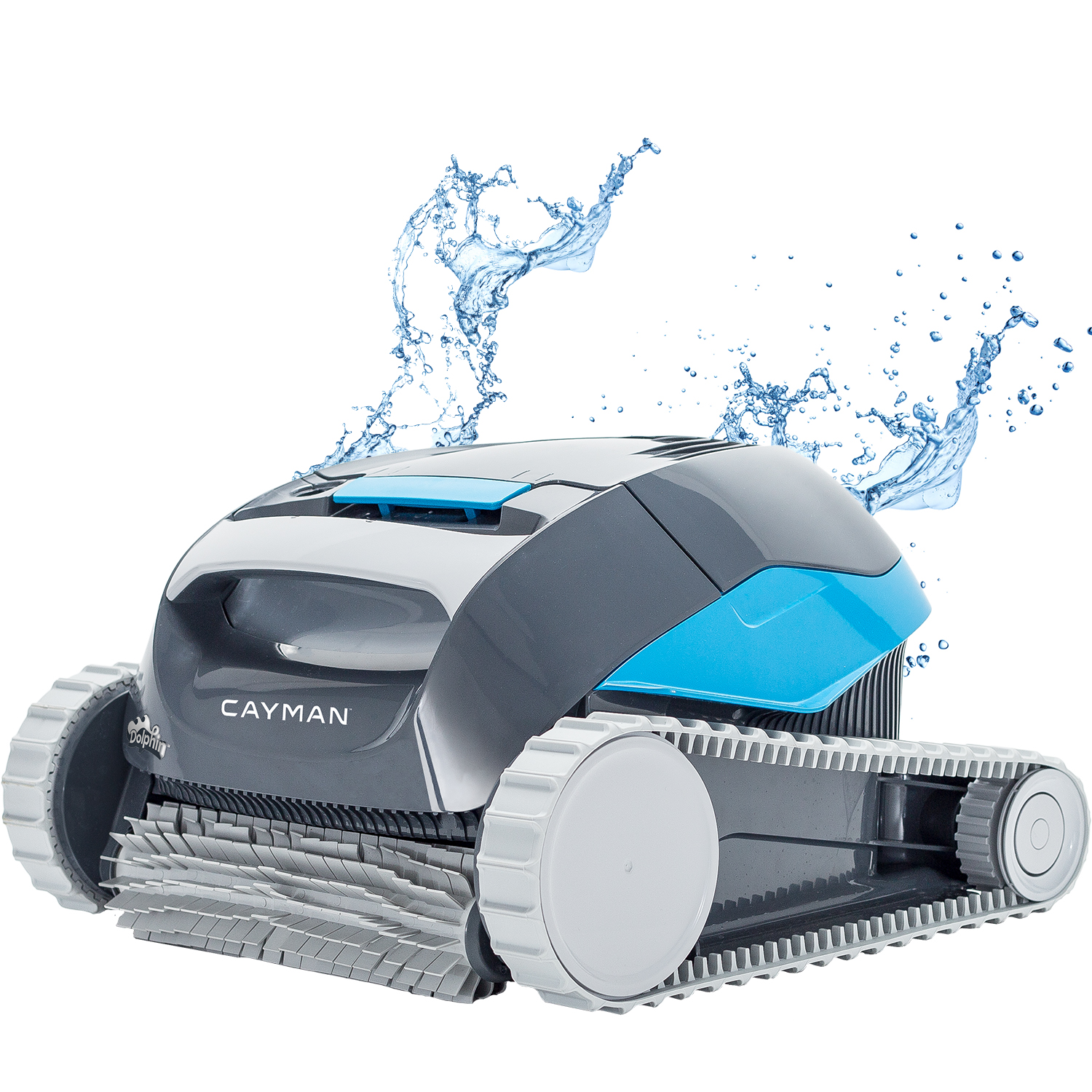
Pick 4: Over 4,000 GPH for pools up to 33 ft
Dolphin Cayman
The Cayman's dual 24-volt DC motors are published at over 4,000 GPH, which puts a smaller, lighter robot in the same flow band as the 50 ft models. In a pool up to 33 ft that flow has less floor to cover in its 2 hour cycle, and the MaxBin basket, described as 50% larger than standard Dolphin filters, gives it room to keep moving water.
A single HyperBrush loosens debris ahead of the intake. It is fourth because of range, not suction: floor and walls only, in pools up to 33 ft.
- Best for
- In-ground and above-ground pools up to 33 ft that want strong flow at a lower price.
- The trade-off
- No waterline cleaning, a timer with one setting (every day), and NanoFilter panels are an optional add-on.


Side by side
Flow, motors and filters side by side.
| Specification | Dolphin Quantum | Dolphin Premier | Dolphin Sigma | Dolphin Cayman |
|---|---|---|---|---|
| Price today | $1599 | $1949 | $2349 | $1049 |
| Cleans | Floor, walls, waterline, sun shelves and stairs | Floor, walls and waterline | Floor, walls and waterline | Floor and walls |
| Scheduling | Weekly timer: every day, every 2 days or every 3 days | Weekly timer: every day, every 2 days or every 3 days | Weekly scheduler by day and time | Timer: every day |
| App | myDolphin Plus (Wi-Fi) | No app; controls on the power supply | myDolphin Plus (Wi-Fi and Bluetooth) | No app; controls on the power supply |
| Filtration | XXL MaxBin basket with standard and NanoFilter panels | Multi-Media: NanoFilters, oversized leaf bag and standard fine filters | NanoFilters and standard filter cartridges | MaxBin basket with fine panels; NanoFilter panels optional |
| Brushes | Dual HyperBrush | Dual scrubbing brushes | Quad scrubbing brushes | HyperBrush |
| Navigation | SmartNav 2.0 | SmartNav 2.0 | SmartNav 3.0 with gyroscope | SmartNav 2.0 |
| Cable | 55 ft with anti-tangle swivel | 55 ft with 360° anti-tangle swivel | 55 ft with 360° anti-tangle swivel | 50 ft |
| Warranty | 2 years | 3 years | 3 years | 2 years |
What to look for
What strong suction is made of.
-
Published flow
Flow is the volume of water the robot moves through its filter each hour. More flow carries heavier debris and pulls from a little farther away. Among these robots the published range is 4,000 to 4,500 GPH, a difference of one eighth.
-
Filter area
As debris lands on the filter, flow falls. A larger filter surface has more open area left after the same load, so it keeps more of its starting flow through the back half of the cycle.
-
Brushes ahead of the intake
Suction lifts what is loose. Film, pressed-in dirt and wet leaves stuck flat to the floor have to be broken free first. A fast brush in front of the intake is what turns flow into pickup.
-
The right filter for the debris
Finer filter media resists flow more than coarse media. Ultra-fine panels are right for silt and pollen, but leaving them in for leaves trades away suction you paid for. A robot that includes both kinds lets you choose.
The published figures, in one place.
Here are the published flow figures for the five Dolphins compared at QuantumRobotic.com. Two things stand out. First, the whole range is narrow. Second, the lower-priced Cayman and Escape are listed at over 4,000 GPH, in the same band as the larger robots, so you are not giving up suction by buying for a smaller pool. Treat any published figure as the robot at its best. In the water, the number that counts is what is left once the filter has started to load.
| Robot | Published flow | Motors |
|---|---|---|
| Dolphin Premier | 4,500 GPH | Dual commercial-grade ProLine motors |
| Dolphin Sigma | 4,500 GPH | Three commercial-grade ProLine motors |
| Dolphin Quantum | 4,000 GPH | Dual commercial-grade motors |
| Dolphin Cayman | Over 4,000 GPH | Dual 24-volt DC motors |
| Dolphin Escape | Over 4,000 GPH | Dual 24-volt DC motors |
Why a full filter beats any spec sheet.
The fastest way to lose suction is to keep cleaning with a loaded filter. Every leaf and every layer of silt on the filter surface closes off a path for water, and the motor cannot push what the filter will not pass. A robot that began the cycle at its published flow can finish it at a fraction of that.
The signs are easy to read. The robot leaves a trail of fine debris behind it, slides back down walls it normally climbs, or comes back from a full cycle with dirt still on the floor. Before assuming a fault, rinse the filter panels thoroughly from the clean side and check the intake for a wedged twig or pebble.
What suction alone will not do.
Strong flow makes a robot better at one job: carrying loose debris into the filter. It helps to be clear about the jobs it leaves alone.
- It will not scrub. Algae film and waterline marks need a brush; flow only removes what is already loose.
- It will not swallow what does not fit. Long twigs, big palm fronds and pool toys are a job for a net, whatever the GPH.
- It will not collect floating debris. The skimmer handles the surface.
- It will not replace circulation or sanitizer. The pool's pump, filter and chemistry still do their work.
Keeping the suction you paid for.
- Rinse the filter after every cycle in leaf season and at least weekly otherwise. Hold a panel up to the light: if you cannot see through the mesh, it is not clean.
- Use standard panels for leaves and ordinary dirt. Save NanoFilter panels for silt, pollen and dust, when you need the finer catch.
- Check the intake openings on the underside when you empty the basket, and clear anything lodged across them.
Questions, answered
Suction and flow questions.
What GPH counts as strong suction on a robotic pool cleaner?
Among the robots compared here, published flow runs from 4,000 to 4,500 GPH, and all of them are built to pick up ordinary pool debris. A higher figure helps with heavy or bulky debris. Beyond that, a clean filter and a good brush do more for results than the last few hundred gallons per hour.
Why is the Quantum ranked above robots with a higher GPH?
Because the ranking is for usable suction, not the top number. The Quantum's 4,000 GPH passes through the largest basket of the five Dolphins compared here, behind two double-speed brushes, and it costs less than the 4,500 GPH robots. If raw flow is what you want, the Premier and Sigma are the honest answer.
Why has my pool robot lost suction?
Usually it is the filter. Fine debris blinds the mesh even when the basket looks empty, so rinse the panels properly first. Then check the intake for a lodged twig or stone. If flow is still weak with a clean filter and a clear intake, contact us and we will help you work through it.
Does a robot with strong suction need the pool pump running?
No. A robotic cleaner is self-contained: its own motors create the flow and its own basket holds the debris, so it works whether the pool pump is on or off. It needs only a standard outlet for its power supply.
Can strong suction pick up fine sand and silt?
Flow gets fine material to the filter; the filter decides whether it stays. Standard panels let the finest silt pass back out. For that you need ultra-fine media. The Quantum, Premier and Sigma include NanoFilters, and the Cayman takes them as an optional add-on.
The bottom line
Buying on suction, sensibly.
If two robots are within a few hundred GPH of each other, stop comparing flow and compare what protects it. For most in-ground pools that points to the Quantum: a very large basket, fast brushes, both filter sets and the lowest price among the 50 ft picks. Choose the Premier for top published flow with leaf capacity, the Sigma for top flow through ultra-fine filters, and the Cayman when the pool is 33 ft or under. Whichever you buy, a rinsed filter is worth more than any upgrade.
More buying guides
