



By pool shape and design
Best robotic pool cleaner for irregular-shaped pools with islands or channels.
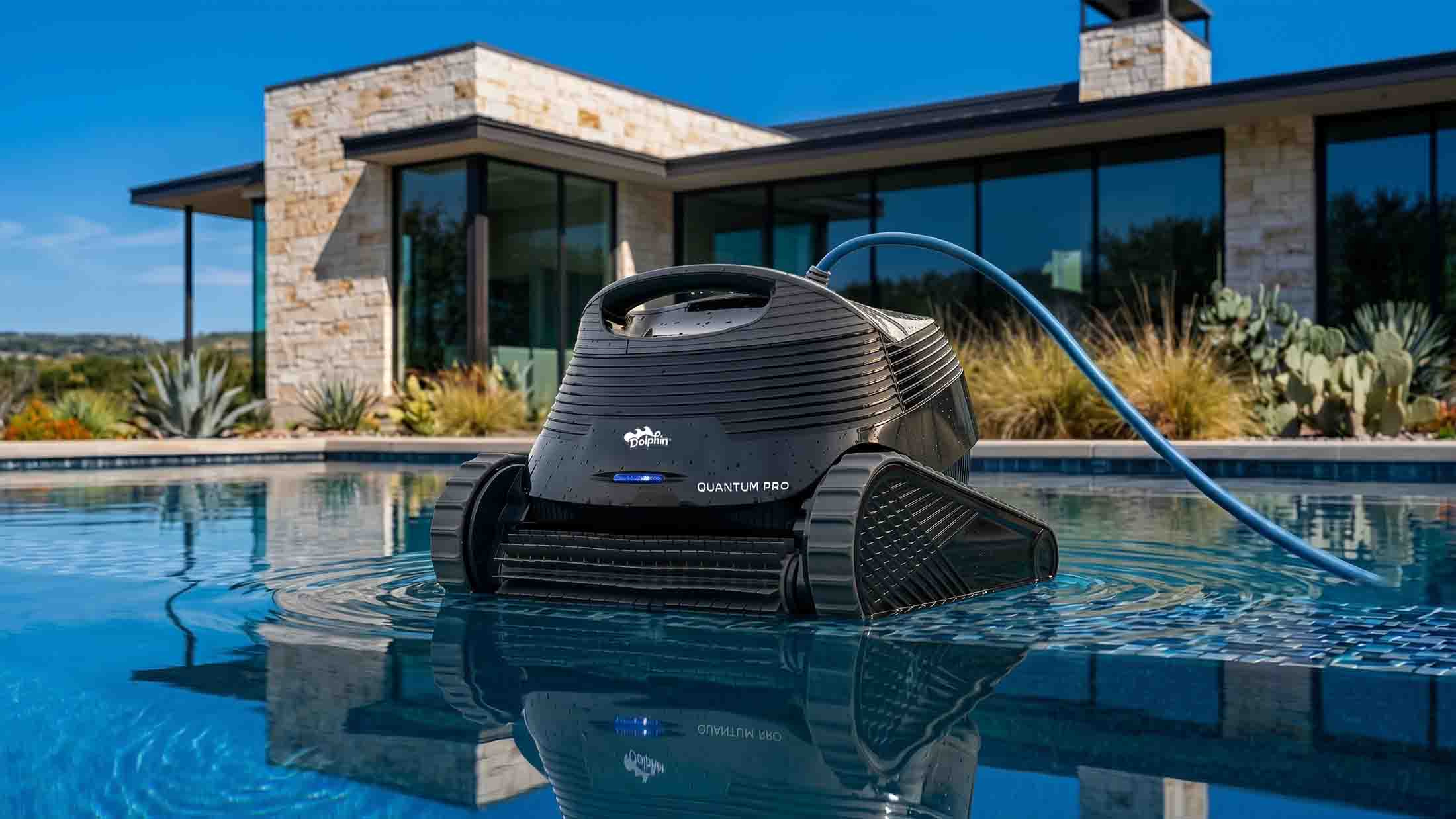
Top pick: Dolphin Quantum
Live prices · Ships free · 30 Day Trial
When a pool has a peninsula, an island, a T-junction or a split-level floor, the question is not how the robot turns but how it gets around what is in the way.
The quick answer
For most irregular pools we recommend the Dolphin Quantum: a swivel cable that resists wrapping around a peninsula, ledges and stairs in its coverage, and at 18.3 lb the lightest of the 50 ft robots here to carry between separated zones. If your layout turns the robot around constantly, the Dolphin Sigma recovers its heading best, thanks to its gyroscope.
Some pools are irregular in a way that goes beyond curves. A T-shape with a swim lane off the main basin. A peninsula of decking that juts into the water. An island with a palm on it. A floor that drops in levels, or a narrow channel linking two basins. Choosing the best robotic pool cleaner for irregular-shaped pools like these is less about the outline and more about what stands in the robot's path.
Two honest points first. A robot only cleans water it can drive through: it will not cross a raised divider or go over a spillway, so separated zones are cleaned one at a time. And a very narrow channel may be skipped altogether. Within those limits the Quantum, the Sigma, the Premier and, for small pools, the Cayman all do good work.
The picks, ranked
The picks for irregular layouts, in order.
$1999$1599Save $400 off the list price
Temporarily out of stock
Pick 1: Best for pools cleaned in more than one zone
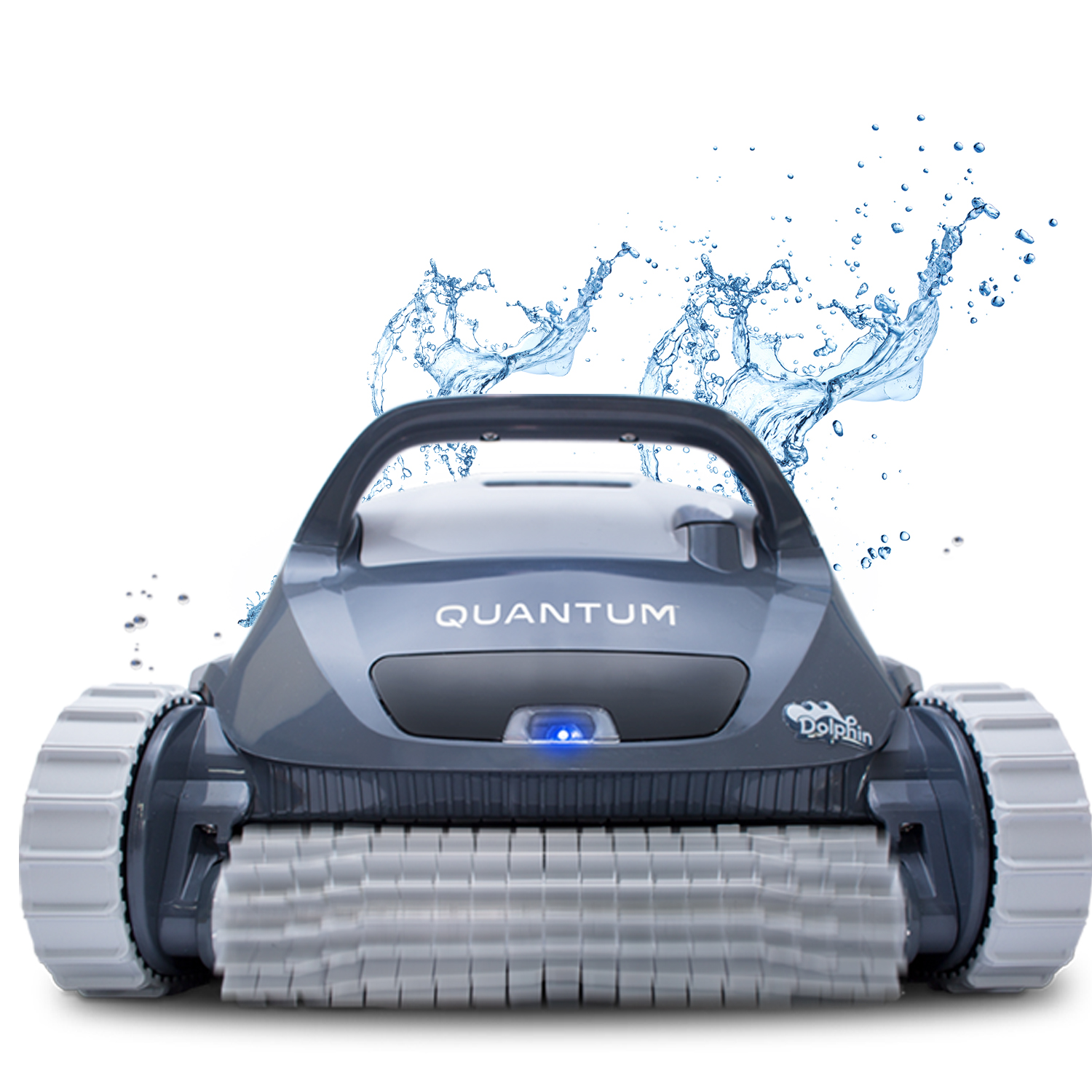
Dolphin Quantum
Irregular pools often end up being cleaned as two or three areas, and the Quantum is the easiest of the 50 ft robots to live with on that routine. It weighs 18.3 lb, the least of the three, and its cycle is 2 hours, so two zones fit in an afternoon. You can start it from the Wi-Fi app once it is in the water. The 55 ft cable has an anti-tangle swivel for peninsulas and islands, and its coverage lists ledges, sun shelves and stairs.
- Best for
- T-shapes, peninsula pools and split layouts up to 50 ft, especially where the robot is moved between zones.
- The trade-off
- Without a gyroscope it may take several cycles around an island before every arm has had equal attention.
$2999$2349Save $650 off the list price
Temporarily out of stock
Pick 2: Best at finding its way after being turned
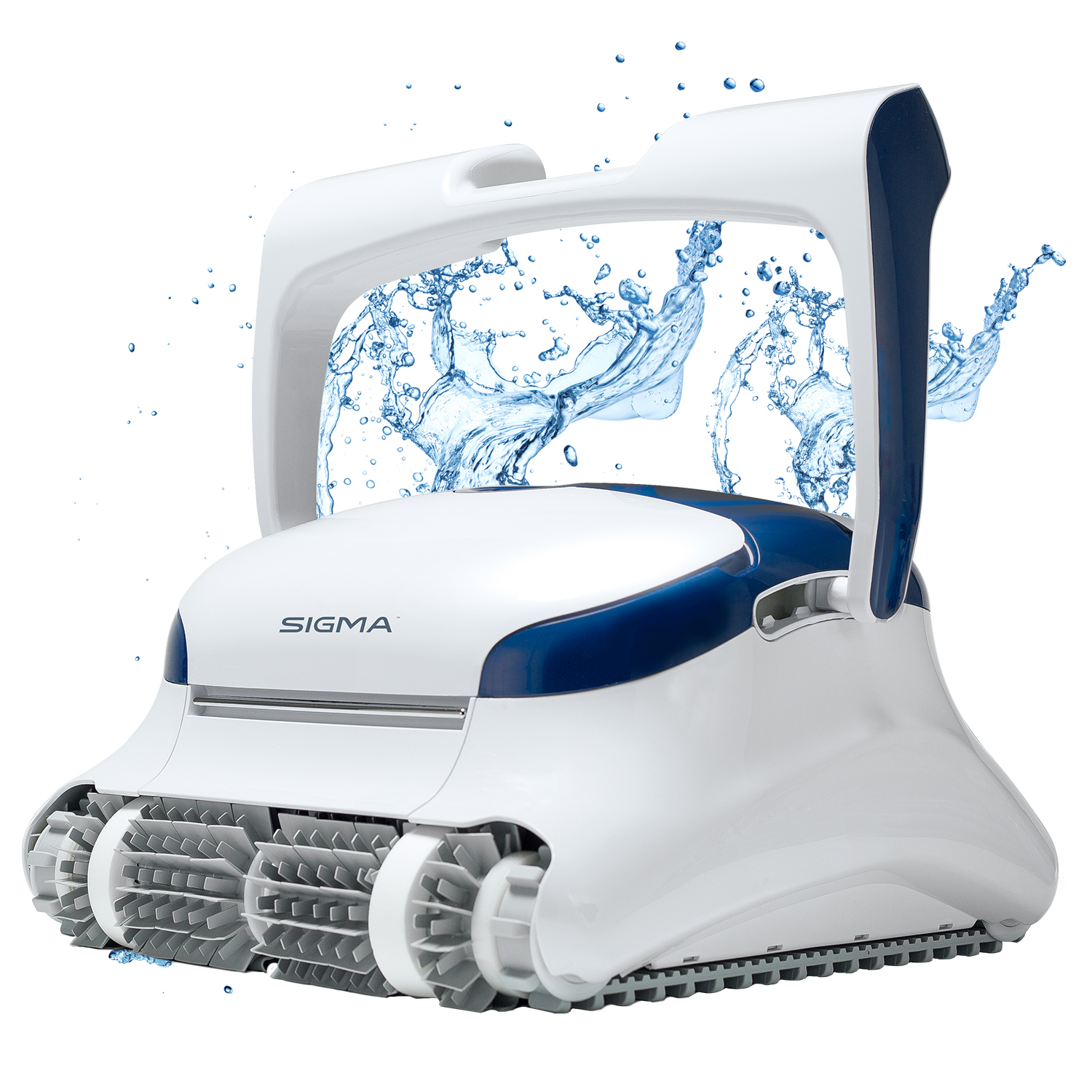
Dolphin Sigma
In an irregular pool one thing is certain: the robot will be knocked off course, repeatedly, and has to pick the job back up. That is what the Sigma's SmartNav 3.0 and onboard gyroscope are for. It knows its heading after rounding an island or meeting a peninsula, so less of its 2.5-hour cycle goes on repeating ground. Quad brushes and three ProLine motors at 4,500 GPH give it the strongest scrubbing and flow of the four, and the cable has a 360-degree swivel.
- Best for
- One connected pool with an island, peninsula or several arms, where orderly coverage matters more than price.
- The trade-off
- At 24.6 lb it is the heaviest to carry between separated zones, and it is the highest-priced pick.
$2499$1949Save $550 off the list price
Temporarily out of stock
Pick 3: Best for long cycles and a T or L layout
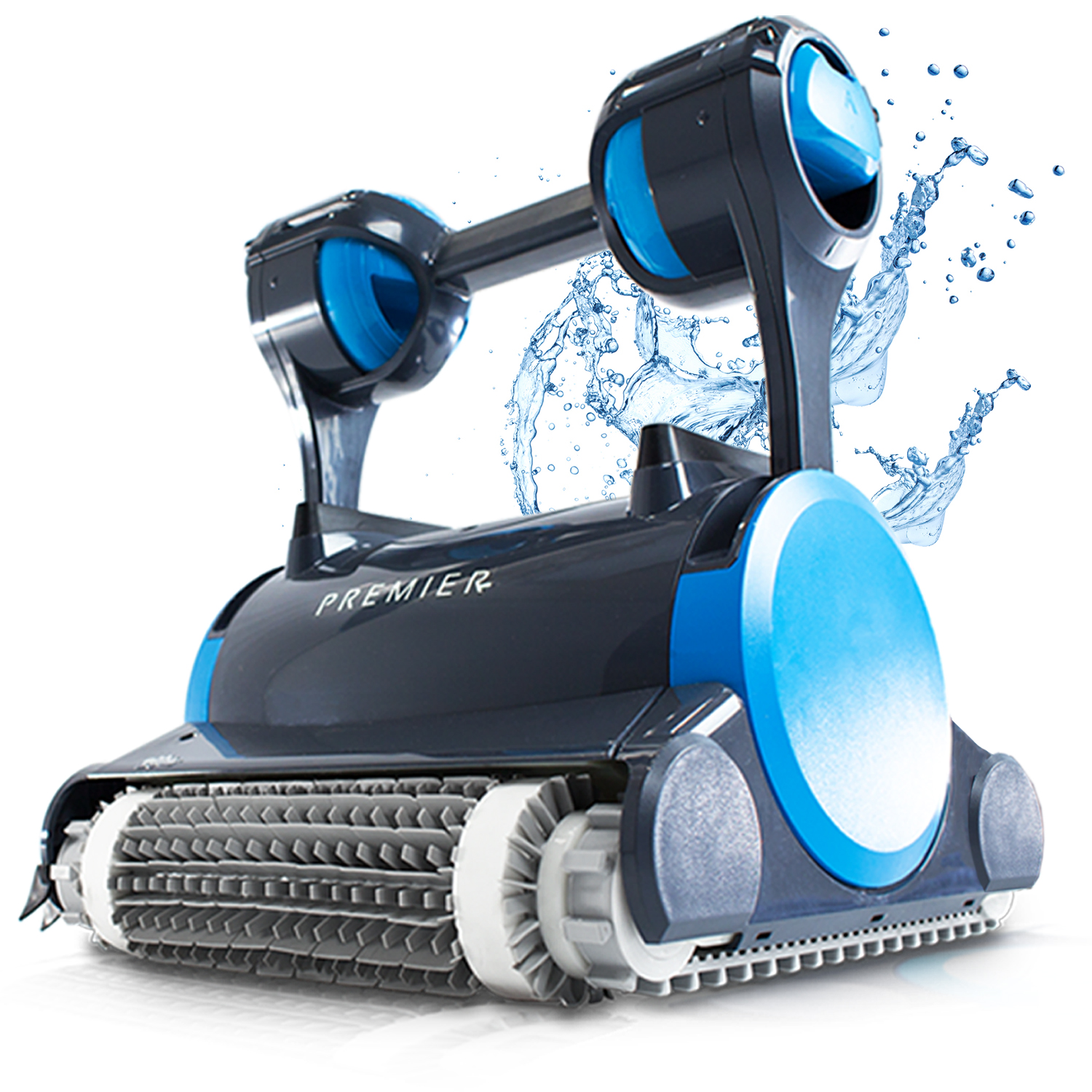
Dolphin Premier
The Premier brings time to the problem. Its 3-hour cycle is the longest of the four, which gives SmartNav 2.0 scanning more chances to find the far arm of a T or the back of a cut-out. Its published shape list is the only one here that names L-shaped pools as well as freeform. The 55 ft cable has a 360-degree swivel, and the Multi-Media system lets you fit the oversized leaf bag when a dead-end arm fills with leaves. The warranty is 3 years.
- Best for
- T and L layouts with a dead-end arm that gathers leaves, and owners who want the longer warranty.
- The trade-off
- No app and no gyroscope, and at 20.3 lb it is a heavier lift than the Quantum when the pool is cleaned in zones.
$1299$1049Save $250 off the list price
Temporarily out of stock
Pick 4: Best for small irregular pools done in zones
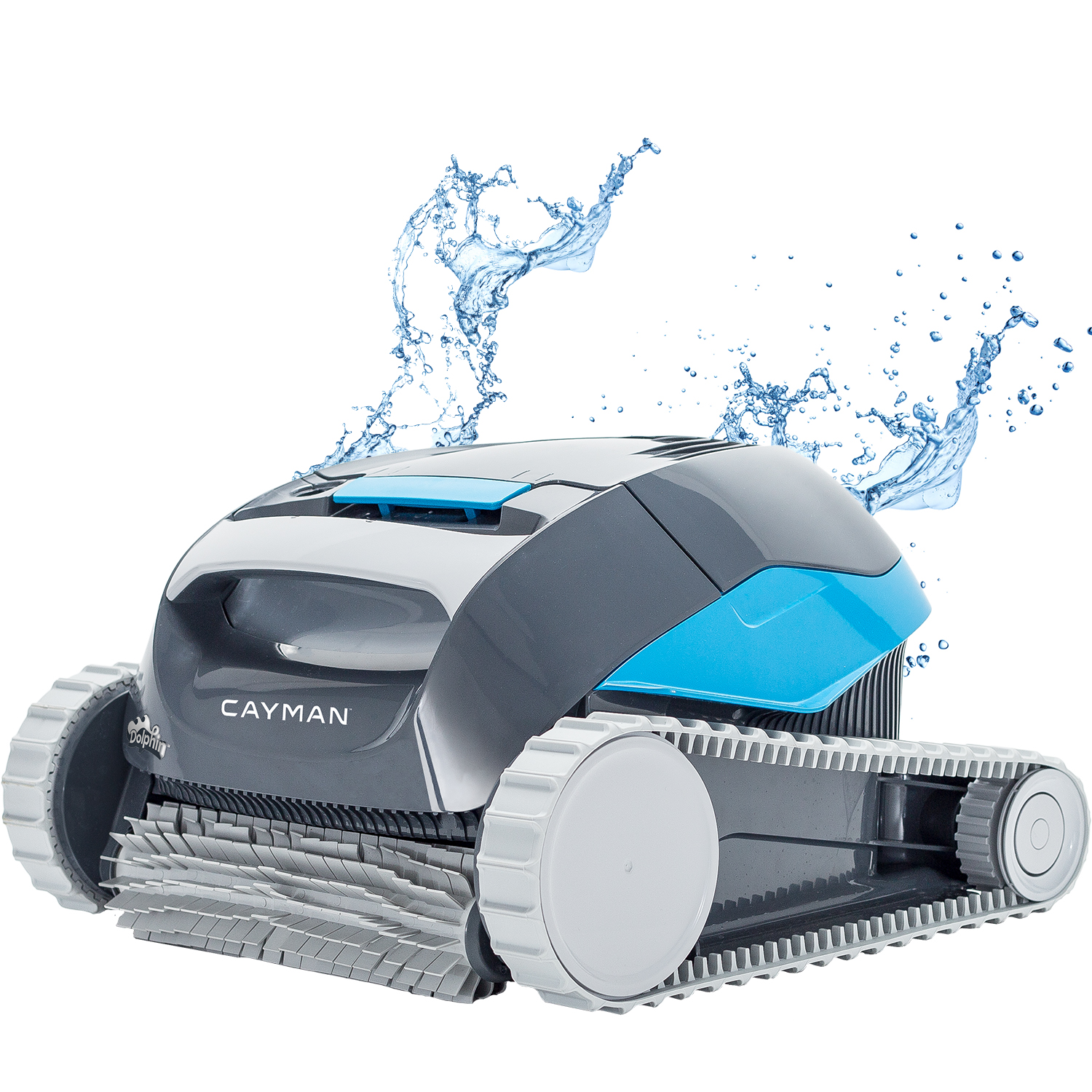
Dolphin Cayman
For a small irregular pool, 33 ft or less on its longest run, the Cayman has one clear advantage: at 14.6 lb it is the lightest of the four to lift from one zone to the next. It cleans floor and walls on a 2-hour cycle, and ledges and steps are on its published obstacle list. The trade-off is the cable. It is 50 ft with no swivel, so around a peninsula it can wind up, and you will need to watch the first cycles and straighten it afterward.
- Best for
- Compact pools with a divider, cut-out or short arm, where each zone is small and the robot gets moved.
- The trade-off
- No swivel, no waterline scrubbing and a daily-only timer; keep it away from layouts with a true island.


Side by side
Specs that matter around obstacles.
| Specification | Dolphin Quantum | Dolphin Sigma | Dolphin Premier | Dolphin Cayman |
|---|---|---|---|---|
| Price today | $1599 | $2349 | $1949 | $1049 |
| Navigation | SmartNav 2.0 | SmartNav 3.0 with gyroscope | SmartNav 2.0 | SmartNav 2.0 |
| Cable | 55 ft with anti-tangle swivel | 55 ft with 360° anti-tangle swivel | 55 ft with 360° anti-tangle swivel | 50 ft |
| Pool length | Up to 50 ft | Up to 50 ft | Up to 50 ft | Up to 33 ft |
| Cleans | Floor, walls, waterline, sun shelves and stairs | Floor, walls and waterline | Floor, walls and waterline | Floor and walls |
| Cycle time | 2 hours | 2.5 hours | 3 hours | 2 hours |
| Scheduling | Weekly timer: every day, every 2 days or every 3 days | Weekly scheduler by day and time | Weekly timer: every day, every 2 days or every 3 days | Timer: every day |
| Warranty | 2 years | 3 years | 3 years | 2 years |
What to look for
What matters when something is in the way.
-
Recovering after a turn.
An island or peninsula sends a robot off on a heading it did not plan. The Sigma's onboard gyroscope tells it which way it is now facing, so it resumes an orderly pattern. Robots with SmartNav 2.0 scan and re-plan instead, which works, but they may revisit one arm of the pool before finding the other.
-
A cable that will not wrap.
A robot that rounds a peninsula or circles an island drags its cable with it. A swivel lets the cable rotate instead of winding tighter, and the Quantum, Sigma and Premier each have one on a 55 ft cable. Where the power supply sits matters as much: facing the obstacle, not hidden behind it.
-
Weight, if you clean in zones.
A pool split by a raised wall, a spillway or a channel too tight to pass means lifting the robot from one zone to the next. The Cayman weighs 14.6 lb and the Quantum 18.3 lb. The Premier is 20.3 lb and the Sigma 24.6 lb.
-
Ledges and level changes.
A sloped transition between levels is ordinary floor to a robot. A vertical step is a small wall: the robot climbs it or turns away. The Quantum lists ledges, sun shelves and stairs in its coverage, and the other three list ledges and steps among the obstacles they handle.
Sort your pool into zones first.
Walk the edge and ask of every divider: could a robot drive through here? Open water with room to turn is one zone, however odd the outline. A raised wall, a spillway between levels or a gap barely wider than the robot is a boundary. Count the zones and measure the longest straight run of each, because the 33 ft or 50 ft rating applies zone by zone. Very narrow channels are the gray area: if the robot can enter but not turn, it may avoid the channel, and that strip is yours to brush.
- One connected zone with obstacles: navigation and a swivel matter most.
- Two or more separated zones: weight and cycle length matter most.
Islands, peninsulas and the cable.
A peninsula is the kinder of the two. Put the power supply on the deck opposite its tip, so the cable fans out to either side instead of bending around it. An island is harder, because a robot can lap it and lay the cable in a full loop. A swivel stops the cable from kinking but cannot undo a loop, so check after the first few cycles and, if the robot has circled, lift the cable clear before the next run.
A normal week in a two-zone pool.
Say the main basin is 34 ft and a raised wading area sits behind a low wall. Leave the Quantum in the main basin on its timer, running every 2 days. Once a week, when you lift it out to rinse the basket anyway, set it in the second zone, provided the water there is deep enough for the robot, which the manual states. Move the power supply if the cable will not reach, and start a single cycle. Two hours later it goes back. That is the whole routine.
Practical setup for an awkward layout.
- Site the power supply where it faces the obstacle: opposite the tip of a peninsula, or on the long side nearest an island.
- Watch one full cycle before trusting the timer, and note any arm the robot never enters.
- If an arm is skipped, set the robot down in that arm, facing its far end, for the following cycle.
- When moving between zones, hold the robot at the surface for a few seconds so it drains, and lift by the handle, never the cable.
Questions, answered
Questions about awkward layouts.
Can a robot get around an island in the middle of the pool?
Yes, as long as the water around the island is wide enough to drive and turn in. The concern is the cable, which can be laid in a loop if the robot laps the island. The swivel on the Quantum, Sigma and Premier prevents kinks; check for wraps after early cycles and move the power supply if it keeps happening.
Is there a robotic pool cleaner for irregular-shaped pools with two levels?
Yes. If the levels meet with a slope or an underwater step, one robot treats them as one pool. If a raised wall or spillway separates them, clean each level as its own zone and move the robot between them. For that routine the Quantum is our pick: the lightest 50 ft robot here, with a 2-hour cycle.
Will the robot fit through a narrow channel between two parts of my pool?
Maybe. A robot needs more than its own width: it needs room to turn at the far end, or it will reverse out. No minimum channel width is published for these robots, so measure the gap and send us the number. If it is tight, plan on brushing the channel and cleaning the two basins as separate zones.
My pool is T-shaped. Where should the power supply go?
At the junction, on the wall of the long bar directly opposite the stem. From there the cable reaches both ends of the bar and the end of the stem without bending around an inside corner. Measure from that spot to each of the three far points, add the depth, and compare the longest figure with the cable length less the setback your manual requires.
The bottom line
The rule for irregular pools.
Count your zones before you compare robots. One connected pool with an island, a peninsula or several arms is a navigation problem, and the Sigma solves it best. A pool cleaned in separate zones is a handling problem, and the Quantum is the lightest 50 ft robot here with the shortest cycle. Choose the Premier for leafy dead ends and the longer warranty, and the Cayman only when every zone is small.
More buying guides
