



By pool shape and design
Best robotic pool cleaner for kidney-shaped pools: cover both lobes.
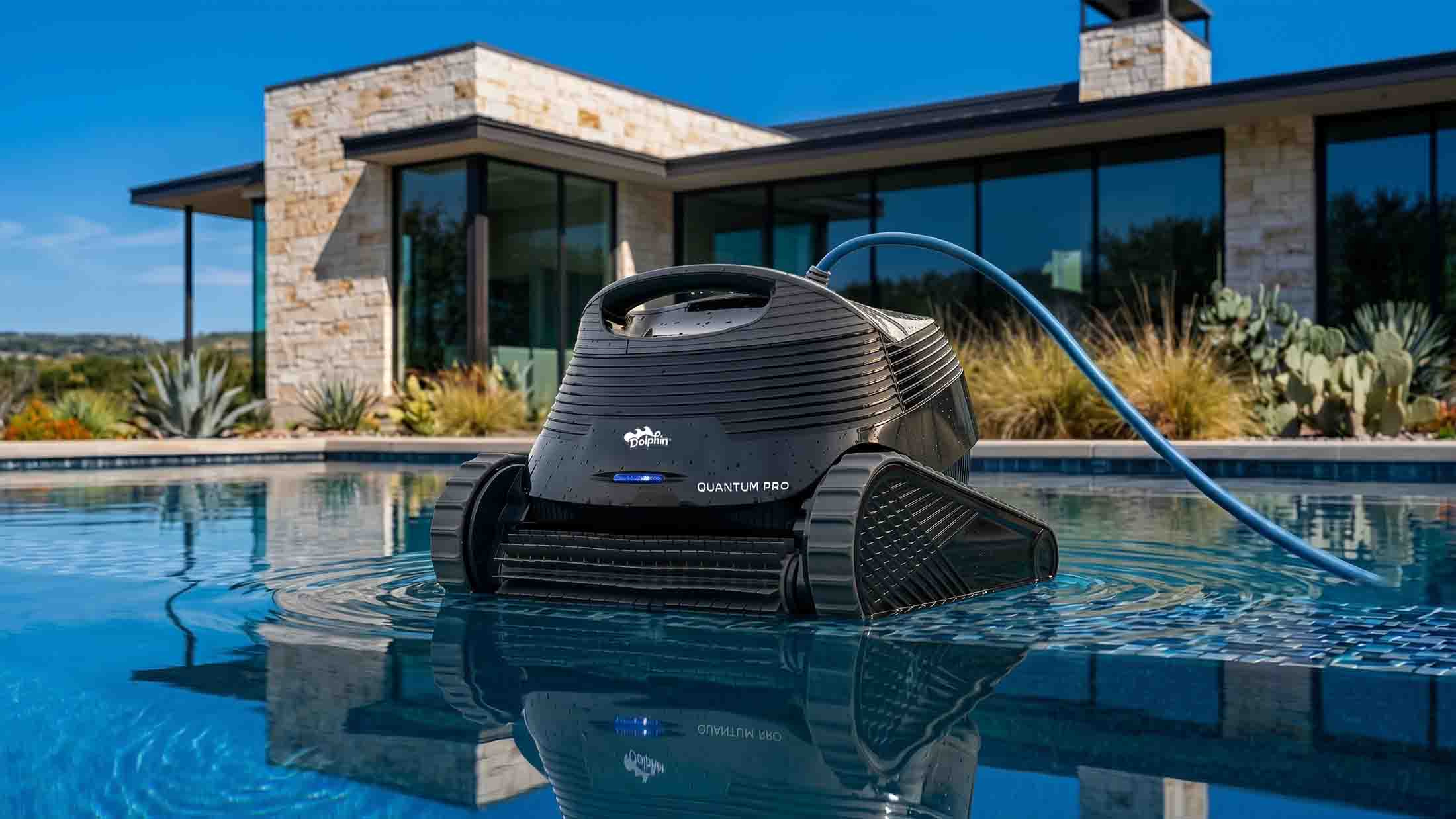
Top pick: Dolphin Quantum
Live prices · Ships free · 30 Day Trial
A kidney pool curves in on one side and swells into two lobes, so the right robot is the one that covers both ends evenly without tying its cable in knots.
The quick answer
For most kidney pools, choose the Dolphin Quantum: it is rated to 50 ft, its swivel cable copes with the constant direction changes, it scrubs the waterline and steps, and it is the lowest-priced 50 ft robot in this guide. Pick the Dolphin Sigma instead if one lobe keeps getting missed and you want gyroscope navigation. A kidney of 33 ft or less can use the Cayman.
A kidney-shaped pool bows outward on one side and curves in on the other, leaving two rounded lobes joined by a narrower waist. Finding the best robotic pool cleaner for kidney-shaped pools comes down to one question: will the robot spend its time evenly across both lobes, or keep returning to the end it started in?
A kidney is not a hard shape. Every Dolphin here turns when it meets a wall and picks a new heading, and over a full cycle the scanning robots cover a kidney well. What separates them is how the cable copes with the turning, how long the pool is, and whether you want the waterline scrubbed. We rank the Quantum first, then the Sigma, the Premier and the Cayman.
The picks, ranked
Four robots for a kidney pool, in order.

$1999$1599Save $400 off the list price
Temporarily out of stock
Pick 1: Best all-round fit for a kidney up to 50 ft
Dolphin Quantum
A kidney asks for three things the Quantum has together: a 50 ft rating, a 55 ft cable with an anti-tangle swivel for all the turning, and waterline scrubbing along a wall that curves the whole way round. Its SmartNav 2.0 scanning does not hold a line the way a gyroscope does, but the weekly timer makes up for it: run it every day or every second day and both lobes are covered several times a week. Steps set into the curve are in its published coverage.
- Best for
- Kidney pools from about 25 to 50 ft long, with steps or a shelf, where you want the waterline scrubbed too.
- The trade-off
- No gyroscope: if one lobe is much larger than the other, coverage can take a few cycles to even out, which the Sigma avoids.

$2999$2349Save $650 off the list price
Temporarily out of stock
Pick 2: Most even coverage across both lobes
Dolphin Sigma
If you have watched a robot favor one end of a kidney, the Sigma answers that specific complaint. SmartNav 3.0 pairs scanning with an onboard gyroscope, so after the inward curve turns it, it corrects its heading instead of drifting. Quad scrubbing brushes and three ProLine motors moving 4,500 GPH back that up, the 55 ft cable has a 360-degree swivel, and the app sets a schedule by day and time. It ranks second only because a typical kidney does not need this much robot.
- Best for
- Owners of larger or lopsided kidneys who want the most methodical route and app scheduling.
- The trade-off
- It is the highest-priced pick and the heaviest at 24.6 lb, and its filters are cartridges rather than a single lift-out basket.

$2499$1949Save $550 off the list price
Temporarily out of stock
Pick 3: Best for kidney pools under trees
Dolphin Premier
The Premier earns its place on kidney pools under trees, where the waist and the shallow lobe collect leaves. Its Multi-Media system includes an oversized leaf bag alongside NanoFilters and standard fine filters, so you can switch media with the season. A 3-hour cycle, the longest of the four, gives SmartNav 2.0 scanning more passes over an uneven outline, and the 55 ft cable has a 360-degree swivel. You set its weekly timer at the power supply, and the warranty runs 3 years.
- Best for
- Leafy yards, owners who prefer controls on the power supply, and anyone who values the longer warranty.
- The trade-off
- No app, and it does not list stairs or shelves in its coverage; compare its live price with the Quantum's.
$1299$1049Save $250 off the list price
Temporarily out of stock
Pick 4: Best for small kidneys of 33 ft or less
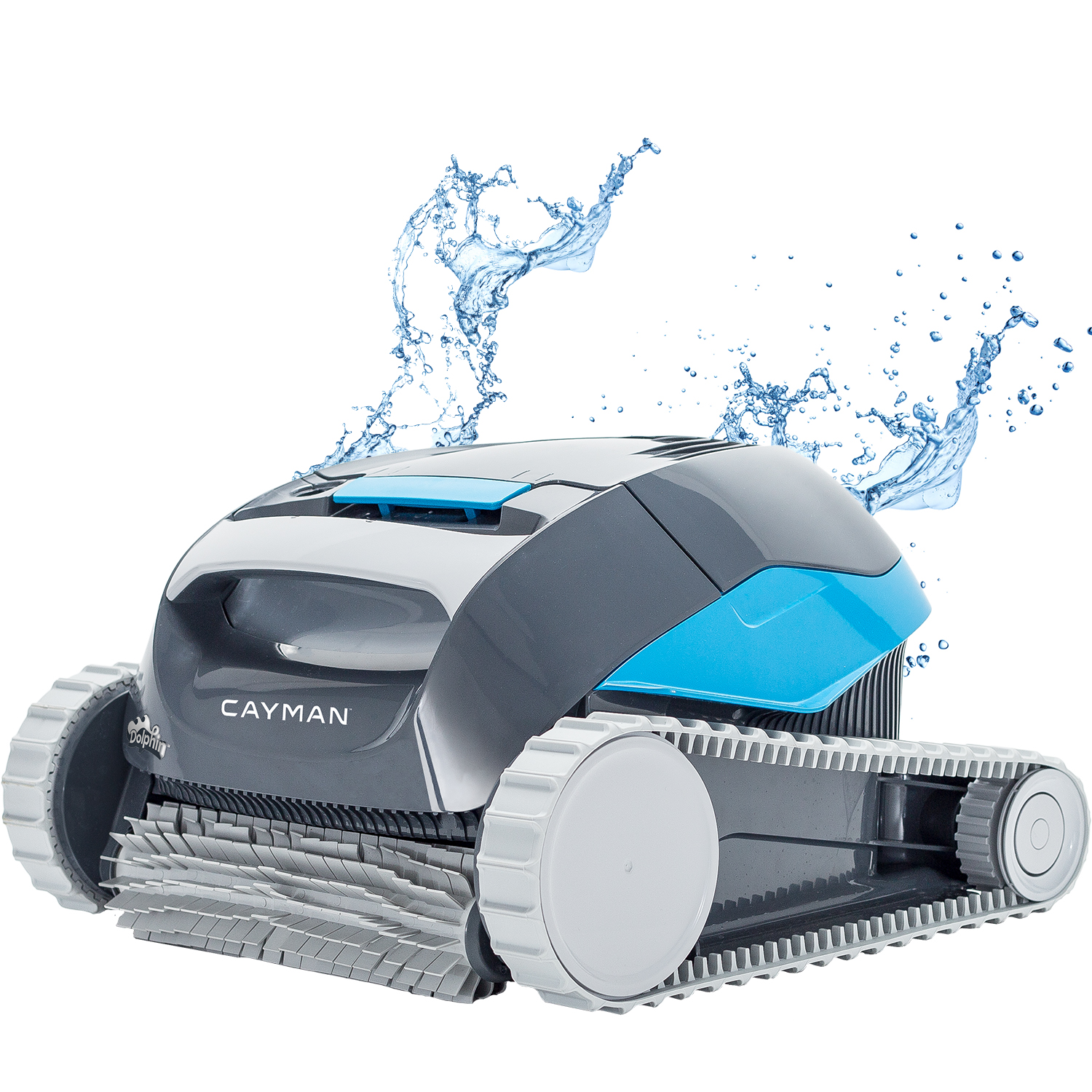
Dolphin Cayman
For a compact kidney such as a 16 by 32, the Cayman does the core job at a lower price. It is rated to 33 ft, cleans floor and walls with a HyperBrush that spins at twice the speed of standard Dolphin brushes, moves over 4,000 GPH, and empties through a top hatch with one tab. It weighs 14.6 lb, less than any other pick here. Its timer has one setting, every day. Site the power supply near the middle of the long side so the 50 ft cable reaches both lobes.
- Best for
- Kidney pools 33 ft and under, in-ground or above-ground, where floor and walls are the job.
- The trade-off
- No waterline scrubbing and no swivel, so brush the tile line yourself and lay the cable out straight from time to time.


Side by side
Kidney-pool specs side by side.
| Specification | Dolphin Quantum | Dolphin Sigma | Dolphin Premier | Dolphin Cayman |
|---|---|---|---|---|
| Price today | $1599 | $2349 | $1949 | $1049 |
| Navigation | SmartNav 2.0 | SmartNav 3.0 with gyroscope | SmartNav 2.0 | SmartNav 2.0 |
| Cable | 55 ft with anti-tangle swivel | 55 ft with 360° anti-tangle swivel | 55 ft with 360° anti-tangle swivel | 50 ft |
| Pool length | Up to 50 ft | Up to 50 ft | Up to 50 ft | Up to 33 ft |
| Cleans | Floor, walls, waterline, sun shelves and stairs | Floor, walls and waterline | Floor, walls and waterline | Floor and walls |
| Cycle time | 2 hours | 2.5 hours | 3 hours | 2 hours |
| Scheduling | Weekly timer: every day, every 2 days or every 3 days | Weekly scheduler by day and time | Weekly timer: every day, every 2 days or every 3 days | Timer: every day |
| Warranty | 2 years | 3 years | 3 years | 2 years |
What to look for
What decides coverage in a kidney pool.
-
Navigation that copes with angled walls.
A robot crossing a kidney meets the far wall at a slant, turns, and sets off on a new line. The Sigma's SmartNav 3.0 uses an onboard gyroscope to hold that line and correct after each turn. The other picks use SmartNav 2.0 scanning, which reaches the same floor over a full cycle by a less tidy route.
-
A cable that can untwist itself.
Curved walls mean more turns than a rectangle of the same size, and every turn twists the cable a little. A swivel lets the twist spin out as the robot works. The Quantum, Sigma and Premier have one on a 55 ft cable. The Cayman's 50 ft cable has no swivel and needs straightening by hand.
-
The longest straight line through the water.
The length rating applies to the longest straight run, from the tip of one lobe to the tip of the other, not to the width of a lobe or the path around the curve. Up to 33 ft suits the Cayman; beyond that you need a 50 ft robot.
-
What sits in the curve.
Builders like to tuck steps or a small shelf into the inward curve. The Quantum lists stairs, sun shelves and Baja ledges in its coverage. The others handle steps as an obstacle to work around, so expect to brush the treads yourself.
Measure the longest straight line, not the lobe.
Stand at the tip of one lobe and sight to the tip of the other: that straight line across the water is the number to compare with a length rating. The curved wall is longer, and it does not count.
Cable reach is a separate check. Measure from where the power supply will sit, set back as your manual directs, to the farthest point of the far lobe, and add the depth. The best spot is usually on the outward-bowing side near the waist.
- Up to 33 ft end to end: the Cayman, or any of the 50 ft robots.
- 34 to 50 ft: the Quantum, Sigma or Premier.
- Over 50 ft: beyond every rating in this guide, so talk to us before ordering.
Why one lobe sometimes gets less attention.
A scanning robot picks a new heading each time it meets a wall. In a kidney, the inward curve acts like a deflector: a robot leaving the big lobe is often turned back before it passes the waist, so the small lobe gets fewer visits in a single cycle.
Three things even it out. Start the robot in the smaller lobe. Run more cycles: the Quantum and Premier timers can run daily, on alternate days or every third day, and the Sigma follows a day-and-time schedule. And keep the cable straight, because a twisted one pulls the robot back toward the power supply. If the small lobe is still dusty after a week, that is the case for the Sigma's gyroscope.
What a robot will not do in a kidney pool.
A robot picks up what has settled and scrubs the surfaces it can reach. It does not skim, so leaves floating in the inward curve still need the skimmer or a net, and it does not replace sanitizer or balanced water. Of these four, only the Quantum lists steps and shelves in its coverage, and a shelf with very little water over it stays a brush job; the manual says how shallow it will work. During an algae treatment, brush the walls by hand as well and let the robot collect what you loosen.
Setting up a robot in a kidney pool.
- Lower the robot into the smaller lobe for the first few cycles and watch where it spends its time.
- On the Cayman, unplug the cable from time to time and walk it out straight on the deck to release the twist.
- Lift the robot out to empty and rinse the filter at least weekly, and always before you shock the pool or add chemicals.
Questions, answered
Kidney pool questions, answered.
Does a kidney-shaped pool need a special robotic pool cleaner?
No. A kidney is on the easy side of curved pools, and any robot here that is rated for its length will clean it. What improves results is a swivel cable for the extra turning and enough scheduled cycles for both lobes to be covered. The Quantum has both, which is why it leads.
Will a robot get stuck in the narrow waist of a kidney pool?
It is unlikely. The waist of a backyard kidney is still far wider than a robot needs to pass or turn. Where robots do stall is on a cable that has twisted short, which is another reason to favor a swivel or to straighten a plain cable regularly.
How do I size a robot for a 16 by 32 kidney pool?
Go by the 32 ft, the longest straight line through the water. That is inside the Cayman's 33 ft rating with a foot to spare, so the Cayman works if floor and walls are enough. If you want the waterline scrubbed, or more margin on length and cable, step up to the Quantum.
Do curved walls stop a robot from climbing to the waterline?
No. The tracks grip a curved wall much as they grip a flat one. The Quantum, Sigma and Premier climb and scrub at the waterline. The Cayman climbs walls too but is not a waterline cleaner, so the tile line stays yours to wipe.
The bottom line
The decision rule for a kidney pool.
Measure the longest straight line first. At 33 ft or less, the Cayman is enough if you only need floor and walls. Past that, or if you want the waterline, steps and a swivel cable, the Quantum is the sensible default and the lowest-priced way to get them. Move up to the Sigma when even coverage of both lobes matters most, and choose the Premier when leaves are a bigger problem than shape.
More buying guides
