



By pool length and dimensions
The best robotic pool cleaner for a 65-foot pool is not a residential one.
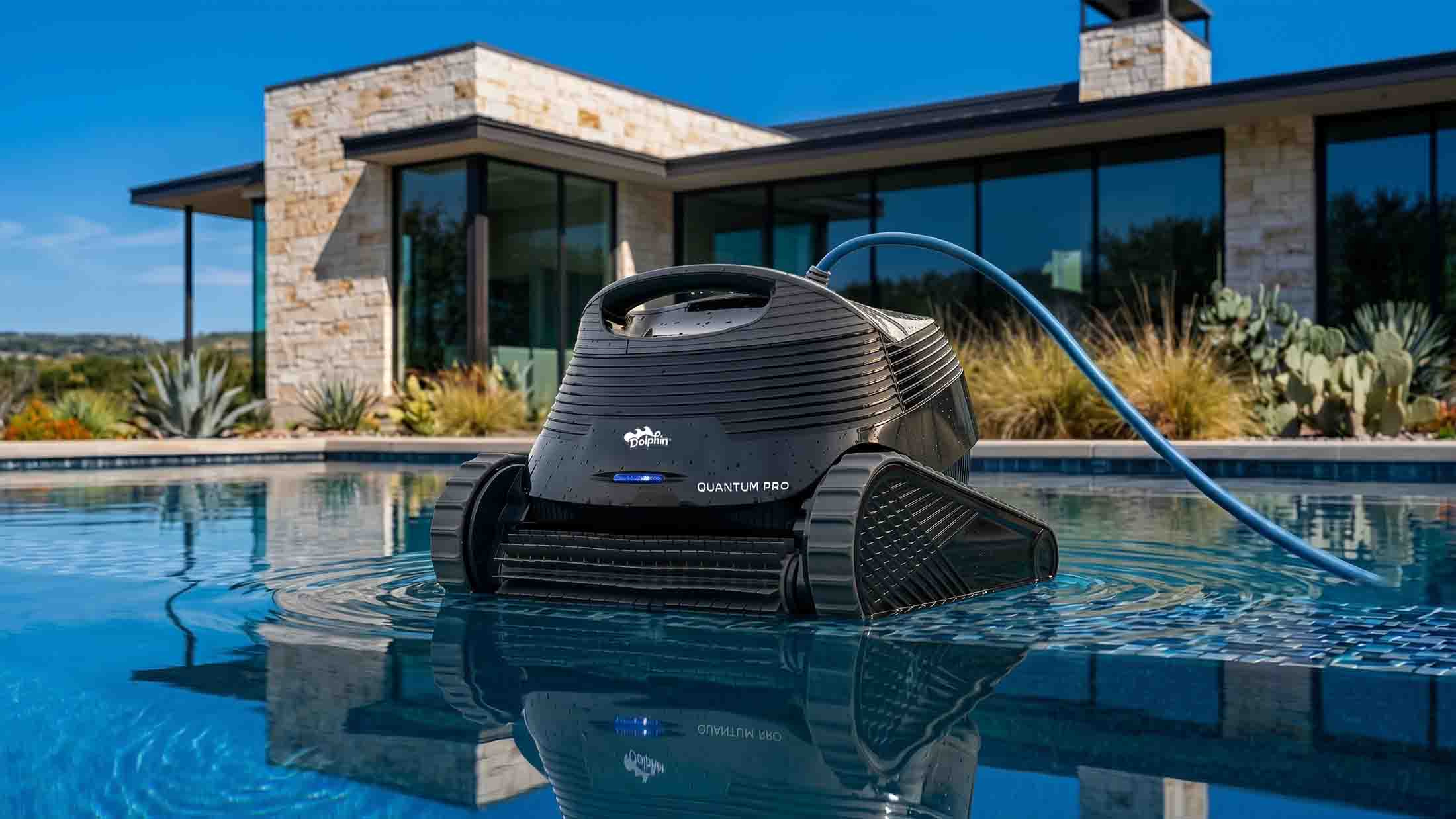
Top pick: Dolphin Quantum
Live prices · Ships free · 30 Day Trial
A 65-foot pool is 15 feet beyond the rating of every robot in this guide. This page covers the one honest stopgap, what it demands of you, and the better answer.
The quick answer
Buy a commercial-class robot with a 100 ft-plus cable if you can; call us and we will point you to one. If you need a stopgap, clean the pool in two zones with the Dolphin Quantum: the lowest-priced and lightest of the three picks, with a 55 ft swivel cable. The Premier is the alternative when leaves are heavy and a 3-year warranty matters more.
Know this first
A 65 ft pool is 15 ft past the rating of every robot on this page; all three stop at 50 ft. None of them is the right tool for this pool. The right tool is a commercial-class robot with a cable of 100 ft or more. What follows is a supervised, two-zone stopgap that will not give full coverage.
Let us save you some time. If you came looking for the best robotic pool cleaner for a 65-foot pool, it is not one of the residential robots in this guide. The Quantum, Premier and Sigma are each rated for a longest run of 50 ft and carry a 55 ft cable. Your pool asks for 15 ft more than that, and clever placement does not close a gap that size.
Owners of pools this long still ask what they can do today, with a robot that ships this week. There is one honest answer: treat the pool as two zones of about 32 ft, clean one, move the power supply, clean the other. It is real work, it needs you there, and it leaves some floor untouched. Below is how to do it properly and which robot makes it least painful.
The picks, ranked
If you go ahead anyway: three stopgaps, in order.

$1999$1599Save $400 off the list price
Temporarily out of stock
Pick 1: Least painful two-zone stopgap
Dolphin Quantum
Used in two zones, a robot never faces more than about 32 ft at a time, so what separates these three is the handling, not the rating. The Quantum is the lightest at 18.3 lb, its XXL MaxBin opens from the top with one click for the rinse between zones, and its 2-hour cycle finishes both zones in four hours of running where the others need five or six.
It is also the lowest-priced of the three, which is the right amount to commit to a stopgap. Its 55 ft anti-tangle swivel cable equals the other two for reach.
- Best for
- Owners who need something working now and will be on hand to move it between zones.
- The trade-off
- The warranty is 2 years, and nothing about this robot changes the fact that the pool is 15 ft over its rating.

$2499$1949Save $550 off the list price
Temporarily out of stock
Pick 2: For heavy leaves and a longer warranty
Dolphin Premier
A pool this size gathers debris by the bucket, and the Premier is the one robot here that includes an oversized leaf bag, part of a Multi-Media system that also includes NanoFilters and standard fine filters. Swapping media takes seconds and needs no tools, which fits a routine built around stopping between zones. Dual commercial-grade ProLine motors move 4,500 GPH.
Each zone gets a 3-hour cycle, so a full clean is six hours of running. The 3-year warranty is worth weighing for a robot that will work double shifts.
- Best for
- Tree-lined 65 ft pools where the filter, not the clock, is the limiting factor.
- The trade-off
- Six hours of cycles plus a move makes a long day, and with no app you start each zone at the power supply.

$2999$2349Save $650 off the list price
Temporarily out of stock
Pick 3: Tidiest pattern inside each zone
Dolphin Sigma
The Sigma adds SmartNav 3.0 with an onboard gyroscope, so within a zone its path is the most disciplined of the three, and quad scrubbing brushes with three commercial-grade ProLine motors give it the most scrubbing hardware. If your pool has rough plaster or a stubborn film on the walls, that counts.
Against it: 24.6 lb is a lot to lift twice per clean, its filters are cartridges and not a lift-out basket, and it is the highest-priced of the three. Paying the most for a stopgap rarely adds up.
- Best for
- Owners who already want a Sigma for its app and scrubbing, and accept the lifting.
- The trade-off
- The heaviest and most expensive of the three, for the same 50 ft rating and 55 ft cable.


Side by side
How the three stopgap robots compare.
| Specification | Dolphin Quantum | Dolphin Premier | Dolphin Sigma |
|---|---|---|---|
| Price today | $1599 | $1949 | $2349 |
| Pool length | Up to 50 ft | Up to 50 ft | Up to 50 ft |
| Cable | 55 ft with anti-tangle swivel | 55 ft with 360° anti-tangle swivel | 55 ft with 360° anti-tangle swivel |
| Cycle time | 2 hours | 3 hours | 2.5 hours |
| Cleans | Floor, walls, waterline, sun shelves and stairs | Floor, walls and waterline | Floor, walls and waterline |
| Navigation | SmartNav 2.0 | SmartNav 2.0 | SmartNav 3.0 with gyroscope |
| Scheduling | Weekly timer: every day, every 2 days or every 3 days | Weekly timer: every day, every 2 days or every 3 days | Weekly scheduler by day and time |
| Robot weight | 18.3 lb | 20.3 lb | 24.6 lb |
| Warranty | 2 years | 3 years | 3 years |
What to look for
What the two-zone method asks of a robot.
-
Reach inside each zone.
Splitting a 65 ft pool gives two zones about 32 ft long. With the power supply opposite the middle of a zone, a 55 ft cable covers it with slack to spare. The split only works because the power supply moves; from one fixed spot the far end stays out of comfortable reach.
-
A cable that untwists itself.
Two cycles and a move every time you clean means a lot of cable handling. An anti-tangle swivel lets the cable unwind as the robot turns, so you are not straightening coils on the deck between zones. All three picks have one.
-
How heavy the routine is.
Each clean means two lifts out of the water, one carry of the robot and one of the power supply. The three robots weigh 18.3 lb, 20.3 lb and 24.6 lb, and none comes with a caddy. Repeated weekly, six pounds is a real difference.
-
Filter access between zones.
The first zone loads the filter before the second zone starts. A basket you can open from the top, rinse and drop back in a minute keeps the second cycle at full flow. This is the step people skip, and the second zone shows it.
How to run a 65 ft pool as two zones.
Pick a dividing line across the pool near the halfway mark; a ladder, a light niche or a tile marker makes a handy reference. Zone one is the shallow side, zone two the deep side.
The robot does not know where your line is. It will cross it until the cable stops it, so the middle of the pool gets cleaned twice and the two far ends get the least attention. The routine itself is short:
- Set the power supply opposite the middle of zone one, at the setback your manual gives.
- Lower the robot in toward the far end of that zone and start a cycle.
- When it stops, lift it out, open the filter and rinse it.
- Carry the power supply to the middle of zone two, then the robot, and run the second cycle.
- Finish by brushing any corner the robot left.
What this costs you in time and attention.
The reason to own a robot is that it runs while you do something else. In two zones, most of that is lost. The weekly timer and the app schedule can only start a cycle where the power supply already sits, so an unattended schedule cleans one zone again and again while the other waits for you.
Count the hours honestly: four to six hours of cycles, a filter rinse in the middle, and two trips along the deck with the power supply and the cable. Done every week through a season, that is a commitment. If it sounds like more than you want to take on, it is better to know before you buy.
What a commercial-class robot changes.
A robot built for long pools carries a cable of 100 ft or more, so the power supply stays in one place and the whole pool is a single zone. Its cycle and filter capacity are sized for that floor area, and it is wheeled to the water on a caddy instead of carried. It can run on a schedule without you, which is the entire point.
It costs more than anything on this page. For a pool that will be cleaned every week for years, we think it is the right purchase. Chat with a Dolphin Expert and tell us the length, width, depth and where your outlets are.
Small things that make the stopgap go better.
- Mark both power supply positions on the deck so the two zones overlap the same way every week.
- Run the deep zone second. Debris drifts downhill toward the deep end, so that cycle should start with an empty filter.
- Lay spare cable on the deck in wide loops, never a tight coil, so the swivel has an easy job.
- Skim the surface before you start. Floating leaves the robot has not met yet will sink behind it.
Questions, answered
What people ask before trying this.
Why not leave the power supply at the midpoint, as people do with shorter pools?
At 65 ft the margin is gone. From the midpoint, the far corners of a pool 20 ft wide are about 38 ft away in a straight line, before the deck setback and the drop to a deep-end floor come off a 55 ft cable. A very narrow pool may just manage it; most will not.
How long a cable does a robot need for a 65 ft pool?
Think 100 ft or more. The cable has to cover the deck setback, the drop to the floor and the full length of the pool, with slack left for turning. The longest cable among the robots in this guide is 55 ft, which is why the best robotic pool cleaner for a 65-foot pool is a commercial one.
Would two robots, one for each end, do the job?
They can, and it removes the carrying. Each robot needs its own power supply and an outlet near its own half, and you should run them at different times so the two cables cannot cross. Add up the cost first, then compare that total with a single commercial unit that is actually rated for the pool.
Can the robot stay in the water overnight between zones?
Yes. These robots are made to stay in the water between scheduled cycles, so doing zone one today and zone two tomorrow is fine. Lift it out to rinse the filter at least weekly, take it out before shocking or adding chemicals, and store it dry and shaded if the pool will sit unused for a long stretch.
The bottom line
Our advice for a 65 ft pool.
Buy for the pool you have. If this is a long-term home and the pool gets weekly use, put the money toward a commercial-class robot with a 100 ft-plus cable and let it run on its own. If you need a stopgap for a season, or the pool is lightly used, clean it in two zones with the Quantum and accept that you are part of the system. Either way, talk to us first.
More buying guides
