



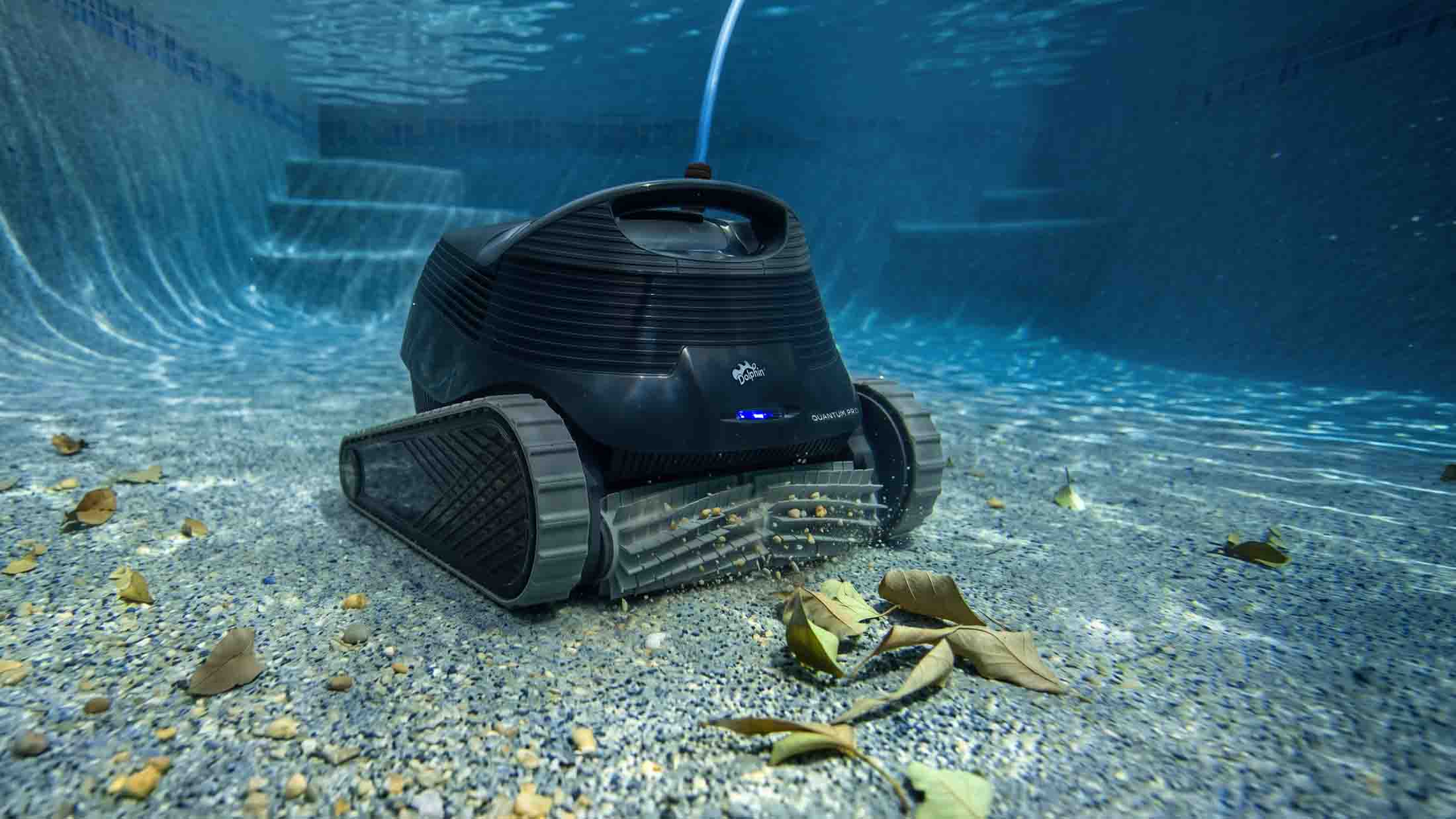
By steps, ledges and tricky features
The best robotic pool cleaner for sloped pools, hopper bottoms and steep breaks.
Top pick: Dolphin Quantum
Live prices · Ships free · 30 Day Trial
Grip gets a robot up a slope, and holding a heading keeps it from drifting back down. We rank four Dolphins on both, from a gentle transition to a hopper bottom.
The quick answer
For most sloped pools, the Dolphin Quantum: HyperGrip continuous rubber tracks and SmartNav 2.0 scanning handle a standard shallow-to-deep transition, and it is the lowest-priced 50 ft robot in this guide. If your slope is steep, or a robot you owned kept ending up in the deep end, choose the Dolphin Sigma. Its gyroscope senses the incline and holds the robot's line.
Almost every in-ground pool has a slope somewhere: the break where the shallow end falls away to the deep end, the tilted panels of a hopper bottom, the shallow V of a sport pool. So the best robotic pool cleaner for sloped pools is not a special machine. Climbing is rarely the problem, because a robot on rubber tracks walks up a normal transition much as it walks up a wall. What goes wrong is direction. Gravity and cable drag nudge a robot downhill at every turn, and one that loses its heading keeps re-cleaning the deep end while the shallow end waits.
A robot for a sloped floor needs two things: traction, which every pick here has, and a way to stay on course, which they manage differently. The Dolphin Premier, the Quantum and the Dolphin Cayman scan the pool with SmartNav 2.0 and even out their coverage over a full cycle. The Sigma carries a gyroscope that reads the incline directly.
The picks, ranked
Four robots, ranked for sloped floors.
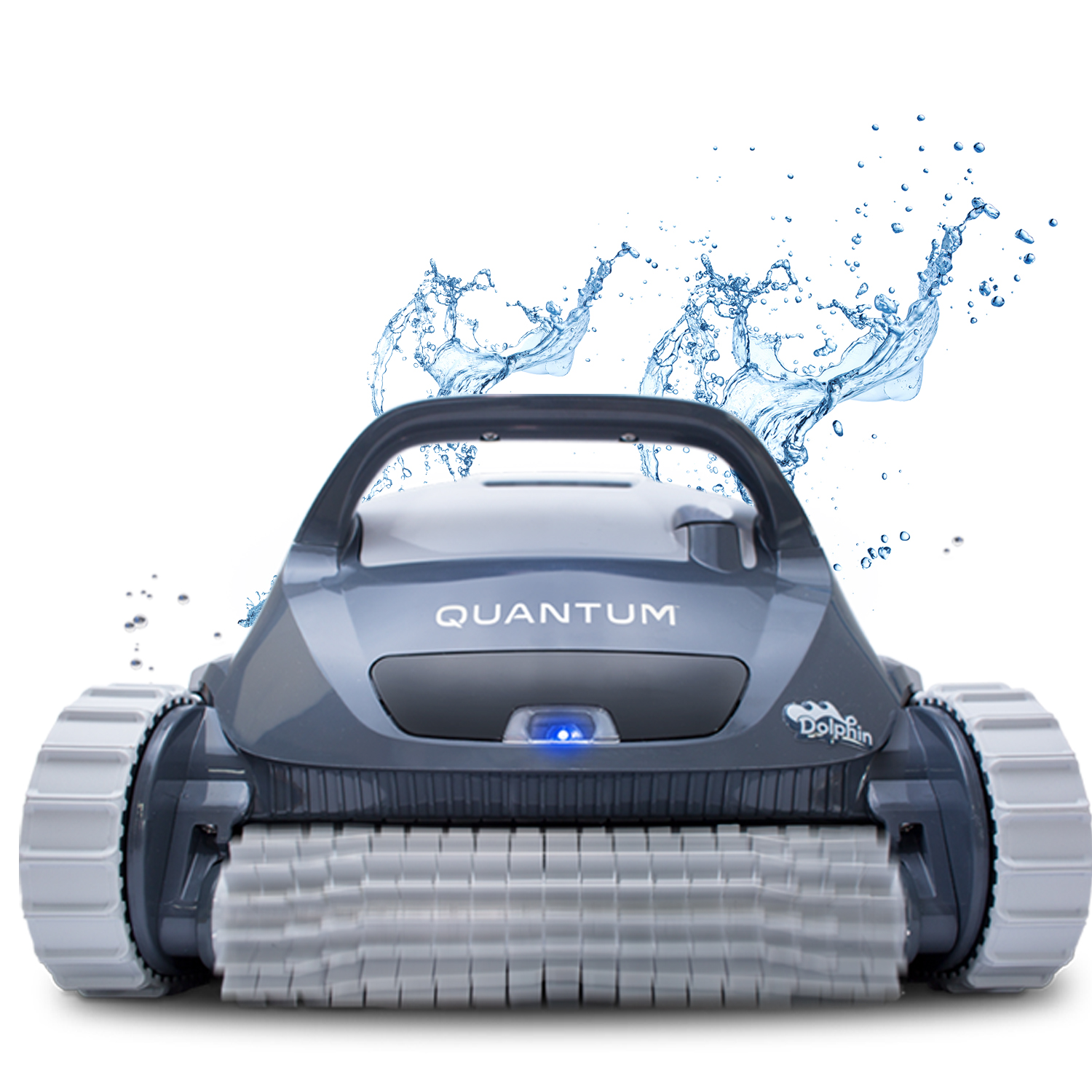
$1999$1599Save $400 off the list price
Temporarily out of stock
Pick 1: Best for a standard shallow-to-deep slope
Dolphin Quantum
Most slopes are ordinary, and for an ordinary slope the Quantum is all the robot the pool needs. HyperGrip continuous rubber tracks keep hold through the break, and SmartNav 2.0 scanning works its way across the floor so that coverage evens out over the 2-hour cycle. Put it on the weekly timer and whatever one cycle leaves in the shallow end, the next can collect. At 18.3 lb it weighs less than the Sigma or the Premier, and it is priced below both.
- Best for
- In-ground pools up to 50 ft with a normal transition slope or a sport-pool V.
- The trade-off
- It has no gyroscope. On a very steep hopper it relies on scanning and repeat cycles, where the Sigma senses the incline.
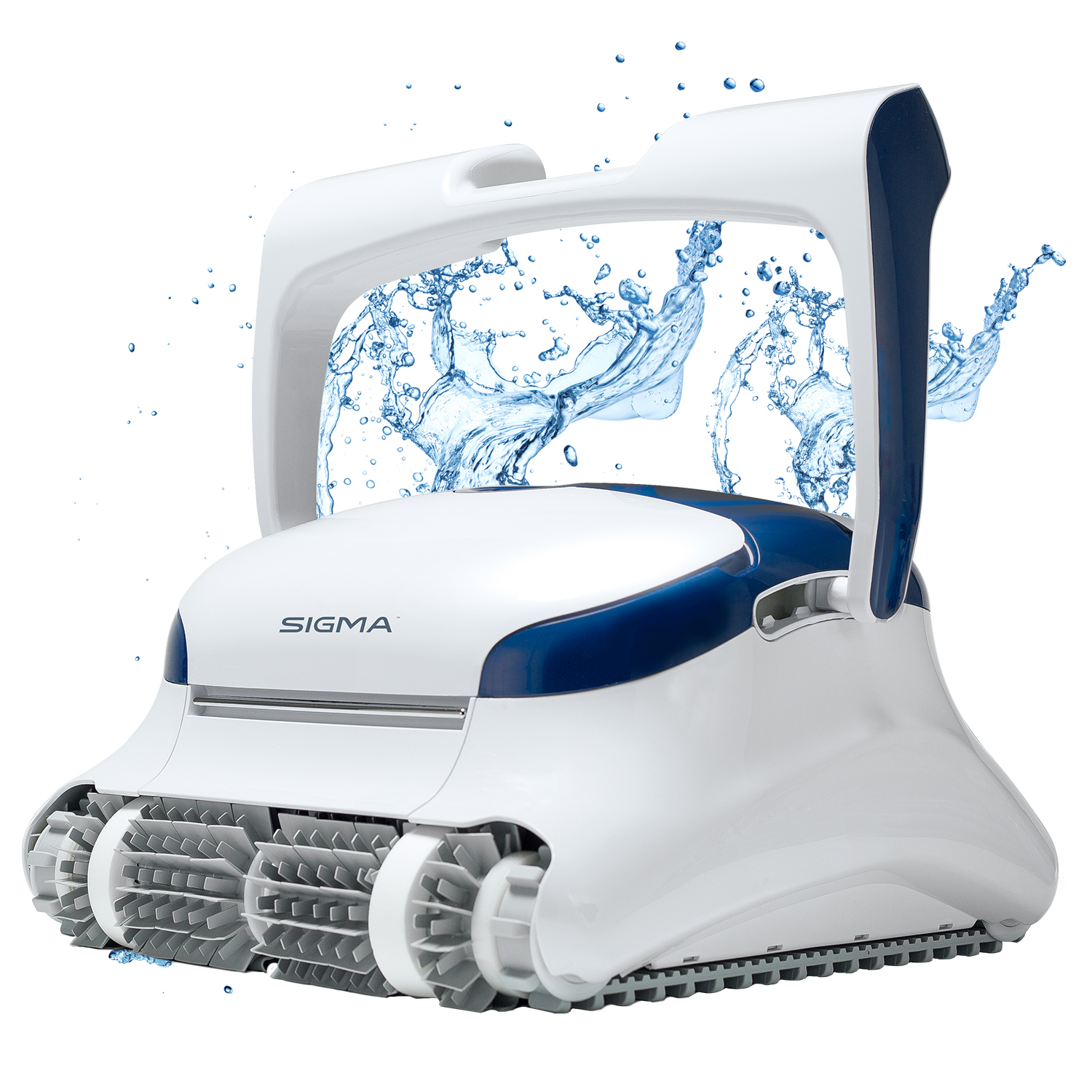
$2999$2349Save $650 off the list price
Temporarily out of stock
Pick 2: Best for steep slopes and hopper bottoms
Dolphin Sigma
Slopes are where the Sigma does something the other picks cannot. SmartNav 3.0 includes an onboard gyroscope, so the robot senses when it is on an incline and holds its line instead of sliding into a downhill turn. If you have watched a robot spend a whole cycle in the deep end, that is the behavior a gyroscope is there to prevent. Flow is 4,500 GPH from three commercial-grade ProLine motors, four brushes scrub, and the 2.5-hour cycle gives it time to cover both ends of the pool.
- Best for
- Hopper bottoms, steep breaks and pools where a previous robot kept returning to the deep end.
- The trade-off
- On a gentle slope you may never notice what the gyroscope is doing, and you will have paid the top price on this page for it. It weighs 24.6 lb.
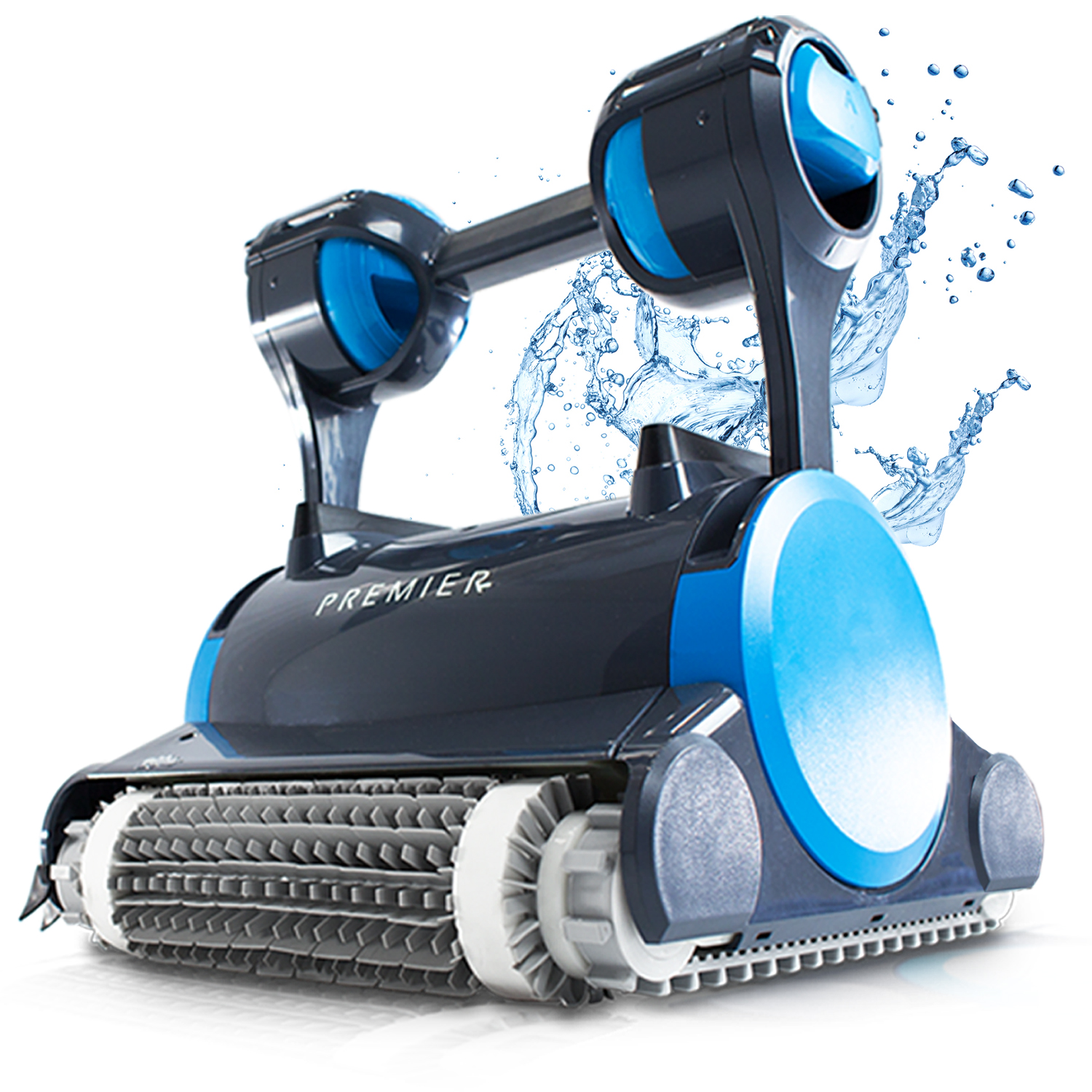
$2499$1949Save $550 off the list price
Temporarily out of stock
Pick 3: Long cycle that evens out both ends
Dolphin Premier
The Premier takes the patient route. It scans with SmartNav 2.0, and its answer to a slope is time: a 3-hour cycle, the longest here, with more passes to make up for any that drift downhill. Its two commercial-grade ProLine motors are rated at 4,500 GPH, and HyperGrip tracks carry its 20.3 lb through the transition. Slopes also feed debris to the deep end, and an oversized leaf bag and NanoFilters are both in the box for that.
- Best for
- Large sloped pools with leaves, where a timer on the power supply is all the scheduling needed.
- The trade-off
- No gyroscope and no app. It is the heaviest of the scanning picks, and it costs more than the Quantum.
$1299$1049Save $250 off the list price
Temporarily out of stock
Pick 4: Sloped pools of 33 ft or less
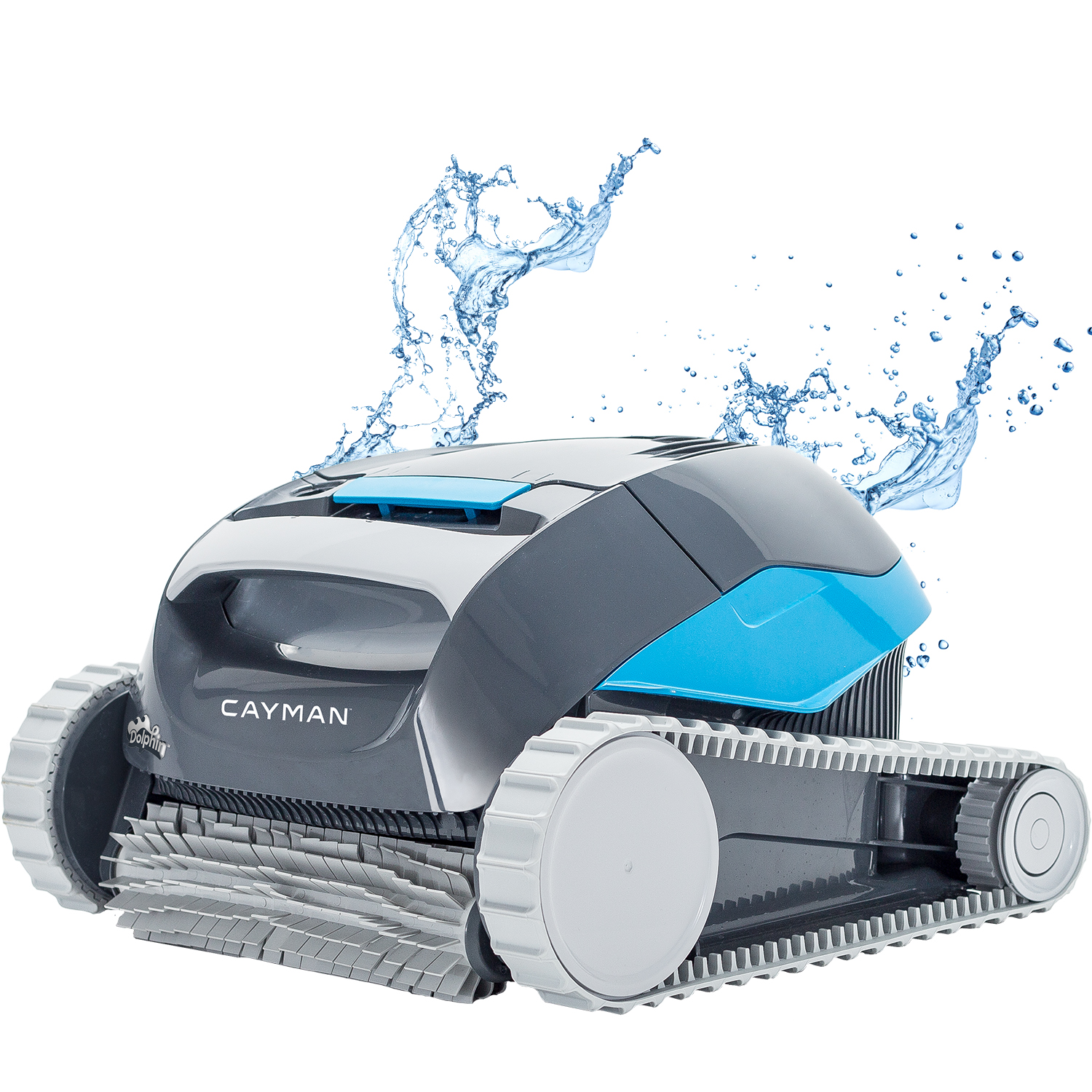
Dolphin Cayman
A short pool can still have a real slope: plenty of 16 x 32 ft vinyl pools drop from 3 ft to 8 ft through a hopper. The Cayman is rated for pools up to 33 ft and lists vinyl liner among its surfaces. It climbs on HyperGrip tracks with dual 24-volt DC motors moving over 4,000 GPH, navigates with SmartNav 2.0 and finishes in 2 hours. Its timer runs every day, and on a sloped floor that daily repeat is useful: a patch missed today can be picked up tomorrow.
- Best for
- Smaller in-ground pools, vinyl hoppers included, on a budget.
- The trade-off
- Floor and walls only, no swivel on its 50 ft cable, and nothing beyond scanning to hold its line. Not for pools over 33 ft.


Side by side
Slope-related specs, robot by robot.
| Specification | Dolphin Quantum | Dolphin Sigma | Dolphin Premier | Dolphin Cayman |
|---|---|---|---|---|
| Price today | $1599 | $2349 | $1949 | $1049 |
| Cleans | Floor, walls, waterline, sun shelves and stairs | Floor, walls and waterline | Floor, walls and waterline | Floor and walls |
| Traction | HyperGrip tracks | HyperGrip tracks | HyperGrip tracks | HyperGrip tracks |
| Navigation | SmartNav 2.0 | SmartNav 3.0 with gyroscope | SmartNav 2.0 | SmartNav 2.0 |
| Cable | 55 ft with anti-tangle swivel | 55 ft with 360° anti-tangle swivel | 55 ft with 360° anti-tangle swivel | 50 ft |
| Robot weight | 18.3 lb | 24.6 lb | 20.3 lb | 14.6 lb |
| Warranty | 2 years | 3 years | 3 years | 2 years |
What to look for
What a slope asks of a robot.
-
Traction
A slope tests grip before anything else. Tracks spread the robot's contact along its whole length, where wheels touch at a few small points. Every pick here runs on HyperGrip tracks, and the Quantum's are continuous rubber. On a standard transition, traction is not what separates them.
-
Holding a heading
On an incline a robot tends to turn downhill. Scanning navigation corrects for that over the length of a cycle. A gyroscope corrects for it as it happens, because the robot can sense that it is tilted. Among these picks only the Sigma has one.
-
How steep, and how much of the floor
A gentle slope across a third of the floor is routine. A hopper bottom, where the deep end is steep panels meeting at a small flat, is closer to wall climbing, and robots treat very steep panels as walls.
Name your slope.
If you are not sure how steep your slope is, measure the depth at the top and bottom of the incline and the distance between them. A drop of 4 ft over 12 ft of floor is a normal transition. A drop of 4 ft over 5 ft is steep enough that a robot treats it more like a wall.
The Escape, rated to 33 ft, will also cope with a standard slope on its tracks. It is left off the shortlist because it publishes no obstacle list and has the shortest cable here, 40 ft.
| Slope type | What the robot does | Pick |
|---|---|---|
| Gentle, constant slope | Drives it like a flat floor. | Quantum, or Cayman up to 33 ft |
| Shallow-to-deep transition break | Climbs and descends on tracks. Scanning evens out coverage over the cycle. | Quantum |
| Sport-pool V with a deep middle | Crosses two slopes on every length. Longer cycles help. | Quantum or Premier |
| Hopper bottom with steep panels | Treats the steepest panels like walls. Heading matters most here. | Sigma |
| Steep slope under a vinyl liner | As for a hopper, provided the liner is tight. | Sigma, or Cayman up to 33 ft |
Why a robot ends up circling the deep end.
Three things pull a robot downhill. Gravity turns its nose toward the low side each time it changes direction. The cable adds drag, and more of it when the power supply sits at the shallow end and the whole length trails up the slope. And a clogged filter cuts the water flow the robot relies on to climb.
None of this is a fault. A scanning robot corrects for it across a full cycle. Let two or three complete cycles run before deciding the shallow end is neglected. If it still is, empty the filter, straighten the cable and move the power supply away from the shallow end.
Vinyl liners on a steep slope.
A sound liner on a slope is no obstacle to any of these four robots. The thing to check is fit. On a steep hopper panel a liner that has stretched can sit loose, and loose vinyl bunches into wrinkles at the foot of the slope. A robot can stall against a large wrinkle. Press on the liner at the break with a brush head. If it moves or puckers, have a liner professional look at it before you add any automatic cleaner.
Help the robot hold its line.
- Set the power supply alongside the slope or a little toward the deep end, not at the far shallow end, so less cable drags uphill.
- Empty the filter before a cycle if the last one was heavy. A robot with a clear filter climbs better.
- Lay the cable straight on the deck every week or two. Twists shorten its reach and tug the robot off course.
- Judge coverage after two or three full cycles, not one.
Questions, answered
Questions about slopes and hoppers.
Can a robotic pool cleaner climb from the deep end back to the shallow end?
Yes. All four picks drive on HyperGrip tracks and climb a normal transition slope in both directions. If a robot is not making it back up, look for a clogged filter, a twisted cable or a power supply placed at the far shallow end before suspecting the robot.
Does a gyroscope matter on a normal pool slope?
Usually not much. On a standard shallow-to-deep transition, scanning navigation and a full cycle give even coverage, which is why the Quantum is our first pick. The gyroscope in the Sigma matters when the slope is steep, when the pool has a hopper bottom, or when robots have a record of staying in your deep end.
Is a hopper-bottom pool a problem for a robot?
It is harder than a flat floor, but not a problem. The steep panels are treated like walls, and the small flat at the bottom collects debris. The best robotic pool cleaner for steep slopes of this kind is the Sigma, because its gyroscope senses the incline. For hoppers in pools of 33 ft or less, the Cayman is the budget route.
Do I need a special robot for a sloped pool?
No. Nearly every in-ground pool has a slope, and every robot on this page is made to cross one. The best robotic pool cleaner for sloped pools is simply a good in-ground robot on tracks, matched to your pool's length. Pay extra for gyroscope navigation only when the slope is unusually steep.
The bottom line
The rule for sloped floors.
Judge the slope, then the length. A normal transition or a sport-pool V: the Quantum, or the Cayman for a pool no longer than 33 ft. A steep hopper, or a history of robots stuck in the deep end: the Sigma. A big pool where leaves follow the slope down: the Premier. Give whichever you choose a few full cycles, and chat with a Dolphin Expert if one area is still being missed.
More buying guides
