



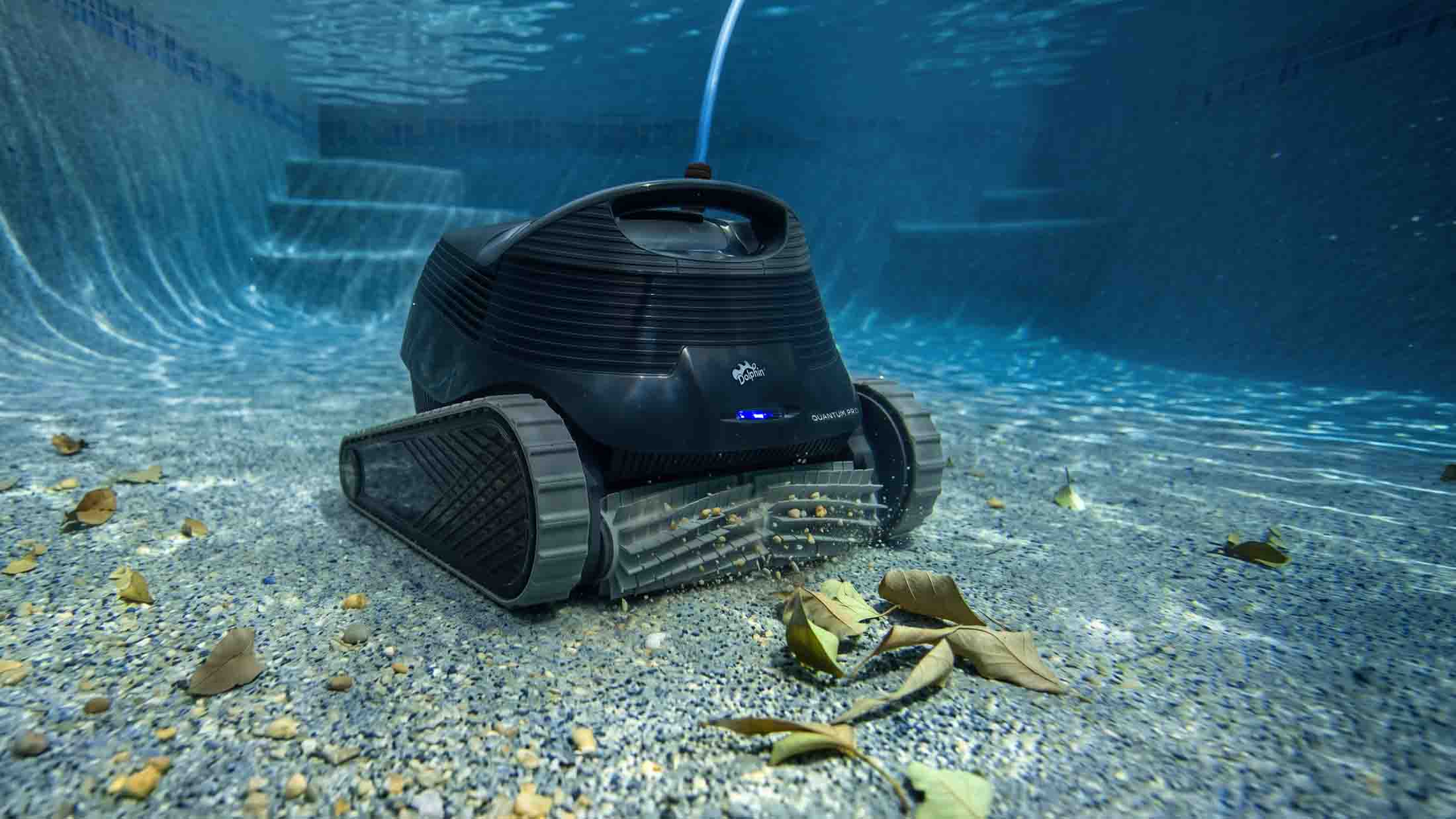
By steps, ledges and tricky features
The best robotic pool cleaner for deep pools with an 8 ft or deeper diving end.
Top pick: Dolphin Quantum
Live prices · Ships free · 30 Day Trial
Depth changes three things for a robot: how much cable it uses, how much wall it climbs and how far you lift it. Here is how four Dolphins handle each.
The quick answer
The Dolphin Quantum is our pick for deep pools: a 55 ft swivel cable to cover the drop, HyperGrip tracks for tall walls, waterline scrubbing and a 50 ft rating at the lowest price of the three full-size robots here. Choose the Dolphin Premier if you want its 3-hour cycle and longer warranty for a big diving pool. The Dolphin Cayman fits deep pools of 33 ft or less.
A deep pool, for this guide, has 8 ft or more of water at its deepest point: the classic diving pool, the old hopper bottom, the sport pool dug deep at one end. The Dolphins on this page are built for residential in-ground pools, standard diving depths included. The useful question is which one, because the best robotic pool cleaner for deep pools has to deal with things a shallow pool never asks about.
The cable runs down as well as across, so depth eats reach. The walls are taller, so there is more to climb and scrub. And the robot has to come back up. We rank the Quantum first, with the Premier and the Dolphin Sigma behind it for owners who want longer cycles. One thing you will not find here is a maximum depth figure. We do not have one for these robots, so we point you to the manual.
The picks, ranked
Four robots for 8 ft of water and more.
$1999$1599Save $400 off the list price
Temporarily out of stock
Pick 1: Best all-round robot for a diving pool
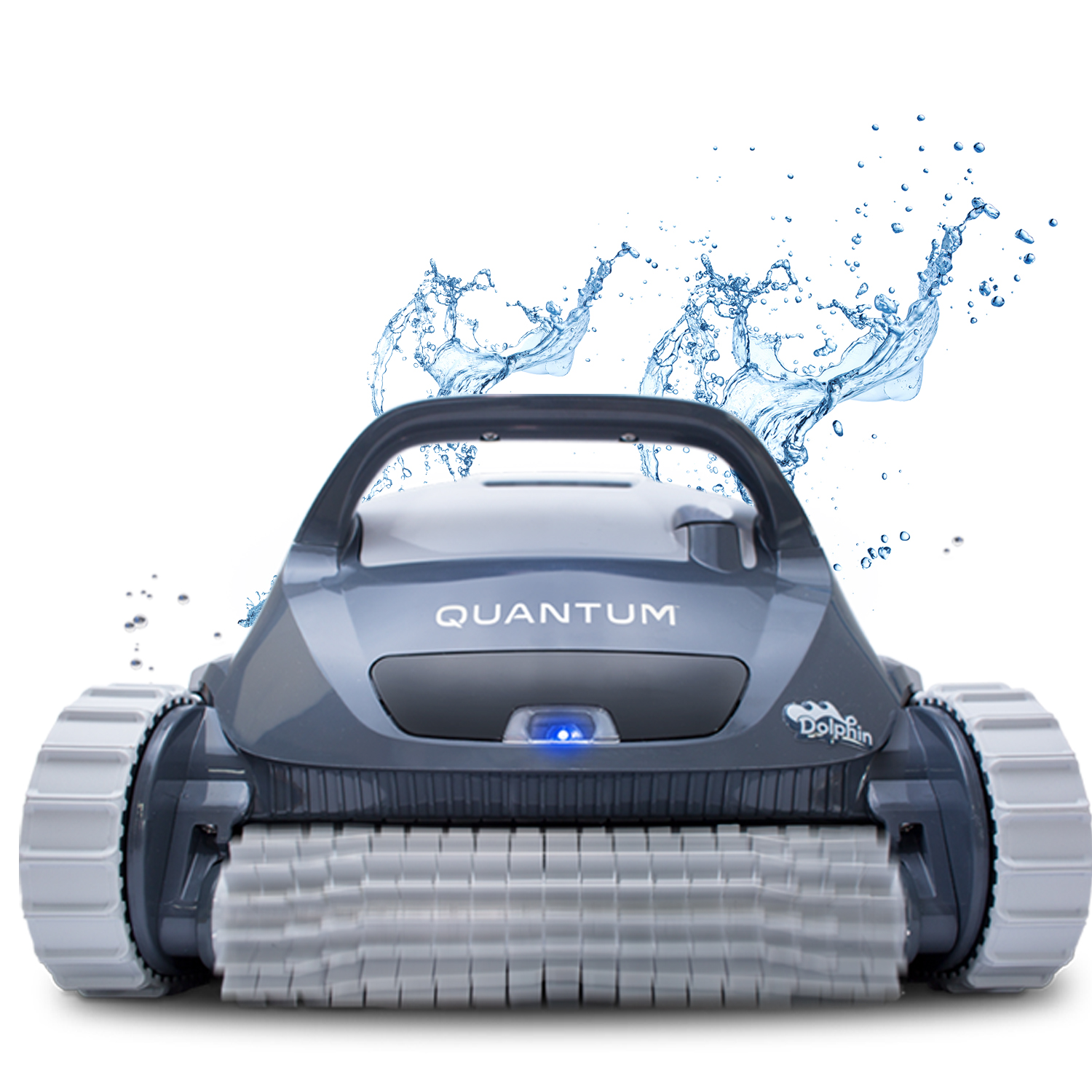
Dolphin Quantum
Depth asks for reach, grip and a full clean from floor to tile, and the Quantum has each at a lower price than the two robots ranked below it. Its 55 ft cable has an anti-tangle swivel, which helps keep the extra length a deep end pulls out from twisting. HyperGrip continuous rubber tracks carry its 18.3 lb up tall walls, and the dual HyperBrush scrubs all the way to the waterline. The XXL MaxBin, with over 400 square inches of filter area, takes what collects at the bottom, with NanoFilter panels included for silt.
- Best for
- In-ground diving pools up to 50 ft whose owners want the whole depth cleaned on a schedule.
- The trade-off
- Its 2-hour cycle is the shortest of the three 50 ft picks, and its warranty is 2 years.
$2499$1949Save $550 off the list price
Temporarily out of stock
Pick 2: Longest cycle for big, deep water
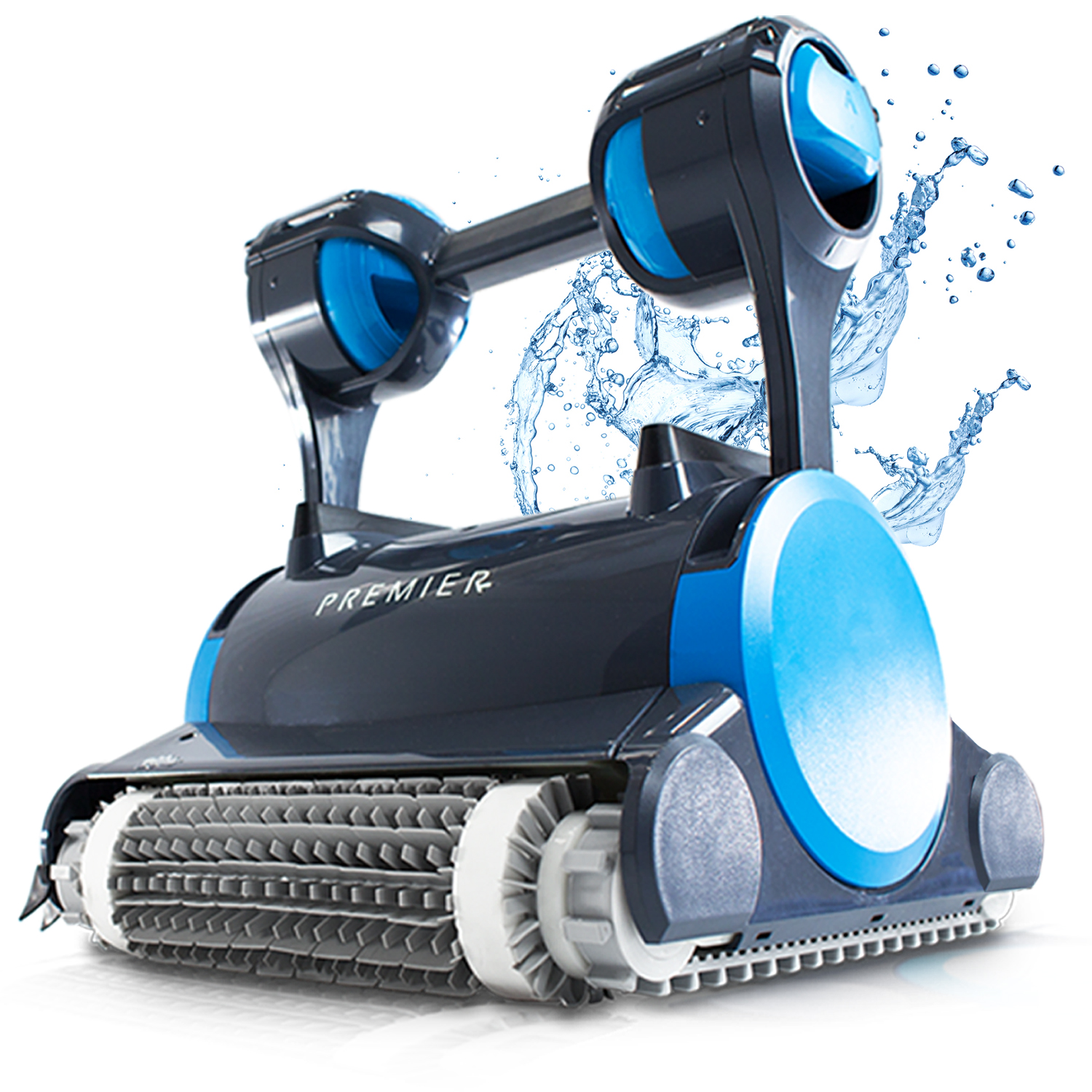
Dolphin Premier
More depth means more surface: taller walls around the deep end and a long slope between the two floors. The Premier answers with time and flow. Its cycle runs 3 hours, the longest of these four, and dual commercial-grade ProLine motors move 4,500 GPH. The 55 ft cable has a 360-degree anti-tangle swivel. For what gathers at the bottom, the Multi-Media system gives you an oversized leaf bag, NanoFilters and standard fine filters, all included. The warranty is 3 years.
- Best for
- Large diving pools near trees, and owners who want the longest cycle and warranty.
- The trade-off
- No app: scheduling is the weekly timer on the power supply. It costs more than the Quantum, so check the live price on each card.
$2999$2349Save $650 off the list price
Temporarily out of stock
Pick 3: Gyroscope navigation across slope and depth
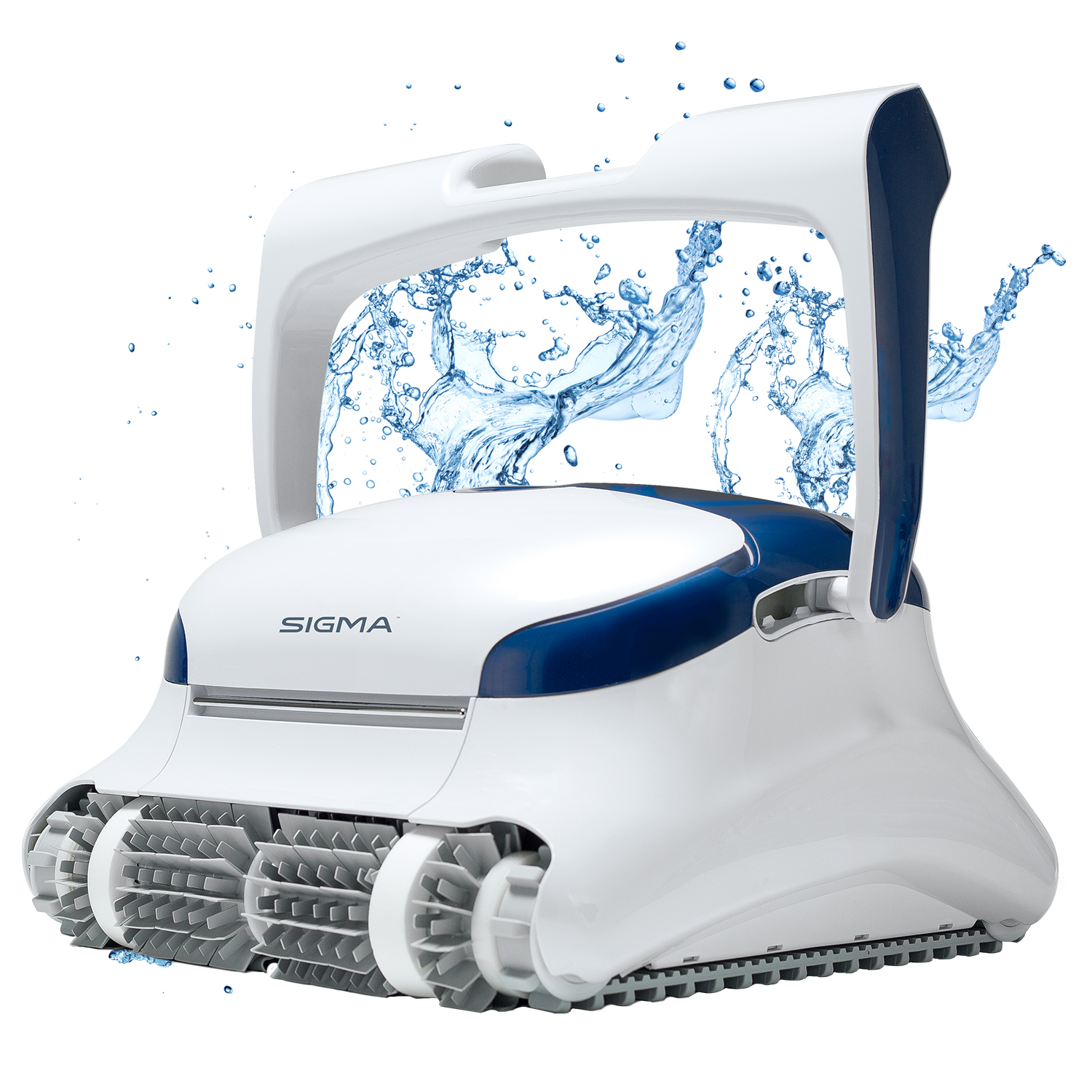
Dolphin Sigma
A deep pool is never only deep. It has a slope, a break and a change of wall height, and the Sigma is the pick that senses its own tilt as it crosses them. SmartNav 3.0 uses an onboard gyroscope to hold a heading on the incline, three ProLine motors move 4,500 GPH, and four scrubbing brushes work floor, walls and waterline over a 2.5-hour cycle. The cable is 55 ft with a 360-degree swivel, and the myDolphin Plus app sets schedules by day and time.
- Best for
- Deep pools with a complicated floor, and owners who like to run everything from a phone.
- The trade-off
- It is the highest-priced pick here and, at 24.6 lb, the heaviest to bring up from the deep end.
$1299$1049Save $250 off the list price
Temporarily out of stock
Pick 4: Deep pools of 33 ft or less
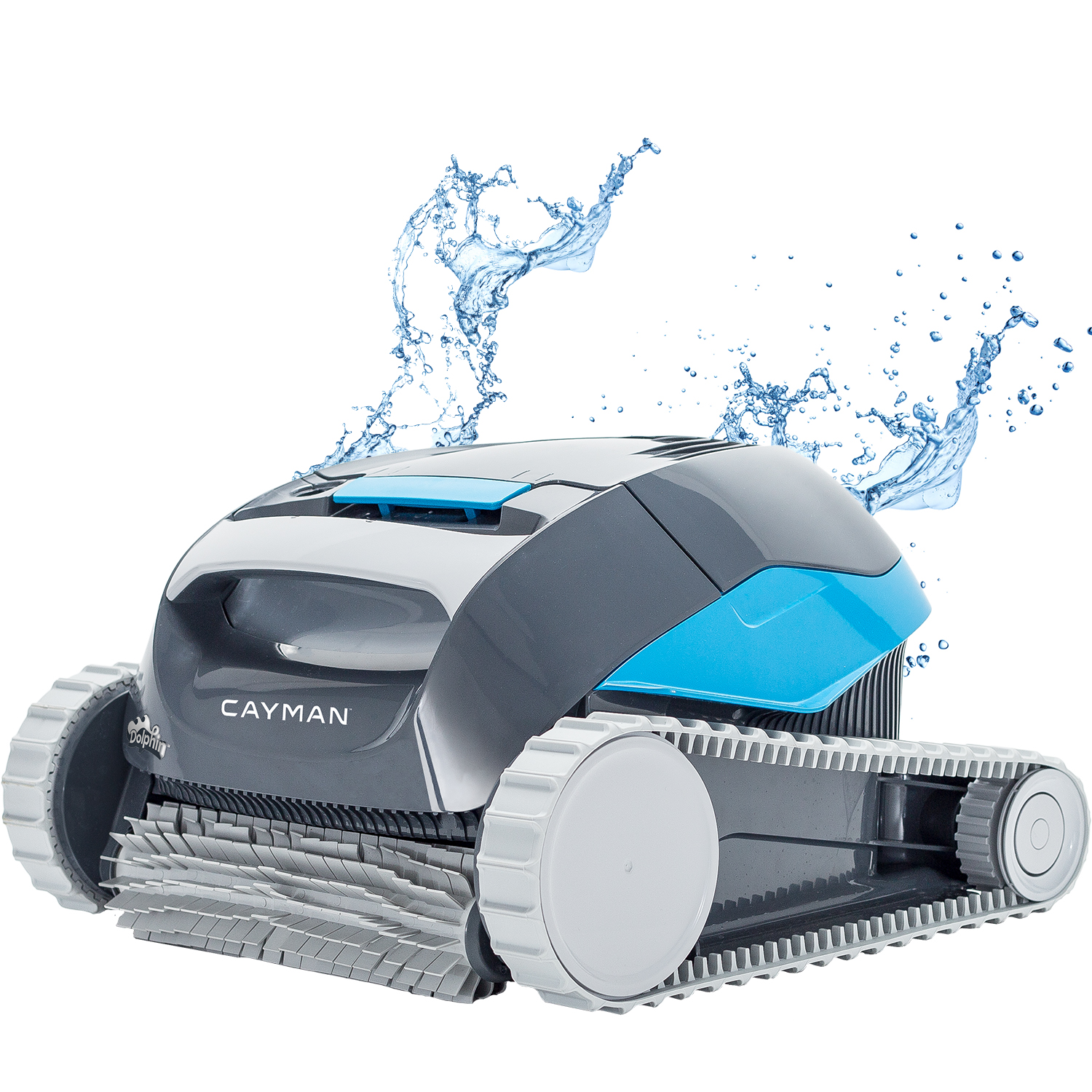
Dolphin Cayman
Plenty of older diving pools are short: 30 or 32 ft long with a deep hopper at one end. The Cayman is rated for pools up to 33 ft, its 50 ft cable leaves room for the drop in a pool that size, and HyperGrip tracks with a HyperBrush handle the deep-end walls in a 2-hour cycle. Raising it from the bottom is easier too: at 14.6 lb, no pick here weighs less. Go past 33 ft of pool length and it is the wrong choice, however deep the water.
- Best for
- Compact diving pools up to 33 ft where floor and walls are the job.
- The trade-off
- It does not clean the waterline, its cable has no swivel, and its timer runs every day only. Not for pools longer than 33 ft.


Side by side
Deep-pool specs compared.
| Specification | Dolphin Quantum | Dolphin Premier | Dolphin Sigma | Dolphin Cayman |
|---|---|---|---|---|
| Price today | $1599 | $1949 | $2349 | $1049 |
| Cleans | Floor, walls, waterline, sun shelves and stairs | Floor, walls and waterline | Floor, walls and waterline | Floor and walls |
| Traction | HyperGrip tracks | HyperGrip tracks | HyperGrip tracks | HyperGrip tracks |
| Navigation | SmartNav 2.0 | SmartNav 2.0 | SmartNav 3.0 with gyroscope | SmartNav 2.0 |
| Cable | 55 ft with anti-tangle swivel | 55 ft with 360° anti-tangle swivel | 55 ft with 360° anti-tangle swivel | 50 ft |
| Robot weight | 18.3 lb | 20.3 lb | 24.6 lb | 14.6 lb |
| Warranty | 2 years | 3 years | 3 years | 2 years |
What to look for
What depth changes for a robot.
-
Cable reach, in three directions
On a flat pool you measure across the water. On a deep one, add the drop. A robot on the floor of a 9 ft deep end has used roughly 9 ft of cable before any of it runs across the surface.
-
Wall height
Deep-end walls can be twice the height of shallow-end walls, so each climb takes longer. Track grip matters more than in a flat play pool, and so does cycle length. All four picks run on HyperGrip tracks, with cycles from 2 to 3 hours.
-
A floor you cannot reach with a pole
The deep floor is the hardest part of a pool to brush or vacuum by hand, because the pole has to work 8 or 9 ft down at an angle. It is where a robot saves the most effort, provided its cable lets it get there on every cycle.
-
Bringing it back up
A robot that finishes in the deep end comes up through 8 ft or more of water. Weight counts: 14.6 lb for the Cayman, 18.3 lb for the Quantum, 20.3 lb for the Premier, 24.6 lb for the Sigma.
Add the depth to your cable sum.
Cable reach is a separate check from the pool length rating, and in a deep pool it has three parts. First, the setback: the power supply sits back from the water's edge by the distance in your manual. Roughly 12 ft is a typical example, not a published figure, so use your own. Second, the run across the water from that point to the farthest corner. Third, the depth at that corner.
Take a 16 x 36 ft pool with a 9 ft deep end and the power supply at the middle of a long side. The far corner is about 24 ft away across the water. Add 9 ft of depth and a 12 ft setback and the total is about 45 ft. That is inside a 55 ft cable and inside the Cayman's 50 ft. It is over the Escape's 40 ft, which is why the Escape is not ranked for deep pools.
Tall walls take time.
The deep end of a diving pool can have walls of 8 or 9 ft, against 3 or 4 ft at the shallow end. A robot climbs them the same way, on tracks with its brushes turning, but each trip up and down takes longer. If the deep-end walls still show a film after a cycle, the fix is more cleaning time, not more power: schedule cycles closer together.
Robots on a schedule are made to stay in the water between cycles. Lift yours out at least weekly to empty and rinse the filter, and always before you shock the pool.
What we will not give you: a maximum depth.
We do not have a published maximum for the Dolphins on this page, so we do not state one. What we can say is that they are built for residential in-ground pools, and standard diving depths are part of that. If your pool is deeper than a typical residential diving end, check the depth figure in the manual of the robot you are considering, or ask a Dolphin Expert before you order. More motors or a longer cable are not a depth rating.
Running a robot in a deep pool.
- Feed enough cable into the water for the robot to reach the deepest corner. Too little pulls it up short of the bottom.
- To retrieve it, draw the cable in gently until the robot nears the surface, then lift by the handle and let it drain. Never haul it out by the cable.
- After the first few cycles, look at the deep floor in good light. If one strip is always missed, move the power supply a few feet along the deck.
Questions, answered
Deep pool questions.
How deep can a Dolphin robotic cleaner go?
No maximum depth is published for the Dolphins in this guide, so we will not quote one. They are built for residential in-ground pools, which includes standard diving depths of 8 ft and more. For an unusually deep pool, the manual for the specific model is the place to confirm the figure before you buy.
Does an 8 or 9 ft deep end need a longer cable?
It needs more of the cable you have. Depth is added to the distance across the water and to the setback of the power supply. The three full-size picks have 55 ft cables and the Cayman has 50 ft, which left a margin in the worked example on this page.
Will a robot climb a 9 ft wall all the way to the top?
Wall height is not listed as a limit for any of the four picks, and all of them climb on HyperGrip tracks. The Quantum, Premier and Sigma clean up to and including the waterline. The Cayman cleans the wall but not the waterline.
Is the best robotic pool cleaner for deep pools different from one for a flat-bottom pool?
It is the same kind of machine, but the priorities shift. In a flat pool you can choose mostly on length and price. In a deep pool, cable length, a swivel, track grip and cycle time carry more weight, and a 40 ft cable is harder to live with. That is why the full-size Dolphins lead here.
The bottom line
Choosing for a deep pool.
Work out the cable sum first, because a robot that cannot reach the deepest corner is the wrong robot at any price. For a deep pool that stops at 33 ft, the Cayman will do it. Above that, the Quantum gives the best balance of reach, coverage and cost. The Sigma adds gyroscope navigation. The Premier adds a longer cycle and a 3-year warranty. Our Price Match Guarantee applies to all four.
More buying guides
