



By debris and dirt problem
The best robotic pool cleaner for large debris has a wide path and a big basket.
Top pick: Dolphin Quantum
Live prices · Ships free · 30 Day Trial
Big debris asks two questions of a robot: will it fit through the intake, and is there somewhere roomy for it to go once it is inside.
The quick answer
Choose the Dolphin Quantum: its XXL MaxBin basket is the largest in this guide, takes whole leaves, pods and small twigs on standard panels, and opens from the top so you can see and dump what it caught. The Dolphin Premier is the other strong choice, with an oversized leaf bag in its Multi-Media set. Branches, palm fronds and stones still come out by hand.
Large debris is the stuff you can pick up with your fingers: whole leaves, seed pods, blossoms, mulch chips, small sticks, the odd hair tie or dive toy. A robot deals with it very differently from dust. Dust needs a fine filter. Big pieces need a wide way in and a roomy, open place to land, and a fine filter only gets in their way.
So the best robotic pool cleaner for large debris is ranked here on intake and basket, not on filtration fineness. The Quantum and the Premier share the lead on capacity, and on this site the Quantum goes first. The Dolphin Cayman brings a MaxBin basket to smaller pools, and the Dolphin Sigma, for all its power, is held back by cartridges that prefer fine material.
The picks, ranked
Four picks for large debris, in order.

$1999$1599Save $400 off the list price
Temporarily out of stock
Pick 1: Largest basket here, open from the top
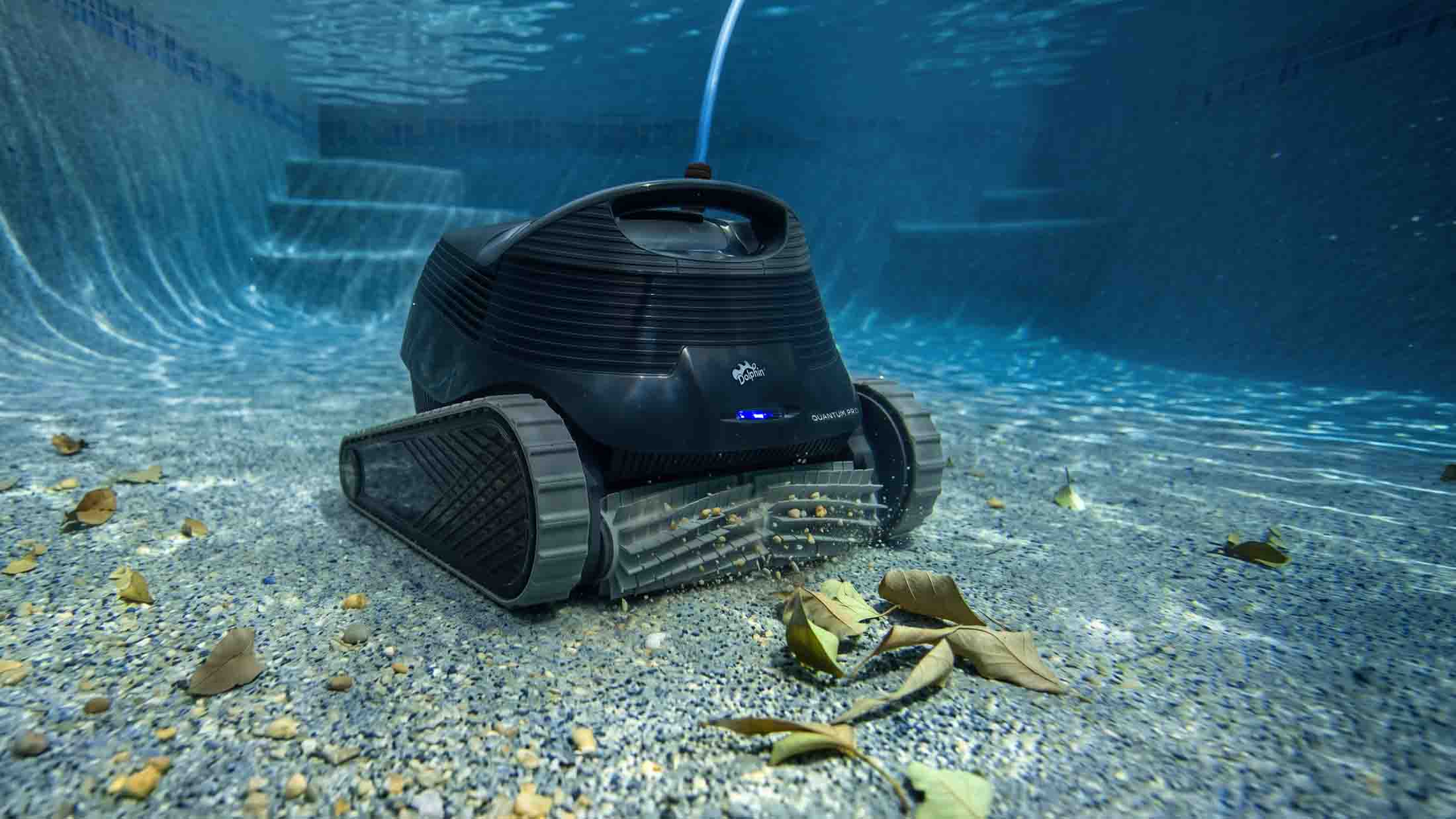
Dolphin Quantum
The Quantum's XXL MaxBin is the largest basket of the robots in this guide, and its filter area is over 400 square inches. With its standard panels fitted it is an open space that whole leaves, seed pods and small twigs drop into without packing the filter, carried in by dual commercial-grade motors moving 4,000 gallons an hour.
The lid opens with one click from the top, so you see exactly what was collected and can tip it out in one motion. A full set of NanoFilter panels is included for the crumbs afterward, and the weekly timer runs it as often as every day.
- Best for
- Pools up to 50 ft that collect pods, blossoms, mulch and whole leaves through most of the year.
- The trade-off
- It does not include a leaf bag, and like any robot it cannot swallow pieces larger than its intake.

$2499$1949Save $550 off the list price
Temporarily out of stock
Pick 2: Leaf bag and bag options for messy loads
Dolphin Premier
The Premier matches the Quantum on capacity by a different route. Its Multi-Media system includes an oversized leaf bag for bulk, standard fine filters and NanoFilters, and disposable debris bags are an optional fourth choice for loads you would rather throw away than rinse, such as mulch and rotting blossoms. Everything swaps through the top with no tools. Dual ProLine motors move 4,500 gallons an hour, and a full-filter indicator on the power supply shows when to empty. The warranty is 3 years. It is second here because it costs more than the Quantum for a similar result on ordinary large debris.
- Best for
- Owners who want a bag for bulk, the choice of disposable bags, and longer warranty cover.
- The trade-off
- Higher price and a 3-hour cycle, with controls on the power supply only. The same intake limit applies.
$1299$1049Save $250 off the list price
Temporarily out of stock
Pick 3: Open MaxBin basket for smaller pools
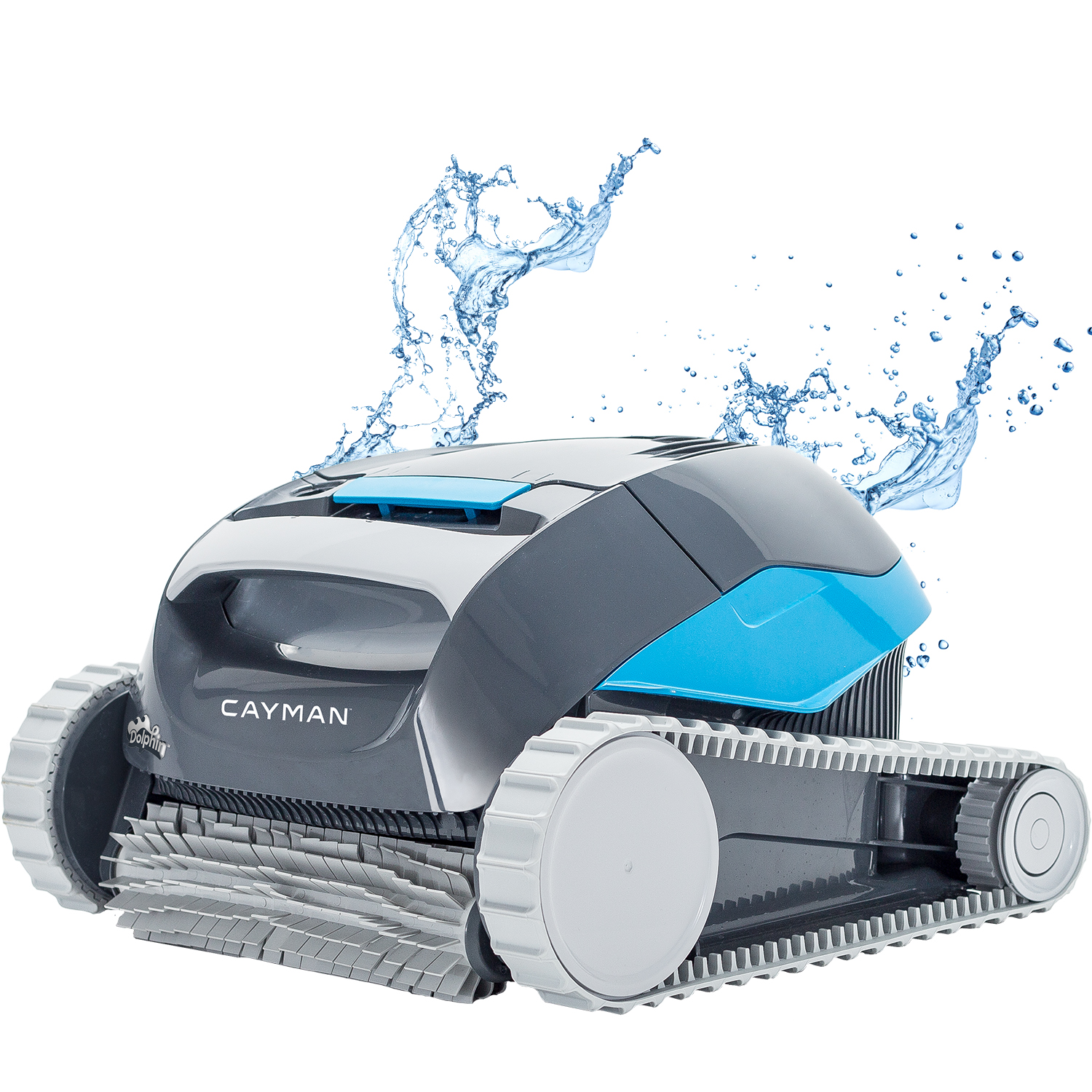
Dolphin Cayman
The Cayman ranks third, ahead of the Sigma, for one reason: it collects into an open basket. Its MaxBin is 50% larger than standard Dolphin filters, takes ordinary large debris, and empties through a top hatch with one tab. For a pool of 33 ft or less that sees leaves, pods and garden debris, that is the right design at a lower price. Dual 24-volt DC motors move over 4,000 gallons an hour, and the timer runs a 2-hour cycle every day. It cleans floor and walls.
- Best for
- Pools of 33 ft and under with trees, shrubs or flower beds close to the water.
- The trade-off
- Smaller basket than the Quantum's XXL version, no swivel on its cable, and it is rated only to 33 ft.

$2999$2349Save $650 off the list price
Temporarily out of stock
Pick 4: Strong cleaner, held back by cartridges
Dolphin Sigma
The Sigma has more motors and brushes than any other pick here: three ProLine motors at 4,500 gallons an hour and four scrubbing brushes. On large debris it is limited by where the debris goes. It filters through cartridges, which favor fine material over bulk, so a load of pods or whole leaves fills them sooner than it would fill a basket or a bag.
It is the right pick only if large debris is occasional in your pool and fine cleaning is the daily job. The warranty is 3 years.
- Best for
- Pools where big debris is an occasional visitor and fine dirt is the everyday problem.
- The trade-off
- Cartridges fill soonest with bulky loads, and it is the highest-priced and heaviest pick on this page.


Side by side
Baskets, bags and cartridges compared.
| Specification | Dolphin Quantum | Dolphin Premier | Dolphin Cayman | Dolphin Sigma |
|---|---|---|---|---|
| Price today | $1599 | $1949 | $1049 | $2349 |
| Filtration | XXL MaxBin basket with standard and NanoFilter panels | Multi-Media: NanoFilters, oversized leaf bag and standard fine filters | MaxBin basket with fine panels; NanoFilter panels optional | NanoFilters and standard filter cartridges |
| Filter access | Top-load, one-click open | Top-load, no tools | Top hatch, one-tab emptying | Cartridges |
| Brushes | Dual HyperBrush | Dual scrubbing brushes | HyperBrush | Quad scrubbing brushes |
| Flow rate | 4,000 GPH | 4,500 GPH | Over 4,000 GPH | 4,500 GPH |
| Cycle time | 2 hours | 3 hours | 2 hours | 2.5 hours |
| Cleans | Floor, walls, waterline, sun shelves and stairs | Floor, walls and waterline | Floor and walls | Floor, walls and waterline |
| Scheduling | Weekly timer: every day, every 2 days or every 3 days | Weekly timer: every day, every 2 days or every 3 days | Timer: every day | Weekly scheduler by day and time |
| Warranty | 2 years | 3 years | 2 years | 3 years |
What to look for
How to judge a robot on big debris.
-
The way in.
Debris has to pass under the robot and through its intake before anything else happens. Pieces that fit are collected. Pieces longer or wider than the opening get pushed along the floor or wedge across it.
-
Somewhere open to land.
A big, open basket or bag swallows bulky pieces without packing tight. Cartridges and ultra-fine media have less open volume, so a handful of pods can blanket them and cut the flow.
-
Seeing what it caught.
Large debris includes things you want back and things that should not go around again. A basket that opens from the top lets you look in, pick out the toy or the stone, and tip out the rest.
-
Standard media for bulk, fine media after.
Coarse loads call for standard panels. Once the big pieces are out, the crumbs they leave, bits of bark, petals and leaf fragments, call for fine or ultra-fine media. A robot with both in the box covers each stage.
The fit test: what goes in, what blocks, what harms.
Before a cycle, walk the pool edge and sort what you see into three groups. The middle group is the one that gets missed, because a robot will run with a stick wedged underneath and simply clean less.
- Goes in: whole leaves, petals and blossoms, seed pods, mulch chips, short twigs and sand.
- Blocks: long sticks, strips of bark and palm fronds. They bridge the intake, stop collection and can ride under the robot for a whole cycle. Net them out.
- Harms: stones, screws, coins, hard toys and anything stringy such as hair ties or fishing line. Hard objects can jam an impeller, and stringy ones wrap around brushes and tracks.
Where big debris comes from, and how to cut it down.
Most large debris has an address. Mulch washes or blows in from beds that sit above the coping; edging the bed, or switching the strip nearest the pool to stone, keeps it out. Flowering trees and shrubs drop blossoms for a few weeks, then pods for a few more. Storms bring the sticks.
You cannot stop all of it, but two habits help. Clear the deck before the wind does, since what is on the deck today is in the pool tomorrow. And run the robot daily in drop weeks, because pods and blossoms that sit turn soft and break into pieces too small for standard panels.
If something gets stuck.
Sooner or later a robot swallows something it should not. The signs are a robot that stops moving, moves but collects nothing, or makes a new rattling sound. Stop the cycle, unplug the power supply, and lift the robot out before you look.
Open the top and empty the basket. Check the intake underneath and turn the brushes by hand to feel for anything wound around them. If a hard object has reached the impeller, follow the manual's steps for clearing it, and do not run the robot until it is out. If you are unsure, talk to us before forcing anything.
Before you press start.
- Fit the standard panels, not the NanoFilters, whenever you can see pods, whole leaves or mulch on the floor.
- Net out anything longer than your hand. A quick pass with a leaf rake prevents most wedged sticks.
- Collect dive toys, goggles and hair ties after every swim, so they are not on the floor when the timer starts the next cycle.
- Empty the basket while the debris is still wet. Dried pods and petals stick to the panels and take longer to rinse off.
Questions, answered
Large debris: questions before you buy.
Can a robotic pool cleaner pick up sticks and twigs?
Short twigs, yes: they pass through the intake and land in the basket. Long sticks are the problem. Anything longer than the intake is wide tends to bridge it, so the robot drags it around instead of collecting it. Net those out first.
Will small stones or gravel damage a pool robot?
They can. Sand and fine grit are collected without trouble, but a stone or other hard object that reaches the impeller can jam it. Pick out anything hard that you can see before a cycle, and if the robot starts rattling, stop it and check before running it again.
Can the best robotic pool cleaner for large debris also filter fine dust?
Yes, if it comes with both kinds of media. The Quantum includes standard panels and a full set of NanoFilter panels, and the Premier includes a leaf bag, fine filters and NanoFilters. Use the coarse option while big pieces are present and swap to ultra-fine once they are gone.
What should I do if the robot picks up a toy or a hair tie?
Stop the cycle and unplug the power supply. Lift the robot out, open the top and empty the basket; most toys end up there. Hair ties and string tend to wind around a brush or track instead, so turn those by hand and unwrap anything you find before restarting.
Does mulch from flower beds hurt the robot?
No. Mulch chips are light and collect in the basket like leaves. The nuisance is what mulch does afterward: it sheds fine bark dust. Collect the chips on standard panels, then run a cycle with fine or NanoFilter media for the dust.
The bottom line
The decision rule for big debris.
Pick the robot with the roomiest, most open place for debris to land, and one you can look into. That is the Quantum for most pools up to 50 ft, or the Premier if you want a leaf bag, disposable bags and a longer warranty. For 33 ft and under, the Cayman's MaxBin does the job. Choose the Sigma only if big debris is rare. Then do your part: net the long pieces and pick out the hard ones.
More buying guides
