



By feature
The best robotic pool cleaner with dual brushes, and what the second brush does.
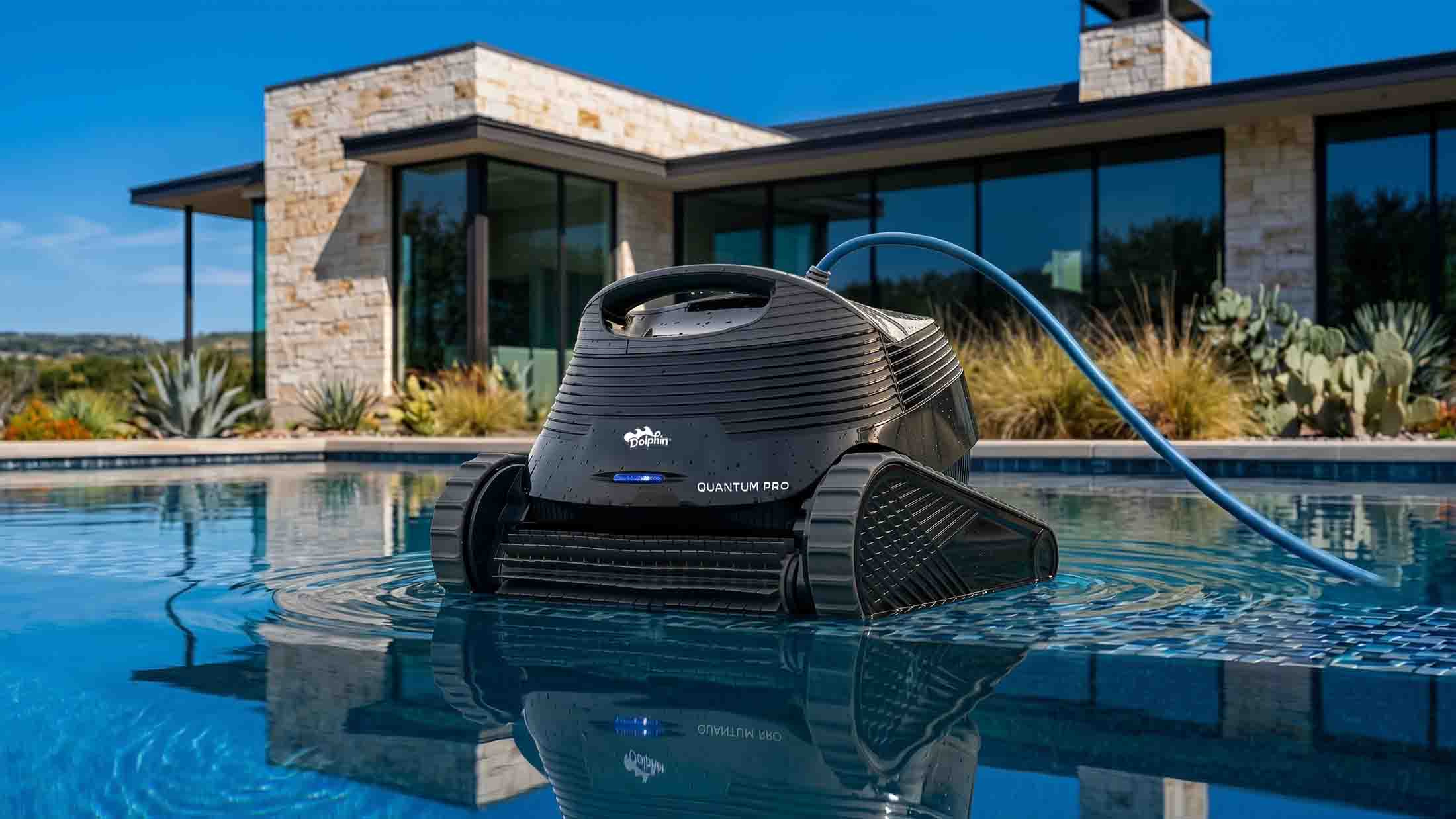
Top pick: Dolphin Quantum
Live prices · Ships free · 30 Day Trial
Three in-ground Dolphins with more than one brush, ranked for scrubbing, plus an honest word on the two single-brush models that are not on this list.
The quick answer
Pick the Dolphin Quantum. Its dual HyperBrush puts a brush at each end, both spinning at twice the speed of standard brushes, on the lowest-priced 50 ft robot here. Step up to the Sigma if you want the most brush contact of all: it has quad scrubbing brushes and a gyroscope. The Premier pairs dual scrubbing brushes with a 3 hour cycle and a leaf bag.
A robot's pump can only collect what is loose. The film that makes a wall feel slippery, the gray line at the water's edge, the dirt pressed into plaster: none of it moves until something scrubs it. That is the brushes' job, and it is why shoppers ask for the best robotic pool cleaner with dual brushes instead of settling for one.
Two brushes mean the robot scrubs with the leading brush and again with the trailing one, and keeps more brush against a wall while it climbs. Three of the five Dolphins compared at QuantumRobotic.com have at least two. The Cayman and Escape have a single HyperBrush each, so they are left off this page, and we explain that choice further down.
The picks, ranked
Three dual-brush picks, in order.

$1999$1599Save $400 off the list price
Temporarily out of stock
Pick 1: Two fast brushes: dual HyperBrush
Dolphin Quantum
The Quantum has a HyperBrush at each end, and both spin at twice the speed of standard brushes. On this page that is the strongest mix of count and speed: every strip gets two scrubs per pass, and each scrub is a wipe, not a roll. The brushes go everywhere the robot does, which on the Quantum includes the waterline, sun shelves, Baja ledges and stairs.
What the brushes lift goes into the XXL MaxBin, and a full set of NanoFilter panels is included for the fine cloud that scrubbing creates. All of that comes at a lower price than the other two picks.
- Best for
- In-ground pools up to 50 ft where film on walls, ledges and the waterline is the main complaint.
- The trade-off
- Two brushes, not four, and a 2 year warranty. The Sigma and the Premier are each covered a year longer.

$2999$2349Save $650 off the list price
Temporarily out of stock
Pick 2: Most brush contact: quad scrubbing brushes
Dolphin Sigma
If two brushes are good, the Sigma's answer is four. Its quad scrubbing brushes put more brush on the surface at any moment than either other pick, and three commercial-grade ProLine motors move 4,500 GPH to carry away what they loosen. NanoFilters, described as filtering down to 2 microns, are included.
The gyroscope in SmartNav 3.0 matters here too, because brushes only clean where the robot goes. The Sigma is second for two reasons: its brushes are described as scrubbing brushes, without the HyperBrush's doubled speed, and it is the highest-priced robot on the page.
- Best for
- Freeform or heavily used pools whose owner wants the most scrubbing and will pay for it.
- The trade-off
- Highest price here and the heaviest robot to lift, at 24.6 lb. Its filters are cartridges, with more pieces to rinse.

$2499$1949Save $550 off the list price
Temporarily out of stock
Pick 3: Dual scrubbing brushes with the longest cycle
Dolphin Premier
The Premier's dual scrubbing brushes turn at standard speed. What it brings in place of speed is time: a 3 hour cycle, the longest of the three, so each wall sees more passes before the robot stops. Flow is 4,500 GPH from dual ProLine motors.
It suits the pool that is leafy as well as filmy. The Multi-Media set includes an oversized leaf bag for bulk and NanoFilters for the fines that brushing raises, and you swap between them in seconds. The warranty runs 3 years.
- Best for
- Pools under trees that also need steady scrubbing, and owners who value a longer warranty.
- The trade-off
- No app, and its brushes are not the double-speed HyperBrush type. It costs more than the Quantum, so check the live price on the card.


Side by side
Brushes, flow and coverage compared.
| Specification | Dolphin Quantum | Dolphin Sigma | Dolphin Premier |
|---|---|---|---|
| Price today | $1599 | $2349 | $1949 |
| Cleans | Floor, walls, waterline, sun shelves and stairs | Floor, walls and waterline | Floor, walls and waterline |
| Scheduling | Weekly timer: every day, every 2 days or every 3 days | Weekly scheduler by day and time | Weekly timer: every day, every 2 days or every 3 days |
| App | myDolphin Plus (Wi-Fi) | myDolphin Plus (Wi-Fi and Bluetooth) | No app; controls on the power supply |
| Filtration | XXL MaxBin basket with standard and NanoFilter panels | NanoFilters and standard filter cartridges | Multi-Media: NanoFilters, oversized leaf bag and standard fine filters |
| Brushes | Dual HyperBrush | Quad scrubbing brushes | Dual scrubbing brushes |
| Navigation | SmartNav 2.0 | SmartNav 3.0 with gyroscope | SmartNav 2.0 |
| Cable | 55 ft with anti-tangle swivel | 55 ft with 360° anti-tangle swivel | 55 ft with 360° anti-tangle swivel |
| Warranty | 2 years | 3 years | 3 years |
What to look for
What to look at beyond the brush count.
-
A brush at the front and the back
With a brush at each end, a strip of floor is scrubbed twice per pass: once by the leading brush and once by the trailing one. When the robot reverses, the order swaps. A single-brush robot scrubs each strip once.
-
How fast the brush turns
A brush that turns at the pace of the tracks mostly rolls over the surface. One that is driven faster wipes across it. Dolphin's HyperBrush spins at twice the speed of standard brushes, and the Quantum carries two of them.
-
Where the robot takes its brushes
Film builds where sunscreen and body oils collect, which is the waterline, and wherever circulation is weak. Check that a robot climbs the walls and cleans the waterline. Brushes that never get there do nothing for the line you can see from the patio.
-
What catches the loosened dirt
Scrubbing turns stuck film into a cloud of fine particles. If the filter is too coarse, the cloud drifts off and settles again. Ultra-fine media such as NanoFilters is what turns brushing into removal, so check whether it is included.
What a brush does that suction cannot.
Water flowing into a robot will carry off a leaf or a pinch of sand. It will not peel away anything that is attached. Three things in a pool are attached: early algae film, which is a slick feel before it is a color; biofilm, the thin slime that forms on any wet surface; and dirt worked into the texture of plaster or pebble.
A brush breaks that bond mechanically. Once the material floats free, the robot's flow pulls it in and the filter holds it. Two brushes do this twice per pass, which counts most on walls, where a robot spends less time than on the floor.
There are limits. A robot does not replace sanitizer, and during an algae treatment you still brush by hand, especially steps, corners and behind ladders. The robot's part is keeping film from getting established and collecting the residue afterward.
Why the Cayman and Escape are not on this list.
Both are good robots with one HyperBrush each. That brush spins at twice the speed of standard Dolphin brushes, so it scrubs properly; there is just one of it. A page about dual brushes cannot honestly list them.
They are still the right purchase for many smaller pools. Each is rated for pools up to 33 ft and cleans the floor and walls. If your pool is above-ground, or under 33 ft with light film, a single fast brush, run often, is a fair trade for the lower price. If you came here because slick walls are your problem, stay with the three picks.
Brushes are wear parts. Check them.
Brushes lose their edge slowly, and a worn brush cleans like a slower one. Rough finishes such as pebble and older plaster wear them faster than vinyl or fiberglass. All three picks list gunite, plaster, pebble, tile, vinyl liner and fiberglass among their published surfaces, so the finish is not a reason to choose between them.
- Look at the brushes when you rinse the filter. Flattened or smooth patches mean less bite on the film.
- Pull off hair, string and palm fiber wound around the brush ends, where it slows the brush.
- Replacement brushes are a normal service part. Ask us before the season starts if yours look tired.
Small habits that help the brushes do their work.
- Run the robot on a schedule instead of waiting for visible film. On the Quantum, the timer's every 2 days setting keeps brushing ahead of buildup.
- Brush the top steps, corners and behind the ladder by hand before a cycle, so the robot collects what you loosen.
- Fit the NanoFilter panels for the first cycle after any hand brushing or algae treatment, then rinse them straight away.
- Keep sanitizer in range. Brushes remove film; they do not stop it growing back in under-treated water.
Questions, answered
Dual-brush questions, answered.
Are two brushes really better than one on a pool robot?
For walls and film, yes. A robotic pool cleaner with dual brushes scrubs each strip with a leading and a trailing brush, so the surface gets two contacts per pass where a single-brush robot gives one. On a floor with loose debris only, the difference is small. On slick walls it shows.
What is the difference between a HyperBrush and a standard scrubbing brush?
Speed. Dolphin describes the HyperBrush as spinning at twice the speed of standard brushes, so it wipes across the surface instead of rolling along with the robot. The Quantum has two. The Sigma and Premier use scrubbing brushes, four and two of them, which add contact without the doubled speed.
Will dual brushes remove algae from my pool walls?
They will scrub off light film and help keep it from settling, and with ultra-fine filters fitted they collect dead algae after a treatment. They will not clear a bloom by themselves. That takes sanitizer, hand brushing of the spots a robot does not reach, and filtration. Treat the water first, then let the robot clean up.
Do robot brushes wear out a vinyl liner?
Vinyl liner is on the published surface list for all three picks, so they are made to run on it. What harms a liner is usually a sharp object or grit dragged across it, or water chemistry out of range, not a brush in normal use. Keep stones out of the pool and check the brushes for anything embedded.
Does the Sigma count as a dual-brush robot when it has four?
It goes past the requirement. Anyone searching for dual brushes wants more scrubbing than one brush gives, and four scrubbing brushes deliver the most contact on this page. We list it second because the Quantum's two brushes spin faster and the Quantum costs less. Compare both live prices before you decide.
The bottom line
How to decide.
Count the brushes, then ask how fast they turn and where the robot takes them. The Quantum gives two double-speed brushes across floor, walls, waterline, shelves and stairs for the least money on this page. Pay more for the Sigma when you want four brushes and gyroscope-guided coverage. Choose the Premier when leaves are as much of a problem as film and a 3 year warranty matters to you. Skip the single-brush robots if walls are why you are shopping.
More buying guides
