



By feature
The best robotic pool cleaner with waterline cleaning.
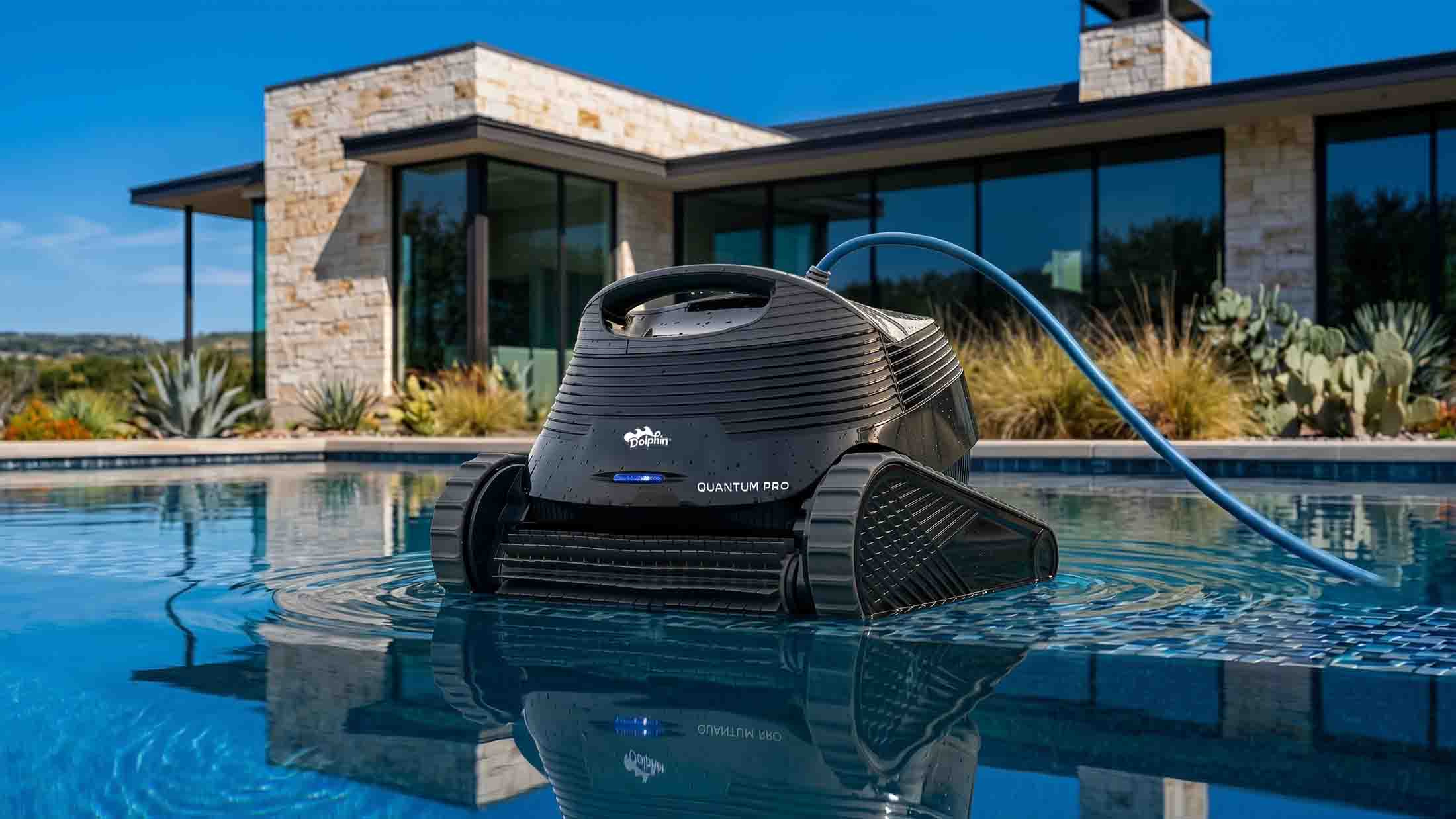
Top pick: Dolphin Quantum
Live prices · Ships free · 30 Day Trial
The band at the top of the wall is the part of the pool everyone sees. Three of the robots here climb up and scrub it; two turn back first.
The quick answer
The Dolphin Quantum is our pick for waterline cleaning: it climbs to the waterline and scrubs along it with a dual HyperBrush, and it is the lowest-priced robot here that does. Pick the Dolphin Premier if a longer 3-hour cycle and a 3-year warranty matter more. The Dolphin Sigma adds quad brushes and gyroscope navigation at the highest price. Any of them lifts film, not hardened calcium.
The waterline is where a pool shows its age first. Sunscreen, body oils and pollen float, the water level drifts up and down a little each day, and whatever floats gets left on the wall as a gray or yellow band. On tile it dulls the grout. On a liner or fiberglass it reads as a bathtub ring.
Not every robot goes there. A robotic pool cleaner with waterline cleaning climbs the wall until it reaches the surface, then scrubs along the line before dropping back down. Of the five Dolphins these guides compare at QuantumRobotic.com, three do that: the Quantum, the Premier and the Sigma. The Cayman and the Escape clean the floor and walls and stop below the waterline, so they are not picks on this page, however well they do the rest.
The picks, ranked
Three robots that scrub the waterline, ranked.

$1999$1599Save $400 off the list price
Temporarily out of stock
Pick 1: Lowest-priced robot here that scrubs the line
Dolphin Quantum
The Quantum cleans floor, walls and waterline, and it is the lowest-priced of the three robots on this page, which is why it leads. It works the film with a dual HyperBrush spinning at twice the speed of standard brushes, on HyperGrip continuous rubber tracks that hold it to the wall. Its coverage also takes in sun shelves, Baja ledges and stairs, the other places a ring forms.
The routine is easy to keep. The weekly timer on the power supply runs a 2-hour cycle every day, every 2 days or every 3 days, and the myDolphin Plus app can start an extra cycle over Wi-Fi after a busy pool day.
- Best for
- In-ground pools up to 50 ft where the tile line or liner border is the part you most want kept clean.
- The trade-off
- A 2 year warranty, where the next two picks carry 3. It has two brushes on the wall; the Sigma has four.

$2499$1949Save $550 off the list price
Temporarily out of stock
Pick 2: Longest cycle, with a 3-year warranty
Dolphin Premier
The Premier matches the first pick's floor, walls and waterline coverage and gives the job more time: its cycle runs 3 hours, the longest of the three. Dual commercial-grade ProLine motors move 4,500 GPH, and dual scrubbing brushes work the line.
Two things justify the higher price. The warranty runs 3 years. And Multi-Media filtration lets you fit the included NanoFilters when the waterline problem is pollen, or the oversized leaf bag in fall. The weekly timer sits on the power supply with three presets, so the wall gets scrubbed on a routine with no phone involved.
- Best for
- Owners who also fight leaves or pollen and want the longer warranty with a simple timer.
- The trade-off
- No app, and at 20.3 lb it is about 2 lb heavier than the first pick. Check the live price on the card.

$2999$2349Save $650 off the list price
Temporarily out of stock
Pick 3: Most brushes on the wall, highest price
Dolphin Sigma
The Sigma puts the most hardware on the wall: quad scrubbing brushes, three commercial-grade ProLine motors moving 4,500 GPH, and SmartNav 3.0 with an onboard gyroscope to keep its passes orderly. For a wide tile band with seasons of film in the grout, more brush contact per pass is a real advantage. Its included NanoFilters are described as filtering down to 2 microns, which suits the pollen that feeds a waterline ring.
It is third here on price, not ability. It is the highest-priced robot on the page, and the first pick reaches the same line for less.
- Best for
- Pools with heavy, recurring waterline film where four brushes and app scheduling are worth paying for.
- The trade-off
- Highest price of the three and the heaviest at 24.6 lb. Scheduling is set in the app, by day and time.


Side by side
Waterline robots compared.
| Specification | Dolphin Quantum | Dolphin Premier | Dolphin Sigma |
|---|---|---|---|
| Price today | $1599 | $1949 | $2349 |
| Cleans | Floor, walls, waterline, sun shelves and stairs | Floor, walls and waterline | Floor, walls and waterline |
| Scheduling | Weekly timer: every day, every 2 days or every 3 days | Weekly timer: every day, every 2 days or every 3 days | Weekly scheduler by day and time |
| App | myDolphin Plus (Wi-Fi) | No app; controls on the power supply | myDolphin Plus (Wi-Fi and Bluetooth) |
| Filtration | XXL MaxBin basket with standard and NanoFilter panels | Multi-Media: NanoFilters, oversized leaf bag and standard fine filters | NanoFilters and standard filter cartridges |
| Brushes | Dual HyperBrush | Dual scrubbing brushes | Quad scrubbing brushes |
| Navigation | SmartNav 2.0 | SmartNav 2.0 | SmartNav 3.0 with gyroscope |
| Cable | 55 ft with anti-tangle swivel | 55 ft with 360° anti-tangle swivel | 55 ft with 360° anti-tangle swivel |
| Warranty | 2 years | 3 years | 3 years |
What to look for
What to judge a waterline robot on.
-
Whether it reaches the line at all
Waterline is a coverage item on a spec sheet, not a given. If the coverage reads floor and walls, the robot turns back before the surface. If it reads floor, walls and waterline, it climbs to the surface and works along it. Read that line before any other.
-
Brushes that scrub
Waterline film is greasy and it clings. It comes off with brush contact, not suction. Count the brushes and ask how they are driven: the Quantum's dual HyperBrush spins at twice the speed of standard brushes, the Premier has dual scrubbing brushes and the Sigma has four.
-
How often it will run
Film scrubbed every day or two never hardens. Film left for three weeks does. A timer or schedule does more for the waterline than any single feature, because the robot goes up the wall on days you would not have bothered.
-
Grip and a clean filter
Holding position at the surface takes traction and water flow. A filter packed with debris cuts the flow, and a robot that climbed well last week may stall halfway up. Rinse the filter before blaming the robot.
What a robot lifts from the waterline, and what it leaves.
There are two kinds of line. The first is film: oils, sunscreen, pollen and fine dirt stuck to the wall in a soft band. It smears under a thumb, and a brush removes it. This is what a waterline robot is for, and scrubbed regularly it does not get the chance to build.
The second is scale: calcium that has come out of the water and hardened on the surface, white or gray and rough to the touch. A robot's brush does not remove hardened calcium. That takes a scale remover suited to your surface, used by hand, and it returns unless the water balance that caused it is corrected. Unsure which you have? Rub the line with a fingertip. If it smears, it is film. If nothing moves, it is scale.
Set the water level and the schedule to help the robot.
The robot scrubs where the water is. If the pool has been running low, the old line sits above the surface where no robot can reach it, so bring the water back to its normal level, about the middle of the skimmer opening, before judging the result.
Then let frequency do the work. In swimming season a cycle every day or every 2 days keeps film from setting. A robot working to a schedule can stay in the water between cycles. Lift it out to rinse the filter at least weekly, and always before shocking the pool or adding chemicals.
Why two of our robots are missing from this page.
The Cayman and the Escape are sold here, they climb walls, and they stop below the waterline. That keeps them light and lower-priced, and for a small or above-ground pool they are often the right robot. A page about waterline cleaning should not list a robot that does not do it.
If you already own one, the line is a hand job: a soft brush or sponge along the wall every week or so, a few minutes on a pool up to 33 ft. If the waterline is the reason you are shopping, skip them and start with the Quantum.
Getting the most from a waterline cycle.
- Keep the water at its normal operating level, so the robot scrubs the line you can see and not a few inches under it.
- Rinse the filter before a cycle when the walls matter. Restricted flow is the usual reason a robot fails to finish its climb.
- Ask swimmers to rinse off sunscreen where practical. Less oil in the water means less film on the wall.
- Look at the brushes each month. Worn brushes scrub less and grip less, and the top of the wall shows it first.
- Wipe one test patch by hand after the first week. If the film is gone and a rough white line remains, that is scale, and a different job.
Questions, answered
Waterline questions.
Does a robotic pool cleaner with waterline cleaning remove calcium deposits?
No. A waterline robot removes the soft film of oils, sunscreen and pollen. Hardened calcium scale is bonded to the surface and does not come off under a robot's brush. It needs a scale remover suited to your tile or finish, applied by hand, and a correction to the water balance so it does not return.
Why don't the Dolphin Cayman and Escape clean the waterline?
Their coverage is floor and walls: both climb, and both stop below the waterline. They are good choices for pools up to 33 ft where the line at the top is not the concern. If you want the robot to scrub it, the Quantum is the lowest-priced model here that does.
How often should the robot scrub the waterline?
Often enough that film never sits long. In swimming season that usually means a cycle every day or every 2 days, which a power-supply timer handles on its own. In cooler months with few swimmers, every 3 days is commonly enough. Heavy sunscreen use or a pollen season is a reason to run more often.
Will the robot scrub the entire waterline in one cycle?
Do not count on every inch in every run. A cycle covers the floor and climbs the walls in passes, and where a pass meets the surface the robot scrubs a stretch of the line. Over a week of scheduled cycles those stretches add up around the perimeter.
Can a waterline robot be used on a vinyl liner or fiberglass?
Yes. Vinyl liner and fiberglass are on the published surface lists for all three picks, along with tile, plaster, gunite and pebble. Look over a liner's printed border now and then, and keep the brushes free of trapped grit, since grit is what scuffs a surface.
The bottom line
The waterline rule.
First, be sure the robot lists the waterline in its coverage; two of the five robots here do not. Among the three that do, the Premier earns its price with a 3-hour cycle, a leaf bag and a 3-year warranty, and the Sigma with four brushes and day-and-time scheduling. Without a reason like those, buy the Quantum. Then put it on a schedule, because a line scrubbed every day or two stays soft enough to brush away, and a line ignored for a month does not.
More buying guides
