



By feature
The best robotic pool cleaner with ultra-fine filters, for water that looks dull.
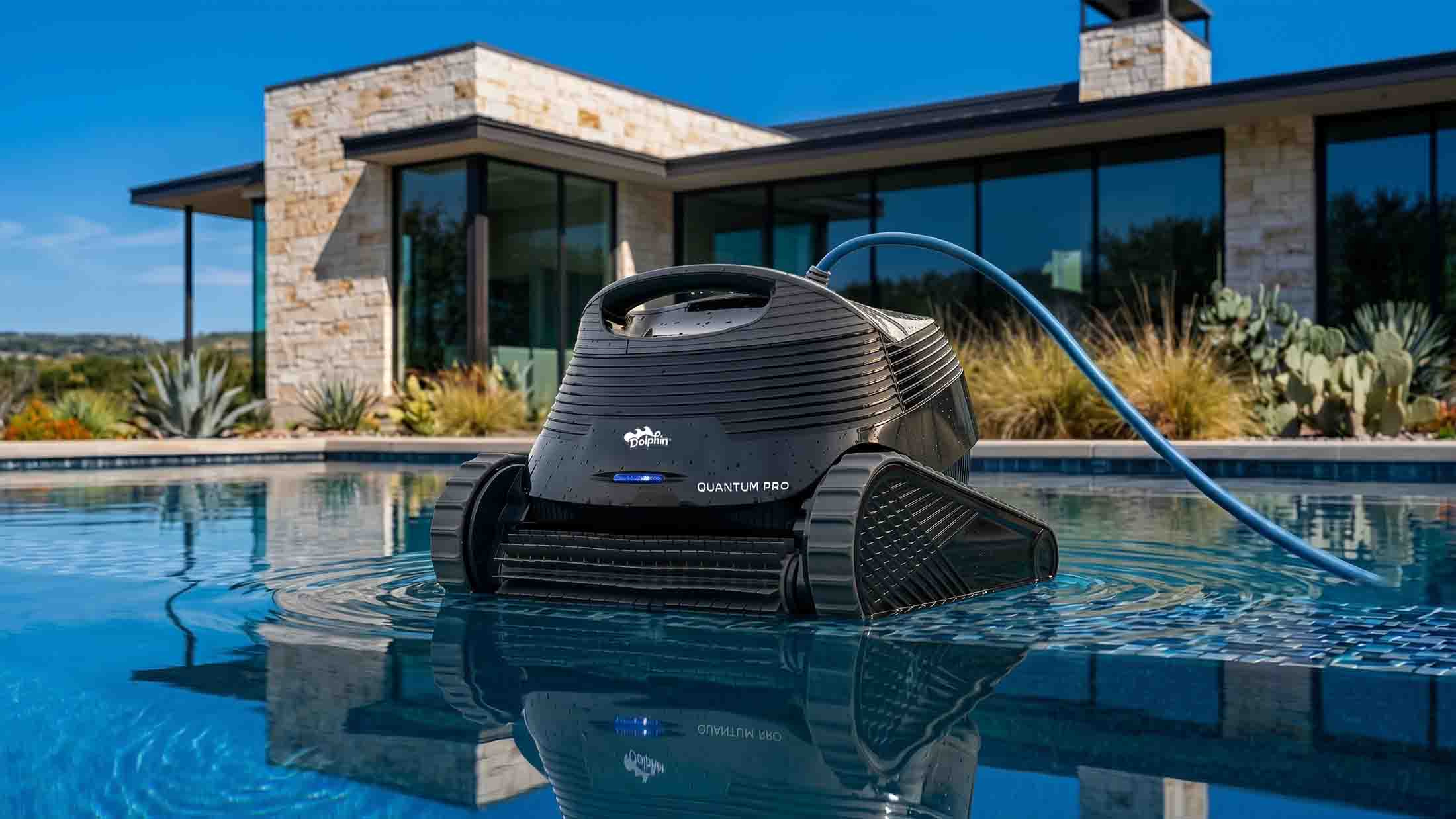
Top pick: Dolphin Quantum
Live prices · Ships free · 30 Day Trial
The debris that makes a pool look tired is too small to see one grain at a time. Ultra-fine filters hold it, at a cost you should know about.
The quick answer
The Dolphin Quantum is our pick: a full set of ultra-fine NanoFilter panels comes in the box, and its XXL MaxBin gives that fine media over 400 square inches to work with. The Dolphin Premier includes NanoFilters plus a leaf bag, and the Dolphin Sigma includes NanoFilters described as filtering down to 2 microns. On the Dolphin Cayman, fine panels are standard and NanoFilter panels are an optional add-on.
Some pools are clean and still look flat. There are no leaves on the floor, the chemistry tests fine, and yet the water has a haze and a brushed wall sends up a gray puff. What you are seeing is debris too small for an ordinary screen: silt, pollen, dust and the remains of dead algae. It passes through a standard robot filter and goes straight back into the pool.
A robotic pool cleaner with ultra-fine filters holds that material. In the Dolphin range the ultra-fine media is called NanoFilters, and three of the five Dolphins compared here at QuantumRobotic.com include a set. Fine filtration is not free, though. The tighter the media, the faster it loads, so the question is not only which robot has it, but which robot makes it practical to use week after week.
The picks, ranked
Four robots for fine debris, ranked.

$1999$1599Save $400 off the list price
Temporarily out of stock
Pick 1: Fine panels included, and the area to use them
Dolphin Quantum
The Quantum ships with standard panels and a full set of NanoFilter panels for its XXL MaxBin, so the ultra-fine option costs nothing extra. The basket matters as much as the media: over 400 square inches of filter area gives fine panels a lot of surface before they load up.
Swapping is quick. The basket opens from the top with one click, and the panels lift out for rinsing. A dual HyperBrush loosens film so the filter can catch it. It is the lowest-priced of the three robots here that include NanoFilters.
- Best for
- In-ground pools up to 50 ft with dust, pollen or silt, whose owners want fine media without an add-on.
- The trade-off
- Two media sets, where the next pick offers more. Fine panels need rinsing after every cycle, and the warranty is 2 years.

$2499$1949Save $550 off the list price
Temporarily out of stock
Pick 2: Most media choices in one box
Dolphin Premier
The Premier's Multi-Media system is the broadest filtration kit here: NanoFilters, an oversized leaf bag and standard fine filters are all included, with disposable debris bags as an optional fourth. They swap in seconds through the top of the robot, with no tools. That range suits a pool with both problems, leaves in October and pollen in April, because the ultra-fine media only goes in when the debris calls for it.
It also tells you when the media has loaded: a full-filter indicator on the power supply. The warranty is 3 years.
- Best for
- Pools that swing between heavy leaves and fine dust through the year.
- The trade-off
- No app, 20.3 lb to lift, and a higher price than the first pick. Check the live price on the card.

$2999$2349Save $650 off the list price
Temporarily out of stock
Pick 3: The one with a stated rating: 2 microns
Dolphin Sigma
The Sigma is the one robot here with a number attached to its fine media: its NanoFilters are described as filtering down to 2 microns. They are included, along with standard filter cartridges for heavier work. Three ProLine motors move 4,500 GPH, which helps when the media is tight and resists water more than a coarse screen does.
The app is a practical help with fine filtration: it raises a filter alert, so you are told when the cartridges have loaded. It ranks third because it is the highest-priced robot here.
- Best for
- Owners who want the finest stated filtration and an alert when the filters are full.
- The trade-off
- Highest price on the page and the heaviest robot at 24.6 lb. Its filters are cartridges, not a single lift-out basket.
$1299$1049Save $250 off the list price
Temporarily out of stock
Pick 4: Fine panels standard, NanoFilters as an add-on
Dolphin Cayman
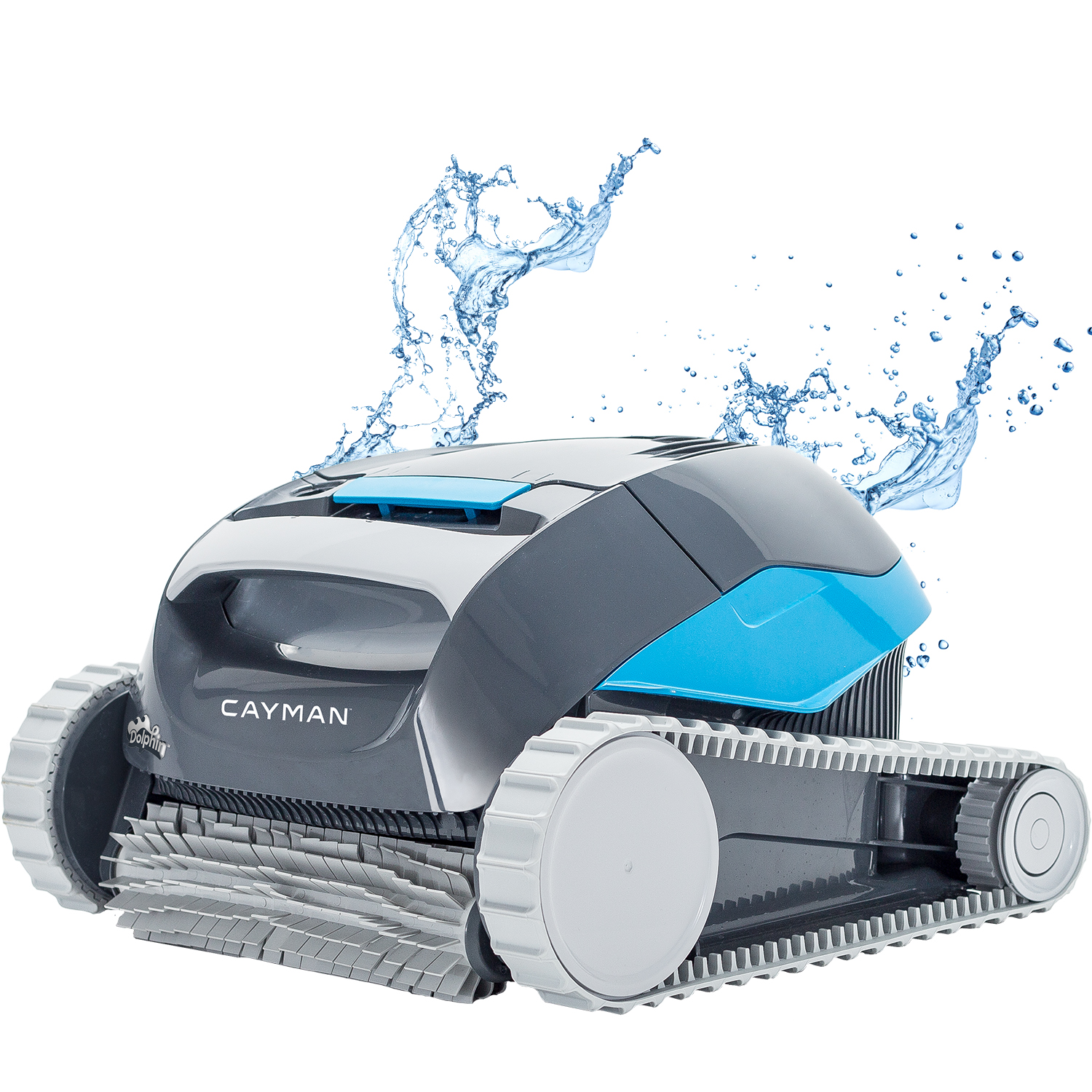
The Cayman is the pick for pools up to 33 ft, in-ground or above-ground. Out of the box its MaxBin carries fine panels, and the basket is 50% larger than standard Dolphin filters, so everyday dirt, sand and small debris are handled well. For the truly fine material, NanoFilter panels are an optional add-on that fits the same basket.
That makes it fourth here: capable, but not ultra-fine until you add the panels. If fine debris is your main problem, count the add-on into the price when you compare it with the Quantum, which includes them.
- Best for
- Smaller pools with occasional fine debris, where an add-on set of NanoFilter panels is enough.
- The trade-off
- NanoFilter panels are not in the box. It cleans floor and walls and stops short of the surface, where pollen film collects.


Side by side
Filtration compared across the four picks.
| Specification | Dolphin Quantum | Dolphin Premier | Dolphin Sigma | Dolphin Cayman |
|---|---|---|---|---|
| Price today | $1599 | $1949 | $2349 | $1049 |
| Cleans | Floor, walls, waterline, sun shelves and stairs | Floor, walls and waterline | Floor, walls and waterline | Floor and walls |
| Scheduling | Weekly timer: every day, every 2 days or every 3 days | Weekly timer: every day, every 2 days or every 3 days | Weekly scheduler by day and time | Timer: every day |
| App | myDolphin Plus (Wi-Fi) | No app; controls on the power supply | myDolphin Plus (Wi-Fi and Bluetooth) | No app; controls on the power supply |
| Filtration | XXL MaxBin basket with standard and NanoFilter panels | Multi-Media: NanoFilters, oversized leaf bag and standard fine filters | NanoFilters and standard filter cartridges | MaxBin basket with fine panels; NanoFilter panels optional |
| Brushes | Dual HyperBrush | Dual scrubbing brushes | Quad scrubbing brushes | HyperBrush |
| Navigation | SmartNav 2.0 | SmartNav 2.0 | SmartNav 3.0 with gyroscope | SmartNav 2.0 |
| Cable | 55 ft with anti-tangle swivel | 55 ft with 360° anti-tangle swivel | 55 ft with 360° anti-tangle swivel | 50 ft |
| Warranty | 2 years | 3 years | 3 years | 2 years |
What to look for
What makes fine filtration work in practice.
-
Whether the fine media is in the box
Some robots include ultra-fine filters; on others they are a separate purchase. Included means you can try fine filtration on the first cloudy day. Here the Quantum, Premier and Sigma include NanoFilters, and the Cayman and Escape take NanoFilter panels as an optional add-on.
-
Filter area
Fine media clogs from the surface inward. The more square inches there are, the longer the robot keeps its flow, and with it its suction and its grip on the walls. This is the practical difference between a fine filter you use and one that stays in the garage.
-
A coarser set to switch to
Ultra-fine filters are the wrong tool for leaves and for the first pass through a dirty pool. A robot that also carries coarser media lets you clear the heavy debris first, then switch to fine to polish. All four picks give you that second option.
-
How easy the swap and rinse are
You will handle these filters after every cycle. Top-load access on the Quantum and Premier, and the Cayman's top hatch, mean lifting the media out without turning the robot over. The Sigma uses cartridges. Whichever it is, picture doing it sixty times a season.
What ultra-fine filters catch, and what they do not.
Ultra-fine media is for particles that behave like a cloud: silt washed in by rain, pollen, windblown dust, and dead algae after a treatment. A standard screen lets much of it through; a fine filter holds it.
It does not clear every kind of cloudy water. Haze caused by water chemistry is not debris, and no robot filter removes it. Living algae is not a filtration problem either: it needs treatment and brushing, and the robot's job comes afterward, collecting what has died and settled. And a robot filters only the water it draws in along the floor and walls. The pool's own filter still does the circulating.
The trade-off: finer media clogs faster.
Every filter trades fineness against flow. The tighter the weave, the more it catches and the sooner it blinds. A robot running on loaded fine filters loses suction, slows down, and may stop climbing the walls. That is not a fault; it is the filter doing its work.
So treat ultra-fine as a finishing tool. If the pool has leaves, twigs or a heavy layer of dirt, run the coarser media first and clear the bulk. Then fit the fine media for a cycle or two to polish, and rinse it with a hose after every cycle. The table gives the short version.
| What is in the pool | Media to fit |
|---|---|
| Leaves, acorns, twigs | Standard media, or the Premier's leaf bag |
| Sand and everyday dirt | Standard or fine panels |
| Pollen, silt, dust | Ultra-fine |
| Dead algae after a treatment | Standard first, then ultra-fine |
Getting clear water from fine filters.
- Clear leaves and heavy dirt with the coarser media first. Fine filters in a leafy pool clog early in the cycle.
- Run the fine media with the pool pump off when you can, so suspended dust settles to the floor where the robot travels.
- Brush the walls and steps an hour or so before a fine-filter cycle, to knock dust down for the robot to collect.
- Rinse the fine filters after every cycle, before the debris dries on them.
- If the water is still hazy after two fine cycles, test the chemistry. The cause may not be debris.
Questions, answered
Ultra-fine filter questions.
Do ultra-fine filters clear cloudy pool water?
They clear cloudiness caused by fine debris: silt, pollen, dust, dead algae. They do not clear haze caused by water chemistry or by algae that is still alive. If a brushed wall sends up a puff that settles again, fine filters will help. If the water is uniformly milky and nothing settles overnight, test and balance it first.
Can I leave ultra-fine filters in the robot all the time?
You can in a pool that only ever collects fine dust, as long as you rinse them after every cycle. In most pools it is better to keep the standard media in for everyday running and fit the fine set when the water looks dull or after a dusty wind.
Is a robotic pool cleaner with ultra-fine filters a substitute for the pool filter?
No. The robot filters the water it draws in along the floor and walls during its cycle. The pool's own pump and filter turn over the whole volume for hours a day. The two work together, and neither replaces the other.
How small a particle do these filters hold?
The one figure on the spec sheets is the Sigma's: its NanoFilters are described as filtering down to 2 microns. For scale, a human hair is roughly 70 microns across. No micron rating is stated for the fine media on the other robots, so we do not quote one. The Quantum and Premier include NanoFilters without a number attached.
Does the Dolphin Escape take ultra-fine filters?
Yes, as an add-on. The Escape ships with standard panels in its MaxBin, and NanoFilter panels are sold separately to fit the same basket. It is not among the four picks because the fine media is not in the box.
The bottom line
The rule for fine debris.
Buy the robot that makes fine filtration easy to keep using. For most in-ground pools that is the Quantum: ultra-fine panels included, and the lowest price of the three that include them. Choose the Premier if leaves are as much your problem as dust, the Sigma if you want the stated 2-micron media and a filter alert, and the Cayman for a pool up to 33 ft, adding NanoFilter panels when you need them. Then use fine media to finish a clean pool, not to start a dirty one.
More buying guides
