



By debris and dirt problem
The best robotic pool cleaner for silt, and the patience that goes with it.
Top pick: Dolphin Quantum
Live prices · Ships free · 30 Day Trial
Silt is finer than sand and passes through ordinary robot filters, so clearing it takes ultra-fine panels, still water and more than one cycle.
The quick answer
For silt, choose the Dolphin Quantum. Its included NanoFilter panels hold particles that standard panels pass, the XXL MaxBin spreads the load, and you can start a cycle from your phone without disturbing water you have left to settle. The Premier is the runner-up: NanoFilters included, a longer 3-hour cycle and a 3-year warranty, with controls on the power supply only.
Silt behaves less like dirt and more like smoke. Stir the water and it lifts into a tan haze; leave the pool alone and it comes down again as a soft film that shows every footprint. It arrives with floodwater, with runoff from bare soil or a construction site, and on the wind after a dust event. Rubbed between two fingers it feels smooth, almost like flour, with none of the grit of sand.
That fineness is the whole difficulty. Standard robot filters let silt straight through, so the best robotic pool cleaner for silt is one with ultra-fine media, used by an owner prepared to work in stages. The four picks are the Quantum, the Premier, the Sigma and, with a caveat about its filter panels, the Cayman.
The picks, ranked
Four robots for silt, in ranked order.

$1999$1599Save $400 off the list price
Temporarily out of stock
Pick 1: Starts from your phone on still water
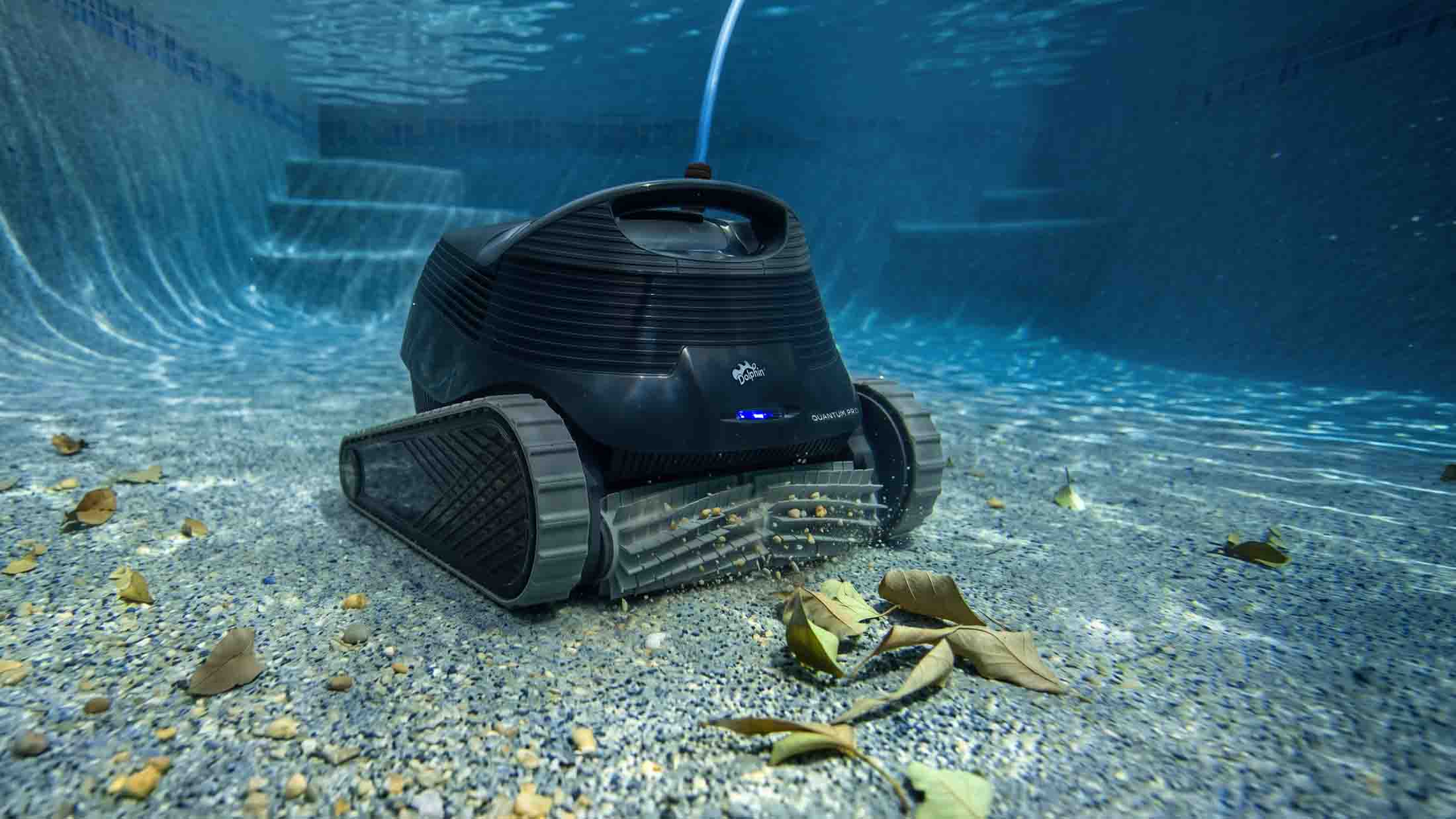
Dolphin Quantum
Silt rewards stillness, and the Quantum can work without you standing over it. Leave it in the pool, switch the pump off, and start the cycle from the myDolphin Plus app hours later, once the film has come down. The included NanoFilter panels hold what standard panels pass, and the XXL MaxBin's filter area, over 400 square inches, takes longer to coat. After the 2-hour cycle the basket opens from the top with one click, ready to rinse and go again.
- Best for
- In-ground pools up to 50 ft that take runoff, floodwater or wind-blown sediment several times a year.
- The trade-off
- The app runs over Wi-Fi, so check the signal reaches the pool area. If it does not, the timer on the power supply needs no phone.

$2499$1949Save $550 off the list price
Temporarily out of stock
Pick 2: Longest single pass over a silted floor
Dolphin Premier
The Premier takes a different route to the same result: one long, unhurried cycle. Three hours on the floor, walls and waterline means repeated passes over the same ground, which suits a film that keeps drifting back down. NanoFilters are included among its Multi-Media options and load from the top with no tools. The full-filter indicator on the power supply shows when silt has coated them, which can be well before the cycle ends. The warranty runs 3 years.
- Best for
- Owners who want one thorough run a day and a robot they set at the power supply.
- The trade-off
- There is no app, so each cycle starts at the power supply or on the timer. It is priced above the Quantum.

$2999$2349Save $650 off the list price
Temporarily out of stock
Pick 3: Scheduled by day and hour, with a filter alert
Dolphin Sigma
The Sigma's scheduler works by day and time, so you can set it to run at dawn after the pump has been off all night, the stillest water a pool ever has. Its app reports when the filter needs attention, useful when silt coats the cartridges partway through a run. NanoFilters are included, and quad brushes lift film from textured floors. It is third because it is the highest-priced robot in this guide, and silt asks for filtration and patience more than power.
- Best for
- Owners who like precise scheduling and alerts, and have a textured floor that holds a film.
- The trade-off
- The highest price here, and cartridges mean a little more handling each time you rinse between cycles.
$1299$1049Save $250 off the list price
Temporarily out of stock
Pick 4: For small pools, once the fine panels are fitted
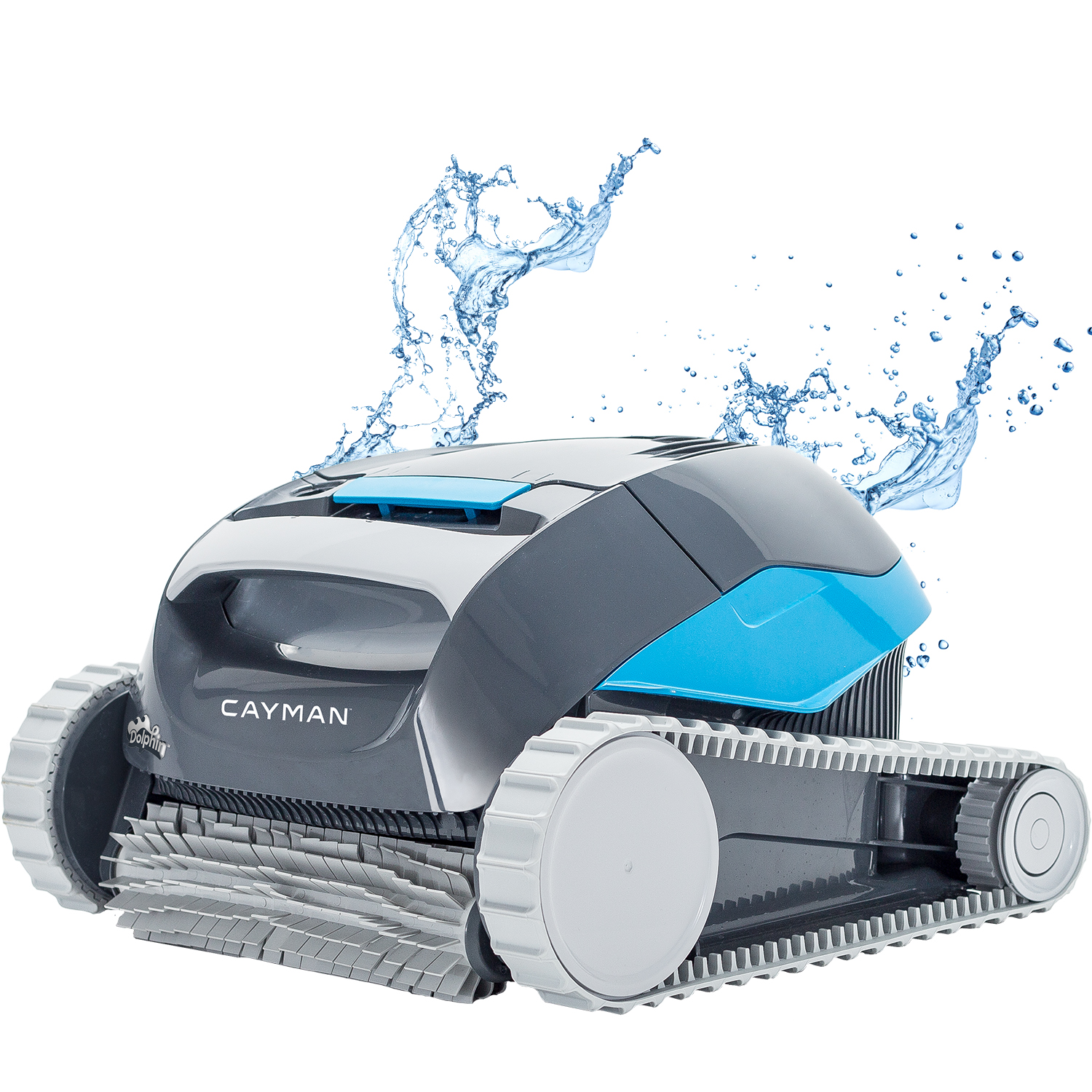
Dolphin Cayman
On its standard fine panels the Cayman will mostly stir silt: the film lifts, passes through and settles again. That is not a fault, just the wrong media for this debris. With the optional NanoFilter panels fitted it becomes a workable choice for a pool up to 33 ft, in-ground or above-ground, with a 2-hour cycle on floor and walls and a MaxBin basket that empties through a top hatch. Its timer runs daily, which keeps a returning film thin once the main clean-up is done.
- Best for
- Pools 33 ft and under where silt is occasional and you will buy the NanoFilter panels with the robot.
- The trade-off
- Standard panels pass silt. No waterline cleaning, so a tan line at the tile is a job for you and a sponge.


Side by side
How the picks compare on filters and cycles.
| Specification | Dolphin Quantum | Dolphin Premier | Dolphin Sigma | Dolphin Cayman |
|---|---|---|---|---|
| Price today | $1599 | $1949 | $2349 | $1049 |
| Filtration | XXL MaxBin basket with standard and NanoFilter panels | Multi-Media: NanoFilters, oversized leaf bag and standard fine filters | NanoFilters and standard filter cartridges | MaxBin basket with fine panels; NanoFilter panels optional |
| Filter access | Top-load, one-click open | Top-load, no tools | Cartridges | Top hatch, one-tab emptying |
| Brushes | Dual HyperBrush | Dual scrubbing brushes | Quad scrubbing brushes | HyperBrush |
| Flow rate | 4,000 GPH | 4,500 GPH | 4,500 GPH | Over 4,000 GPH |
| Cycle time | 2 hours | 3 hours | 2.5 hours | 2 hours |
| Cleans | Floor, walls, waterline, sun shelves and stairs | Floor, walls and waterline | Floor, walls and waterline | Floor and walls |
| Scheduling | Weekly timer: every day, every 2 days or every 3 days | Weekly timer: every day, every 2 days or every 3 days | Weekly scheduler by day and time | Timer: every day |
| Warranty | 2 years | 3 years | 3 years | 2 years |
What to look for
What a robot needs before it can hold silt.
-
Ultra-fine media, not just fine
Silt particles are smaller than the mesh of a standard panel. NanoFilter-class media is what traps them. It is included with the Quantum, Premier and Sigma. On the Cayman it is an optional add-on, and without it the robot mostly rearranges silt.
-
A start that does not stir the water
Everything gained by letting silt settle is lost if the clean-up begins with a splash. A robot that already sits in the pool and starts from a timer, an app or a schedule begins its work on a still floor.
-
Filter area and easy rinsing
Silt blinds a filter quickly: a thin, even coat over the whole surface, after which little water passes. More area takes longer to coat. Easy access matters too, because you will rinse between every cycle.
-
A cycle you can repeat
No robot clears a silted pool in one run. What helps is a cycle short enough to repeat the same day, or long enough to cross the floor several times. The picks here range from 2 to 3 hours.
A quick way to tell silt from everything else.
Stir a patch of the floor with your hand, fill a clear glass from that spot and stand it on a table. Silt clears from the top down over an hour or two and leaves a tan or gray layer at the bottom. Then rub a pinch of the floor film between finger and thumb.
- Smooth, no grit, tan to brown: silt or clay. This page is for you.
- Gritty: sand. It is easier to hold, and standard panels may be enough.
- Gray-white powder after a shock treatment: dead algae. Same filter, same method.
- Green or yellow, returning to the same shaded spots: living algae, which is a water-chemistry problem first.
Stillness first, then the robot.
Turn the pool pump off and leave it off for several hours. Overnight is best. Do not brush: with ordinary dirt, brushing helps the robot, but with silt it only lifts the film back into the water, where no robot can reach it. If the robot is not already in the pool, lower it in slowly and let the ripples die away before starting it.
Let the first cycle run its full length with no interruptions and no swimmers. It will take the bulk and raise a little haze. Rinse the panels until the water runs clear, wait, and repeat. After a flood or a dust event, three or four rounds over two days is ordinary. Between rounds, run the pump so the pool's own filter can work on what is still suspended.
When the floor has disappeared.
If the water is so cloudy that you cannot see the main drain, a robot is the wrong first step. It cannot filter a whole pool's volume, and it would be working in water that drops fresh silt behind it. The usual route is chemical: a clarifier to help the pool filter catch fine particles, or a flocculant that sinks everything into a heavy layer, followed by a slow manual vacuum set to waste. Follow the product label. Once the floor is visible again, the robot handles what remains.
Habits that shorten a silt clean-up.
- Run the robot at first light, after a night with the pump off and before anyone swims. That is when the most silt is on the floor.
- Keep swimmers out between cycles. One cannonball puts an afternoon of settling back into the water.
- Check the pleats for brown patches before refitting the panels. If you can still see silt, the next cycle starts with a half-blocked filter.
- Find the source. A bed that drains toward the pool, a bare slope or a low spot in the deck will deliver more with the next storm.
Questions, answered
Silt questions, in plain terms.
Does the best robotic pool cleaner for silt need a special filter?
Yes. Silt is finer than standard robot panels can hold, so the filter has to be ultra-fine: NanoFilter panels on the Quantum, NanoFilters on the Premier and Sigma, all included. The Cayman and the Dolphin Escape take NanoFilter panels as an optional add-on. With standard panels, any of these robots lifts silt and releases most of it again.
How long should the pump be off before I run the robot?
Several hours at least, and overnight if the silt is very fine. You can judge it by eye: when the water above looks clearer and the film on the floor looks heavier, the silt is down.
Should I brush the pool before the robot runs?
Not for silt. Brushing puts it back into suspension, and a robot only collects what lies on the surfaces it drives over. Let the robot's own brushes loosen the film directly ahead of its intake. Save hand brushing for corners it cannot reach, after the main cycles, sweeping gently toward the floor.
Can I use the robot after adding flocculant?
Wait. Flocculant gathers fine particles into a heavy sludge on the floor, and that sludge is meant to be vacuumed slowly to waste by hand. A robot's filter would coat almost at once, and its movement breaks the layer up. Take the robot out before adding any chemical and return it when the sludge is gone.
Is silt the same thing as dead algae?
No, though they behave alike. Silt is mineral: tan or brown, and it follows a flood, runoff or a dust event. Dead algae is organic: gray-white, and it follows a shock treatment. Both are fine enough to pass through standard panels, and both come out with ultra-fine media and patience.
The bottom line
The rule to take away.
Silt is beaten by fine filters and still water, in that order. For an in-ground pool up to 50 ft, the Quantum gives you both for the least money among the 50 ft robots here. Pick the Premier for one long daily run, the Sigma for scheduling to the hour, and the Cayman for a pool of 33 ft or less with NanoFilter panels added. Whichever you choose, expect several cycles.
More buying guides
