



By pool surface
Best robotic pool cleaner for concrete pools: scrubbing, traction and grit.
Top pick: Dolphin Sigma
Live prices · Ships free · 30 Day Trial
Poured, shotcrete, painted or bare, concrete is the roughest surface a robot meets. Three of the four picks name it on their surface lists, and that decides the order here.
The quick answer
The Dolphin Sigma is the pick for a concrete pool: concrete is on its published surface list, and it brings quad scrubbing brushes, three commercial-grade motors and gyroscope navigation to a rough, uneven floor. Choose the Premier instead if you want the same 4,500 GPH and 3-year warranty with simpler controls, a 3-hour cycle and a leaf bag, at a lower price.
Concrete is the oldest way to build a pool and the hardest on the equipment that cleans it. Whether the shell was poured, shot in place, or built decades ago and painted since, the surface is coarse and often no longer level. There may be hairline cracks, a patch that has settled, a rough seam where a repair was made. Grit collects in all of it.
So the best robotic pool cleaner for concrete pools is the one that scrubs hardest, grips a coarse wall, filters sand as well as silt, and has brushes you can replace. One more test applies: does the robot's published surface list actually say concrete? For three of the four robots below it does. For the Quantum, the robot this store is built around, it does not, and we explain what that means.
The picks, ranked
Ranked by what concrete demands.

$2999$2349Save $650 off the list price
Temporarily out of stock
Pick 1: Most scrubbing here, for a coarse surface
Dolphin Sigma
Concrete is named on the Sigma's surface list, and no robot in this guide scrubs harder. Four scrubbing brushes turn against the floor and walls, three commercial-grade ProLine motors move 4,500 GPH, and HyperGrip tracks carry it over ridges and seams. SmartNav 3.0 uses an onboard gyroscope, so when a settled section nudges the robot sideways it has a sense of heading to recover with.
NanoFilters and standard filter cartridges are both included, for dust and for grit. The warranty is 3 years, not prorated and not limited by cycle count.
- Best for
- Old, rough or uneven concrete pools up to 50 ft that need real scrubbing.
- The trade-off
- It costs the most of the four, and at 24.6 lb it is the heaviest to haul up over a rough coping; its filters are cartridges, not a basket.

$2499$1949Save $550 off the list price
Temporarily out of stock
Pick 2: Tough, simple and well filtered
Dolphin Premier
The Premier also lists concrete, and it matches the top pick on flow and warranty: dual commercial-grade ProLine motors at 4,500 GPH and 3 years of cover. Dual scrubbing brushes and a 3-hour cycle, the longest here, give it time to go over a coarse floor more than once.
Its Multi-Media filtration suits what concrete sheds. Standard fine filters take the grit, NanoFilters take the dust, the oversized leaf bag takes fall debris, and each swaps in seconds from the top with no tools. A full-filter indicator on the power supply tells you when to empty it.
- Best for
- Concrete pools that shed grit or sit under trees, and owners who like controls on the power supply.
- The trade-off
- Two brushes where the Sigma has four, SmartNav 2.0 navigation, and no app.

$1999$1599Save $400 off the list price
Temporarily out of stock
Pick 3: For concrete finished in plaster, pebble or tile
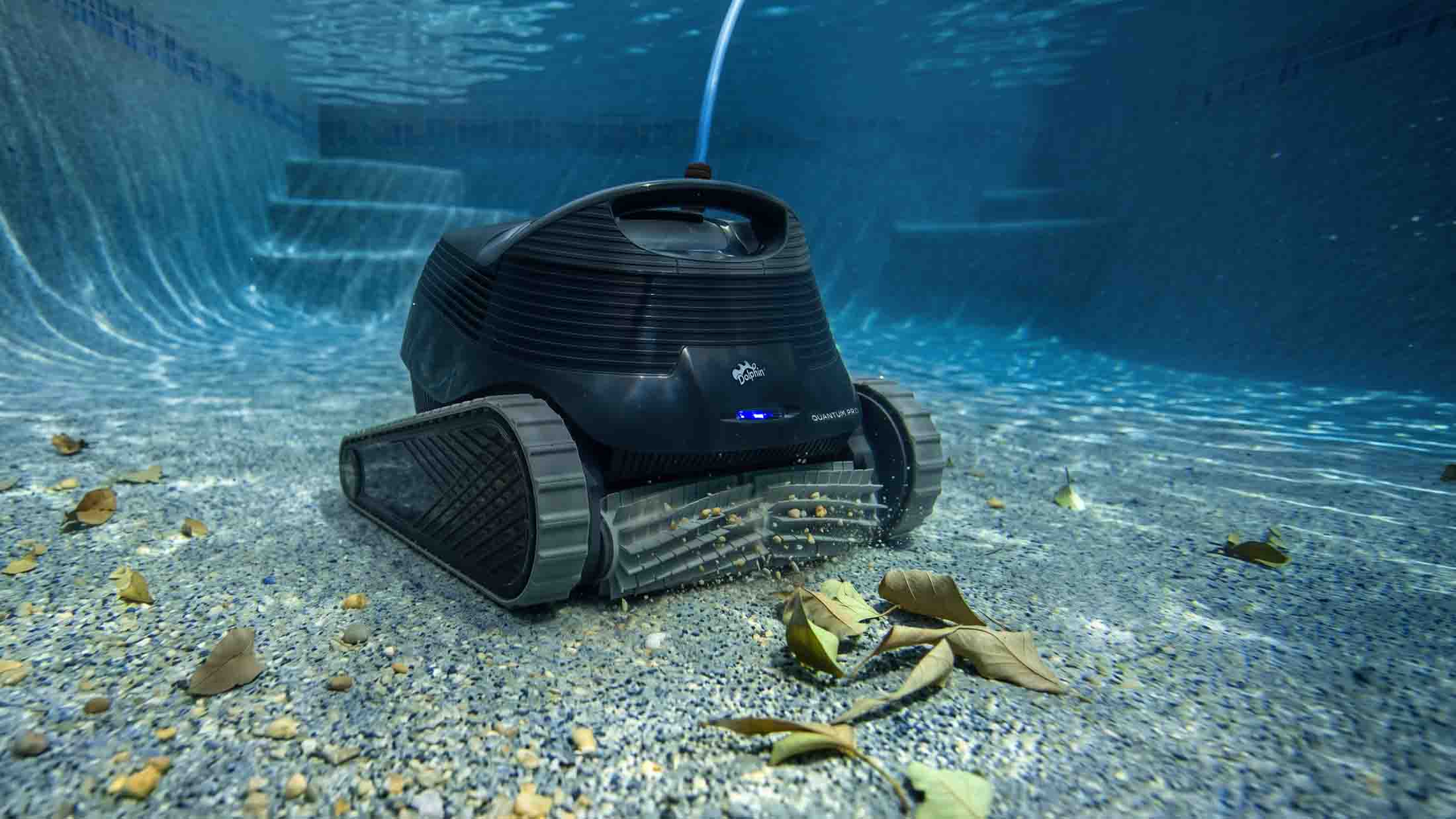
Dolphin Quantum
Most concrete pools are not bare. They are finished in plaster, pebble or tile, and those are all on the published surface list of the Quantum. On a finished pool it does the job well: a dual HyperBrush turning at twice the speed of standard brushes, 4,000 GPH, HyperGrip continuous rubber tracks, and NanoFilter panels included with the XXL top-load MaxBin.
It is also the only pick that lists stairs, sun shelves and Baja ledges, and it costs less than the two robots above. For raw, painted or badly worn concrete, though, choose a robot that names concrete.
- Best for
- Plastered, pebble-finished or tiled concrete pools, especially ones with steps and a shelf.
- The trade-off
- Concrete itself is not on its published surface list, and the warranty is 2 years.
$1299$1049Save $250 off the list price
Temporarily out of stock
Pick 4: Small concrete pools, 33 ft and under
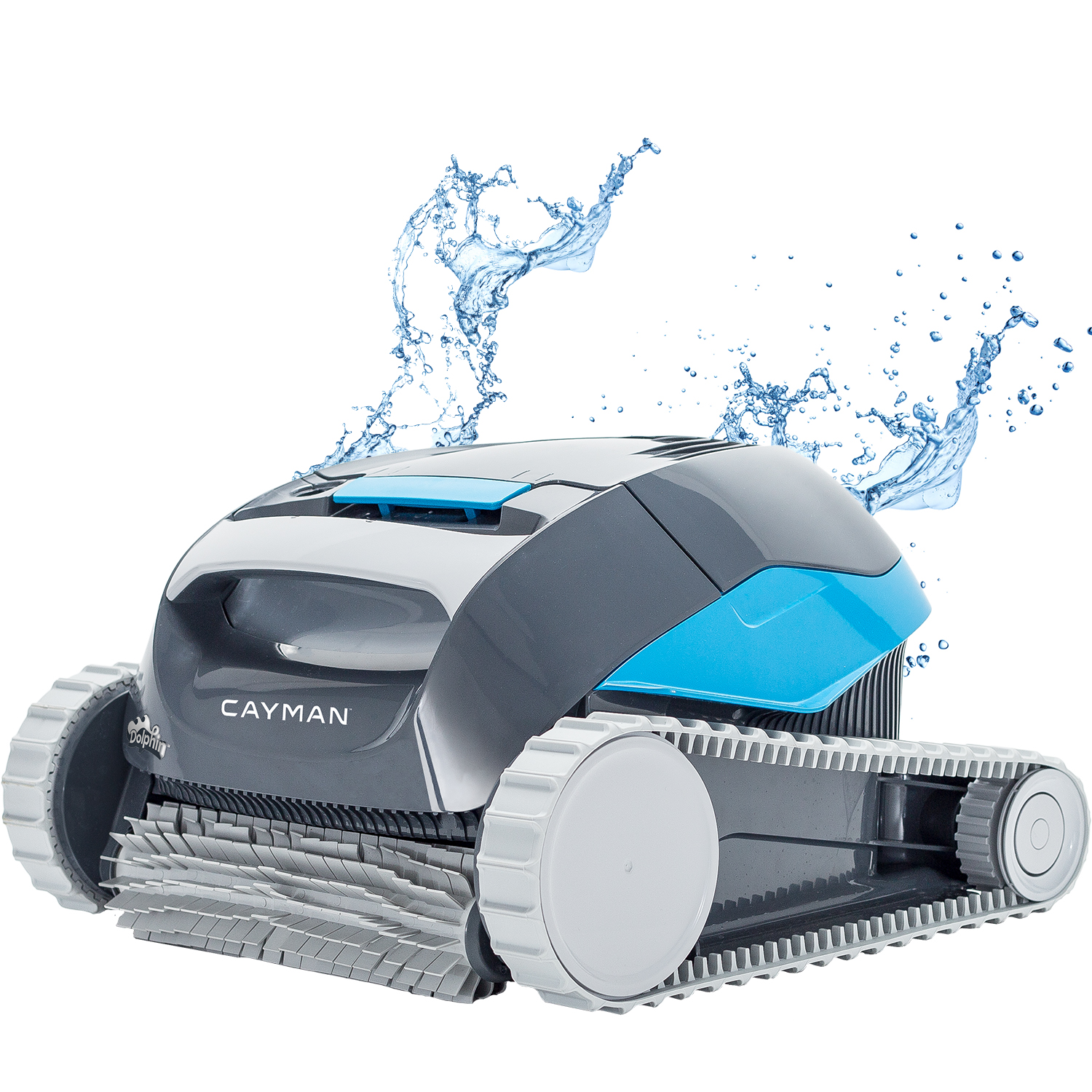
Dolphin Cayman
The Cayman names concrete on its surface list, which makes it the choice for a small concrete pool: an older backyard rectangle, a courtyard pool, anything with a longest run of 33 ft or less. One HyperBrush at twice the speed of standard Dolphin brushes, dual 24-volt DC motors at over 4,000 GPH and HyperGrip tracks clean the floor and walls in 2 hours.
The MaxBin basket has room for grit and empties from a top hatch. With one brush, it is a maintenance robot for a sound surface, not a rescuer of a neglected one.
- Best for
- Compact concrete pools in fair condition where floor and walls are the job.
- The trade-off
- A single brush has a lot to do on a coarse floor, the waterline is left to you, and NanoFilter panels cost extra.


Side by side
Specs that matter on concrete.
| Specification | Dolphin Sigma | Dolphin Premier | Dolphin Quantum | Dolphin Cayman |
|---|---|---|---|---|
| Price today | $2349 | $1949 | $1599 | $1049 |
| Brushes | Quad scrubbing brushes | Dual scrubbing brushes | Dual HyperBrush | HyperBrush |
| Cleans | Floor, walls and waterline | Floor, walls and waterline | Floor, walls, waterline, sun shelves and stairs | Floor and walls |
| Traction | HyperGrip tracks | HyperGrip tracks | HyperGrip tracks | HyperGrip tracks |
| Pool length | Up to 50 ft | Up to 50 ft | Up to 50 ft | Up to 33 ft |
| Filtration | NanoFilters and standard filter cartridges | Multi-Media: NanoFilters, oversized leaf bag and standard fine filters | XXL MaxBin basket with standard and NanoFilter panels | MaxBin basket with fine panels; NanoFilter panels optional |
| Robot weight | 24.6 lb | 20.3 lb | 18.3 lb | 14.6 lb |
| Warranty | 3 years | 3 years | 2 years | 2 years |
What to look for
How to judge a robot for concrete.
-
Concrete on the surface list.
Makers publish the surfaces each robot is intended for. The Sigma, Premier and Cayman all name concrete. The Quantum's list names gunite, plaster, pebble and tile, which are the finishes applied over concrete, but not concrete itself.
-
Scrubbing force.
Coarse concrete holds dirt and algae in its pores, and a light wipe passes over the top. More brushes, turning against the surface with strong flow behind them, lift more. This is the surface where brush count earns its price.
-
Traction and a steady heading.
A rough wall gives good grip, but an uneven floor, a settled slab or a raised crack can turn a robot off its line. Tracks ride over small ridges better than wheels, and a robot that knows its heading recovers its pattern sooner.
-
Filtration for grit.
Concrete sheds sand-like grit as well as fine dust, more so when it is bare, old or under flaking paint. You want room for the grit, ultra-fine media for the dust, and a filter you will not mind rinsing often.
Bare, painted or finished: which concrete do you have.
Concrete describes the shell more often than the surface, so look at what the water actually touches. If you see a smooth white or colored coat, pebbles or tile, the pool is finished concrete and behaves like its finish. If you see paint that rubs off chalky on your hand, it is painted concrete. If you see gray, sandy, exposed cement, it is bare. An older pool can be more than one of these at once. Each treats a robot differently, and the table sums up what to expect.
| What the water touches | What it does to a robot | Our lean |
|---|---|---|
| Plaster, pebble or tile over concrete | Normal brush wear, fine dust | Any pick; the Quantum is suited |
| Painted concrete | Chalk loads fine filters, flakes fill the basket | Sigma or Premier; rinse filters often |
| Bare or rough-troweled concrete | Fast brush wear, sandy grit | Sigma or Premier |
| Cracked or settled sections | Robot may catch or turn away | Repair first; watch early cycles |
Cracks, settled slabs and other things a robot cannot fix.
A robot will drive over a hairline crack without noticing it. A wide crack, a lifted edge or a slab that has dropped half an inch is different: tracks can catch, the robot may turn away, and the strip beyond stays dirty. Watch the first cycles and note where it happens. The repair is a job for a pool contractor, and worth doing before sharp edges chew through brushes.
Be realistic about old concrete. A surface that is shedding sand will fill a filter in one cycle and keep shedding. A robot collects what comes loose; it cannot stop the surface breaking down, cannot remove stains or scale, and does not replace sanitizer or hand brushing during an algae treatment. If the basket is full of grit every day, the pool is telling you it needs resurfacing.
Living with a robot on concrete.
- Rinse the filter after every cycle for the first two weeks. A concrete pool gives up a backlog of grit when a robot first arrives.
- Check the brushes monthly in season. Flattened fins mean less scrub and weaker wall climbing, so fit new ones before they are bald.
- Use standard filters for sandy grit and change to NanoFilters when the water carries a fine haze.
- Lay a towel over rough coping where you lift the robot out, to spare the cable and the robot's body.
Questions, answered
Common questions about robots on concrete.
Why does the Quantum's surface list not say concrete?
Its published list names gunite, plaster, pebble, tile, vinyl liner and fiberglass. Gunite is sprayed concrete, and plaster, pebble and tile are what most concrete pools are finished in, so in practice it covers the usual concrete pool. We still rank it third, because for bare or painted concrete we think you should buy a robot that names the surface outright.
Is a painted concrete pool hard on a robot?
It can be. Old pool paint chalks, and the chalk clouds the water and loads fine filters quickly; flaking paint fills the basket. Plan to rinse filters often, and take heavy chalking as a sign the pool is due for repainting, not as a fault in the robot.
Does concrete wear a robot out faster than vinyl does?
It wears the brushes faster, and to a lesser degree the tracks. Those are replaceable parts made to be changed. The motors and electronics never touch the surface. A warranty that is not limited by cycle count suits a concrete pool that needs frequent cleaning, and both top picks have one.
Is the best robotic pool cleaner for concrete pools also right for gunite?
Yes. Gunite and shotcrete are concrete applied by spraying, and the cleaning problem is the same: a rough, porous surface. Every robot on this page lists gunite. Only three name concrete, which is the reason the order here differs from the order you would see for gunite.
The bottom line
The rule for concrete.
Read your surface, then the surface list. Bare, painted or badly worn concrete: buy a robot that names concrete, the Sigma for the most scrubbing or the Premier for equal flow and warranty at a lower price. Concrete under sound plaster, pebble or tile: the Quantum is suited, costs less, and is the one that cleans steps and shelves. A small pool of 33 ft or less: the Cayman. And if the basket fills with sand every day, call a resurfacer before you blame the robot.
More buying guides
