



By pool surface
Best robotic pool cleaner for gunite pools, whatever finish sits on top.
Top pick: Dolphin Quantum
Live prices · Ships free · 30 Day Trial
Gunite is the shell; plaster, pebble or tile is what the robot touches. Rough, porous finishes call for fast brushes, fine filters, a waterline pass and a 50 ft rating.
The quick answer
The Dolphin Quantum is our pick for most gunite pools: gunite is on its published surface list, its dual HyperBrush spins at twice the speed of standard brushes, NanoFilter panels are included, and it covers the built-in steps and shelves gunite pools tend to have. Choose the Premier instead if durability leads your list: ProLine motors, a 3-hour cycle and a 3-year warranty.
Gunite is concrete sprayed over a steel cage, and nobody swims against the gunite itself. What you and a robot touch is the finish: plaster in most pools, pebble or tile in others. All of them are rougher and more porous than vinyl or fiberglass. Fine dirt settles into the texture, algae finds a foothold there, and brushes have to work harder to shift either one.
Because the shell is sprayed in place, gunite pools are also the ones with freeform outlines, deep ends, benches, sun shelves and wide entry steps. So the best robotic pool cleaner for gunite pools has two jobs: scrubbing and filtration equal to a rough finish, and reach, in length and in coverage, for a pool that was built to order.
The picks, ranked
The gunite shortlist, best fit first.

$1999$1599Save $400 off the list price
Temporarily out of stock
Pick 1: Best all-rounder for a custom gunite pool
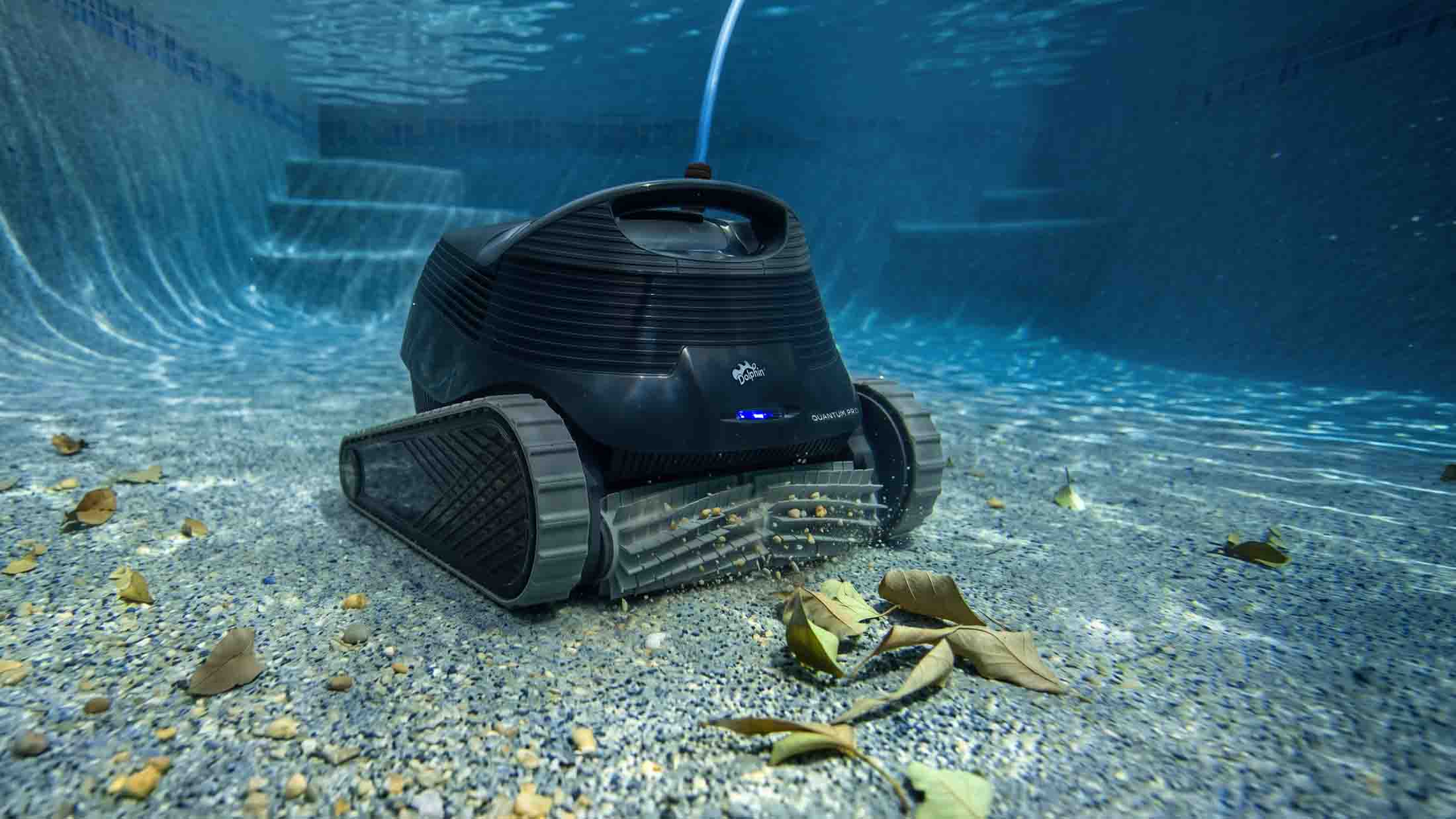
Dolphin Quantum
Gunite is named on the Quantum's published surface list, along with the plaster, pebble and tile that finish it. Its dual HyperBrush turns at twice the speed of standard brushes, a good match for texture that needs repeated quick strokes, and a full set of NanoFilter panels comes with it for plaster dust.
It also suits the way gunite pools are built. The rating is 50 ft, SmartNav 2.0 senses ladders and drains, and stairs, sun shelves and Baja ledges are in its published coverage along with the waterline. The XXL MaxBin top-loads with one click.
- Best for
- Freeform gunite pools up to 50 ft with built-in steps, benches or a shelf.
- The trade-off
- Its 4,000 GPH flow and 2-year warranty are a notch under the Premier and Sigma.

$2499$1949Save $550 off the list price
Temporarily out of stock
Pick 2: Built for rough finishes and long service
Dolphin Premier
On an abrasive surface, the case for the Premier is staying power. Dual commercial-grade ProLine motors move 4,500 GPH, the cycle runs 3 hours so a large pool gets worked over properly, and the warranty is 3 years, not prorated and not limited by cycle count.
Its Multi-Media filtration follows a gunite pool's year: NanoFilters while the plaster is dusting, standard fine filters day to day, and the oversized leaf bag in fall. Gunite, plaster, pebble and tile are all on its surface list.
- Best for
- Large or leafy gunite pools, and owners who rank durability and warranty first.
- The trade-off
- There is no app, and steps and shelves are not in its published coverage.

$2999$2349Save $650 off the list price
Temporarily out of stock
Pick 3: Maximum scrubbing for aged, rough plaster
Dolphin Sigma
When a gunite pool's finish has gone rough with age and the walls need real scrubbing, the Sigma brings the most hardware of the four: quad scrubbing brushes, three commercial-grade ProLine motors at 4,500 GPH, and SmartNav 3.0 with an onboard gyroscope to keep its passes orderly through a freeform. NanoFilters and standard cartridges are both included.
It adds app scheduling by day and time, and its warranty is 3 years. It is third here on cost and weight, not on cleaning.
- Best for
- Older, rougher plaster and big freeforms where you want the most thorough scrub of the four.
- The trade-off
- The highest price of the four picks, 24.6 lb to lift, and four brushes to replace as a rough finish wears them.
$1299$1049Save $250 off the list price
Temporarily out of stock
Pick 4: Small gunite pools, 33 ft and under
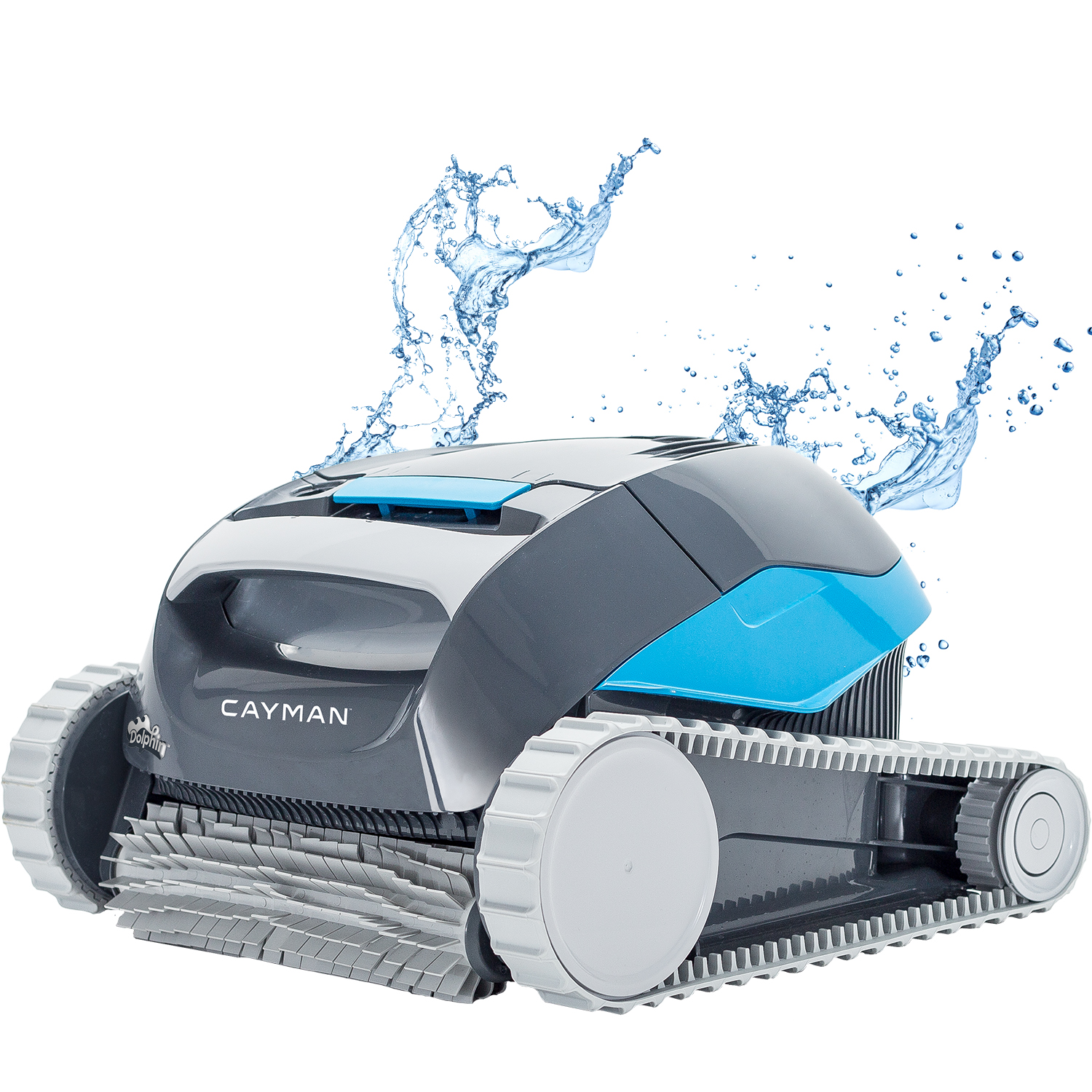
Dolphin Cayman
Some gunite pools are small: courtyard pools, cocktail pools, older rectangles under 33 ft. For those, the Cayman lists gunite, plaster, pebble and tile, runs one HyperBrush at twice the speed of standard Dolphin brushes, and moves over 4,000 GPH through a MaxBin basket with fine panels.
It keeps the price down by leaving things out. It cleans the floor and walls only, NanoFilter panels are an optional add-on, and its warranty is 2 years. In a small pool with a tile band you do not mind wiping, that is a fair bargain.
- Best for
- Compact gunite pools with a longest run of 33 ft or less.
- The trade-off
- One brush against a rough finish, no pass along the tile line, and NanoFilter panels to buy separately.


Side by side
Gunite picks, side by side.
| Specification | Dolphin Quantum | Dolphin Premier | Dolphin Sigma | Dolphin Cayman |
|---|---|---|---|---|
| Price today | $1599 | $1949 | $2349 | $1049 |
| Brushes | Dual HyperBrush | Dual scrubbing brushes | Quad scrubbing brushes | HyperBrush |
| Cleans | Floor, walls, waterline, sun shelves and stairs | Floor, walls and waterline | Floor, walls and waterline | Floor and walls |
| Traction | HyperGrip tracks | HyperGrip tracks | HyperGrip tracks | HyperGrip tracks |
| Pool length | Up to 50 ft | Up to 50 ft | Up to 50 ft | Up to 33 ft |
| Filtration | XXL MaxBin basket with standard and NanoFilter panels | Multi-Media: NanoFilters, oversized leaf bag and standard fine filters | NanoFilters and standard filter cartridges | MaxBin basket with fine panels; NanoFilter panels optional |
| Robot weight | 18.3 lb | 20.3 lb | 24.6 lb | 14.6 lb |
| Warranty | 2 years | 3 years | 3 years | 2 years |
What to look for
Four things to weigh for gunite.
-
Scrubbing that reaches into texture.
A rough finish holds dirt below the level a passing brush touches. Brush speed, brush count and the water flow behind them decide how much comes out. The picks here range from one fast HyperBrush to four scrubbing brushes.
-
Fine filtration for plaster dust.
Plaster sheds a fine gray dust, heavily when new and lightly as it ages, and the finest of it slips through standard panels. Ultra-fine NanoFilters catch it. They are included with the three 50 ft robots here and optional on the fourth.
-
A waterline pass.
Porous finishes and tile bands both collect a line of oils and scale where the water meets the wall. A robot that scrubs the waterline every cycle keeps that film from hardening. It will not remove calcium that has already set.
-
Length and durability.
Gunite pools run large, and many are freeforms of 35 ft and longer with a deep end, which rules out robots rated to 33 ft. Rough surfaces also wear brushes and tracks faster, so warranty length and replaceable parts deserve a look.
Know your finish, because the robot does.
Ask what covers your gunite, because that is the surface the robot meets. Smooth new plaster is the gentlest on brushes and the dustiest in its first months. Aged, etched plaster is abrasive. Pebble finishes are bumpy and hide dirt between the stones. Tile is smooth, but its grout lines hold algae. All four picks list gunite, plaster, pebble and tile, so none is excluded; what changes is how often you swap filters and brushes.
If the pool has just been built or resurfaced, keep every robot out during the builder's start-up period. Follow the builder's schedule, then begin with the NanoFilter panels in.
Brush wear is normal on gunite.
A robot's brushes are the part that meets the finish, and on a rough finish they wear, much as a tire does on a gravel road. That is expected, not a defect. Check them every month or two in season: when the fins look rounded or flattened, or the robot starts sliding on walls it used to climb, it is time. Brushes on all of these robots are replaceable.
Wear is not a reason to run the robot less. Dirt left sitting in a porous finish is what turns into stains, and frequent cycles keep it from settling in. A robot still does not replace sanitizer, or brushing by hand during an algae treatment.
Coverage in a pool that was built to order.
Gunite pools collect features: a deep end with a steep slope, a raised main drain cover, a love seat in one corner, a sun shelf by the steps. Watch the first cycle. A robot should climb the slope and the walls, cross the drain and turn at ladders without help. If it stalls in one place every time, chat with a Dolphin Expert and tell us where. For depth limits, check the manual, since none is given on our spec sheet.
Running a robot in a gunite pool.
- Fit the NanoFilter panels after a replaster or an acid wash, and go back to standard panels once the basket stops filling with gray dust.
- Hose the filter panels after each emptying. Plaster dust packs into fine media and cuts water flow.
- Schedule frequent cycles. A rough finish rewards short, regular visits more than a weekly marathon.
- Between scheduled cycles the robot can stay in the water. Lift it out weekly to rinse the filter, and always before shocking.
Questions, answered
Gunite questions, answered plainly.
Does the finish over my gunite change which robot I should buy?
It changes the upkeep more than the choice. All four picks list gunite, plaster, pebble and tile. On smooth plaster you will go through filters faster than brushes; on pebble or aged plaster, the reverse. If the finish is very rough, the extra brushes of the Sigma or the long cycle of the Premier are worth more.
How fast do brushes wear out in a gunite pool?
Faster than in vinyl or fiberglass, and how much faster depends on the finish and how often the robot runs. We will not put a number on it, because pools differ too much. Inspect them through the season and replace them when the fins flatten or wall climbing falls off.
Can a robot get algae out of the pores in plaster?
It helps keep a clean pool clean by scrubbing often and filtering what it loosens. It does not treat an outbreak. Once algae is established you need the right chemistry and a stiff hand brush, and the robot should come out before you shock. Use it afterwards, with NanoFilter panels, to collect the dead material.
Will the best robotic pool cleaner for gunite pools also clean the tile band?
The three 50 ft picks will. The Quantum, Premier and Sigma all scrub the waterline and list tile as a supported surface, so the tile band found on most gunite pools is part of their normal cycle. Grout lines hold algae, so a hand brush along the tile is still worth a few minutes each month.
The bottom line
Which one for your gunite pool.
Start with length: over 33 ft, the Cayman is out. Among the three 50 ft robots, take the Quantum if the pool has steps or a shelf you want cleaned and you like the lower price. Take the Premier if the finish is rough, the trees are close and you want the longer warranty. Take the Sigma if you want the most scrubbing and are happy to pay for it. Whichever you choose, budget for brushes; gunite uses them up.
More buying guides
