



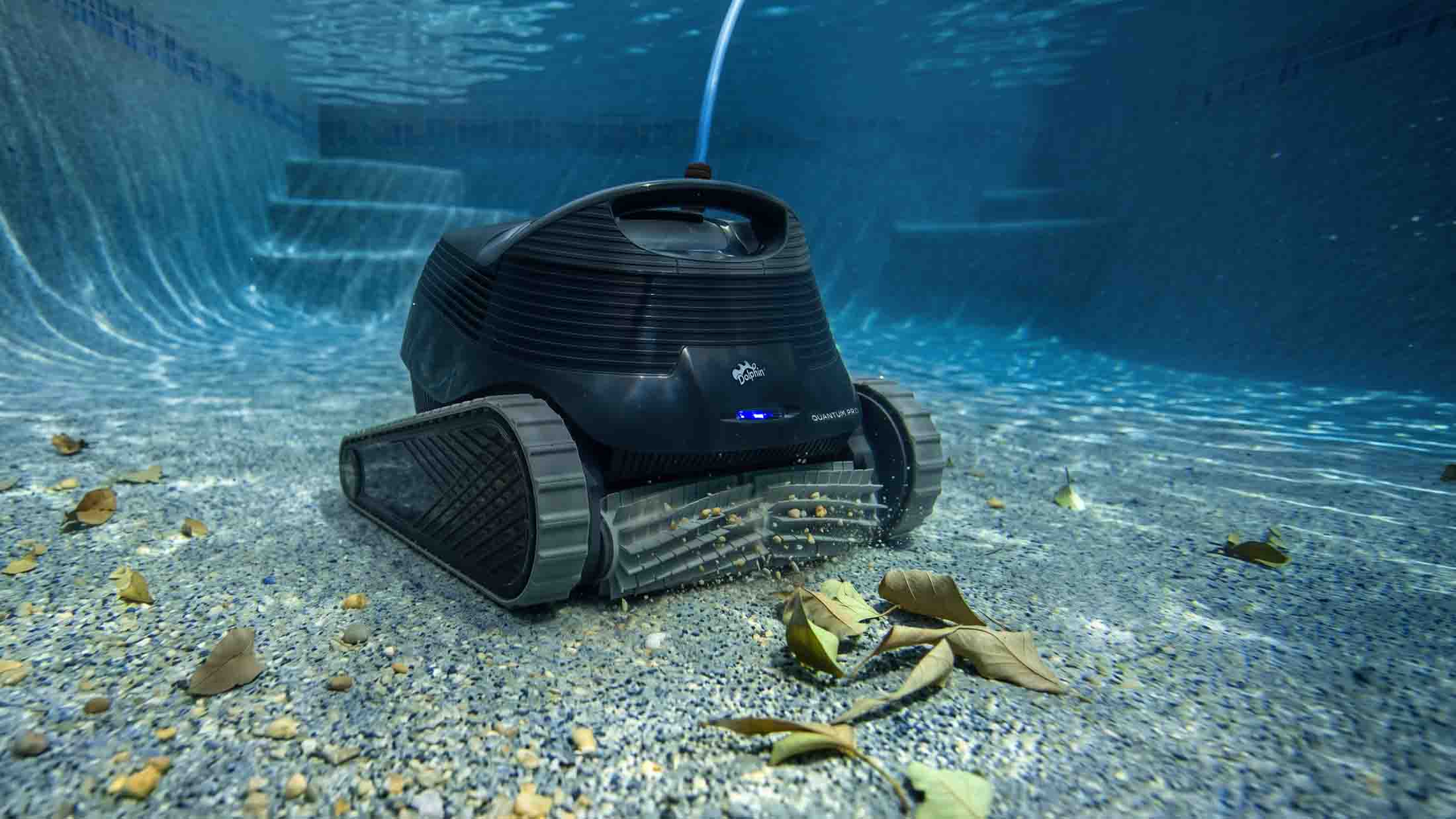
By pool surface
Best robotic pool cleaner for plaster pools: fine filters first, then scrubbing.
Top pick: Dolphin Premier
Live prices · Ships free · 30 Day Trial
Plaster starts smooth, sheds dust for weeks, then slowly roughens and scales. The robot to buy is the one whose filtration can change as the plaster does.
The quick answer
The Dolphin Premier is the pick for a plaster pool: its Multi-Media system includes NanoFilters for plaster dust, standard fine filters and a leaf bag, backed by a 3-hour cycle and a 3-year warranty. Choose the Quantum instead if you want NanoFilter panels included at a lower price, plus an app and coverage of steps and sun shelves.
Plaster is the classic pool finish: a troweled coat of white cement and marble dust, or a quartz blend, over a concrete shell. It is smooth when new. For its first weeks it sheds a fine dust as it cures, and for the rest of its life it slowly roughens, picks up scale at the waterline and gives algae more texture to cling to.
That life story is what the best robotic pool cleaner for plaster pools has to follow. Early on, the job is collecting dust so fine that ordinary filters let it pass. Later it shifts to scrubbing a rougher surface. And at the very start, the right move is not to run a robot at all. All four picks list plaster; they differ in how well their filters keep up.
The picks, ranked
The plaster ranking, filters first.

$2499$1949Save $550 off the list price
Temporarily out of stock
Pick 1: Most filter choices here, for plaster dust
Dolphin Premier
Plaster asks for different filters at different times, and the Premier is built around that idea. Its Multi-Media system has four media options, three of them included: NanoFilters for curing dust and fine silt, standard fine filters for everyday debris, and an oversized leaf bag. They swap in seconds from the top, without tools, and a full-filter indicator on the power supply tells you when dust has loaded the media.
Behind the filters are dual scrubbing brushes, 4,500 GPH from dual commercial-grade ProLine motors, waterline cleaning and a 3-hour cycle. The warranty is 3 years.
- Best for
- Plaster pools of any age up to 50 ft, especially newly resurfaced or leafy ones.
- The trade-off
- There is no app, stairs and shelves are not in its coverage, and a 3-hour cycle is long for a small pool.

$1999$1599Save $400 off the list price
Temporarily out of stock
Pick 2: NanoFilter panels included, for less
Dolphin Quantum
The Quantum comes with a full set of NanoFilter panels as well as standard panels, so it is ready for plaster dust out of the box, and its XXL MaxBin, over 400 sq in, gives fine media plenty of area before they load up. Plaster is on its published surface list.
Its dual HyperBrush spins at twice the speed of standard brushes, and it scrubs the waterline every cycle. It adds what the Premier lacks: the myDolphin Plus app over Wi-Fi, and stairs, sun shelves and Baja ledges in its coverage, places where plaster dust likes to settle.
- Best for
- Plaster pools with steps or a shelf, and owners who want app control at a lower price.
- The trade-off
- The warranty is 2 years, and it has no leaf bag option for heavy fall debris.

$2999$2349Save $650 off the list price
Temporarily out of stock
Pick 3: Extra scrubbing for old, etched plaster
Dolphin Sigma
Plaster that has roughened with age behaves more like sandpaper than like the smooth coat it began as, and that is where the Sigma earns its place. Quad scrubbing brushes and three commercial-grade ProLine motors at 4,500 GPH work the texture, and NanoFilters are included alongside standard cartridges for what the brushes release.
SmartNav 3.0 with an onboard gyroscope, a 2.5-hour cycle, app scheduling by day and time and a 3-year warranty round it out. On smooth, newer plaster you would be paying for scrubbing you do not need.
- Best for
- Aged, rough plaster and large pools where scrubbing matters more than price.
- The trade-off
- It costs the most and weighs the most of the four, and on smooth plaster its extra brushes have little to do.
$1299$1049Save $250 off the list price
Temporarily out of stock
Pick 4: Small plaster pools on a budget
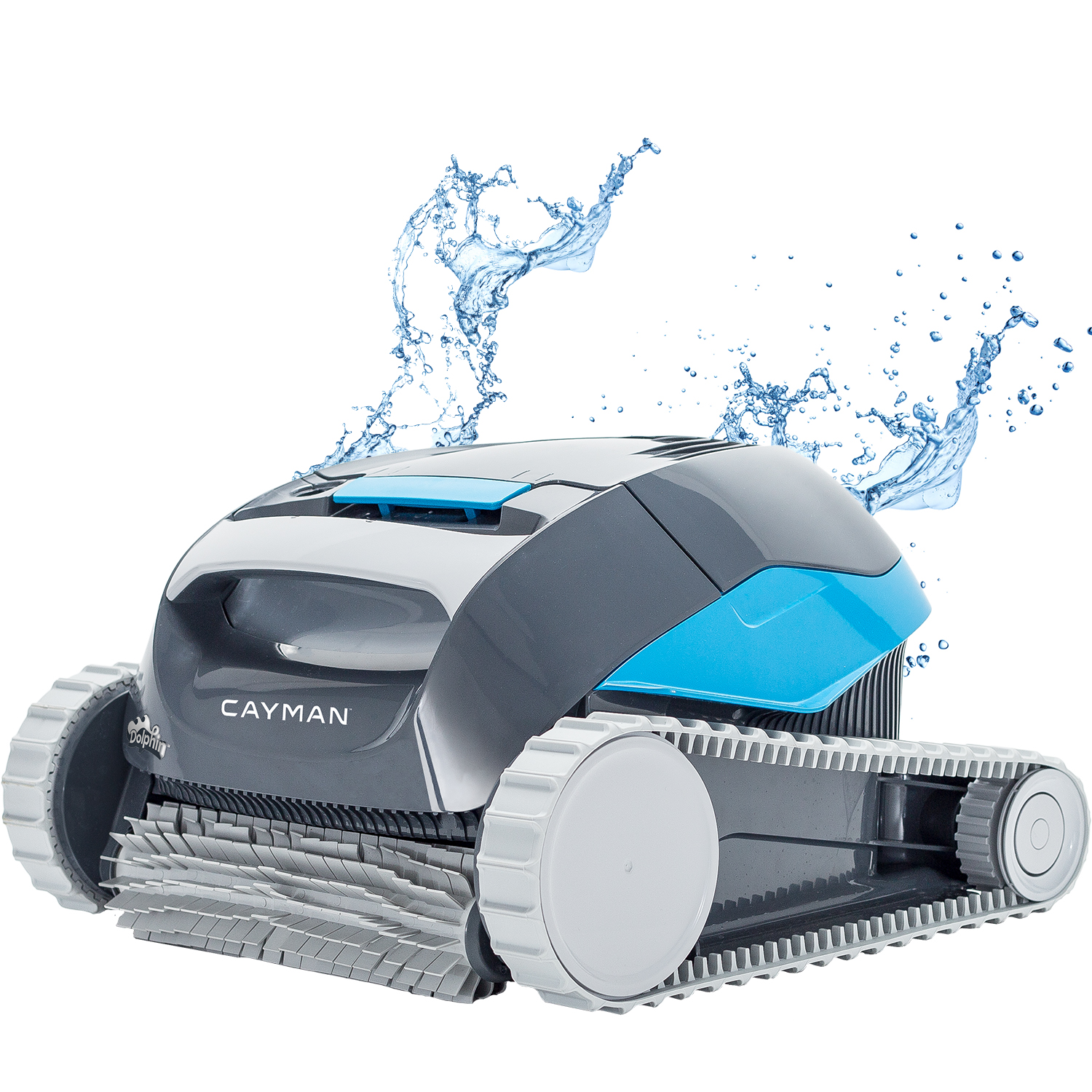
Dolphin Cayman
For a plaster pool with a longest run of 33 ft or less, the Cayman lists plaster and covers the floor and walls in 2 hours with one HyperBrush and over 4,000 GPH of flow. Its MaxBin basket comes with fine panels, which handle ordinary dirt well.
The limits are specific to plaster. NanoFilter panels are an optional add-on, and for a pool that is still dusting you should add them. And it stops short of the surface, so the scale line is yours to keep after with a brush.
- Best for
- Compact, established plaster pools where floor and walls are enough.
- The trade-off
- NanoFilter panels cost extra, there is no waterline pass, and the timer runs every day only.


Side by side
Filters, cycles and warranties compared.
| Specification | Dolphin Premier | Dolphin Quantum | Dolphin Sigma | Dolphin Cayman |
|---|---|---|---|---|
| Price today | $1949 | $1599 | $2349 | $1049 |
| Brushes | Dual scrubbing brushes | Dual HyperBrush | Quad scrubbing brushes | HyperBrush |
| Cleans | Floor, walls and waterline | Floor, walls, waterline, sun shelves and stairs | Floor, walls and waterline | Floor and walls |
| Traction | HyperGrip tracks | HyperGrip tracks | HyperGrip tracks | HyperGrip tracks |
| Pool length | Up to 50 ft | Up to 50 ft | Up to 50 ft | Up to 33 ft |
| Filtration | Multi-Media: NanoFilters, oversized leaf bag and standard fine filters | XXL MaxBin basket with standard and NanoFilter panels | NanoFilters and standard filter cartridges | MaxBin basket with fine panels; NanoFilter panels optional |
| Robot weight | 20.3 lb | 18.3 lb | 24.6 lb | 14.6 lb |
| Warranty | 3 years | 2 years | 3 years | 2 years |
What to look for
What plaster needs from a robot.
-
Ultra-fine filtration.
Plaster dust is closer to flour than to sand. Standard panels stop leaves and grit and pass much of the dust back into the water, where it settles again by morning. Ultra-fine NanoFilters hold it. Three of the picks include them; on the fourth they are an optional add-on.
-
Filters you can switch.
Fine media clog quickly when leaves arrive, and coarse media miss the dust. A plaster pool needs both in the course of a year, so look at how many filter types come in the box and how fast they swap.
-
A waterline scrub.
Calcium and body oils form a line where water meets plaster. Scrubbed several times a week, that film stays soft and comes away. Left alone it hardens into scale no robot removes. Robots that turn back under the surface leave this job to you.
-
Brushes for a roughening surface.
New plaster is easy on brushes. Old, etched plaster is abrasive, wears them faster and holds more dirt. More brush contact and a longer cycle help on aged plaster, and replaceable brushes are a must.
New plaster: when a robot can go in.
Fresh plaster cures under water. For the first weeks it is soft enough to mark and sheds dust constantly, and the builder will have you brushing the whole pool by hand and balancing the water on a schedule. Do not run a robot during that start-up period. Tracks and brushes can mark a surface that has not hardened, and a robot cannot do the brushing the start-up calls for.
How long? Follow your builder. The usual guidance is about four weeks, and some finishes and some builders ask for longer. Once you are cleared, begin with the NanoFilters fitted and expect to rinse them after every cycle for a while; the first runs come back gray.
A plaster pool's year in filters.
Once the pool is established, the filter you want changes with the season. A sensible rhythm looks like this:
- After a replaster, an acid wash or a dust storm: NanoFilters, rinsed after each cycle.
- Ordinary summer weeks: standard fine filters or panels, emptied at least weekly.
- Leaf season: the Premier's oversized leaf bag, or standard filters emptied more often on the other robots.
- After an algae treatment: NanoFilters again to collect the dead algae, once the chemicals have done their work and you have brushed.
Scale, stains and etching: what a robot will not change.
A robot scrubs film before it hardens. It does not remove calcium scale that has already formed, lift metal or organic stains out of plaster, or smooth a surface that has etched. Those come from water balance over months, and the remedy starts with the test kit. Regular scrubbing slows the build-up at the waterline and keeps dirt from bedding into a roughening surface, so you brush by hand less often. It does not make hand brushing unnecessary, and it does not replace sanitizer.
Plaster pool routine with a robot.
- Ask your builder for the date when automatic cleaners may be used on new plaster, and wait for it.
- Rinse NanoFilters while they are still wet. Plaster dust cakes hard if it dries on the media.
- In hot weather, when evaporation concentrates minerals at the surface, schedule the waterline-scrubbing robots more often.
- Take the robot out before adding acid, shock or start-up chemicals, and put it back once the water has circulated.
Questions, answered
Plaster, dust and scale: your questions.
How soon after replastering can I use a robotic pool cleaner?
When your builder says so, which is typically about four weeks after the pool is filled. Until then the plaster is curing and needs hand brushing, not a robot. Starting early risks marks on the soft surface. When you do start, use ultra-fine filters and expect heavy dust loads for the first several cycles.
Why is my robot's filter full of gray powder?
That is plaster dust, and it means the robot is doing its job. New and recently acid-washed plaster sheds it in quantity; older plaster sheds a little all the time. If the powder is passing through and clouding the water, switch to NanoFilters. If the load never eases on an older pool, have the plaster looked at.
Should I leave the NanoFilters in all season?
You can if your pool gets little leaf debris, but they load faster than standard media and need rinsing more often. Most plaster pools do best with standard filters for everyday use and NanoFilters when dust, pollen or silt is the problem.
Will a robot remove the white scale line from my plaster?
No. Hardened calcium scale needs chemical or mechanical treatment, and a robot's brushes will not shift it. What a waterline-scrubbing robot does is keep fresh film from turning into scale in the first place, provided the water is balanced. Three of these picks scrub the waterline; the smallest one does not.
Does the best robotic pool cleaner for plaster pools change as the plaster ages?
The priorities shift. On new plaster, ultra-fine filtration matters most and almost any brush is enough. On plaster that has roughened, scrubbing and cycle length matter more and brushes wear faster. The Premier covers both ends, which is why it leads. For very rough old plaster, the Sigma's four brushes are worth a look.
The bottom line
Picking for plaster.
Let the filters decide. If the pool is new, resurfaced or under trees, the Premier's three included media and 3-year warranty make it the one to buy. If you want the dust handled for less money, with an app and cleaned steps, take the Quantum. Choose the Sigma for old, abrasive plaster, and the Cayman for a small established pool, adding NanoFilter panels. Whichever you choose, keep it out of the water until your builder clears new plaster.
More buying guides
